
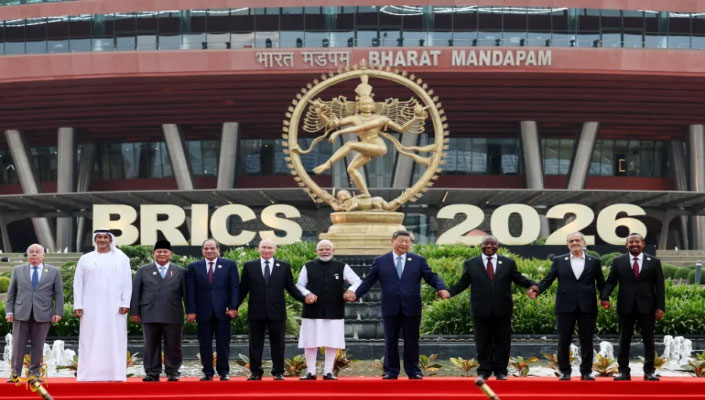
BRICS leaders and officials pose for a group photo during the 18th summit in New Delhi (French)
Afrasianet - Musallam Omran - The inability of the BRICS foreign ministers in the first weeks of the US war on Iran to issue a joint statement – at that critical stage – was not just a procedural detail or a passing diplomatic dispute, but it was the first real test of the group after its recent expansion in 2024, and a test of its ability to transform from an emerging economic bloc to a pivotal political actor that expresses the aspirations of the Global South to build a new international order.
This topic was the focus of an important discussion during a recent seminar organized by the Asia and Middle East Research and Dialogue Center (AMEC) in Jakarta on the repercussions of the West Asian crisis on the BRICS and the Global South.
However, the importance of the debate has gone beyond the moment of crisis itself, to raise a deeper question: Does the BRICS have the ingredients to transform from a platform for economic coordination to a political force capable of contributing to the reshaping of the international order in a more balanced and just manner?
"The BRICS transition from horizontal expansion to institutional deepening is the most urgent entitlement today. History shows that international blocs become influential not just by expanding their membership, but when they succeed in building permanent institutions and regular mechanisms for consultation, dialogue, decision-making, and the settlement of differences and disputes"
________________
Today, it is difficult to underestimate the strategic weight that the BRICS represents. After its recent horizontal expansion, the group now includes eleven member states and ten partner countries, and its members and partners represent about 44% of the global GDP according to the standard of purchasing power parity, more than half of the world's population, about a third of the land area, in addition to its countries possessing many precious and scarce resources.
Since 2018, the G7 economy has surpassed the G7 economy, according to the purchasing power standard, a gap that is expected to widen over the next few years. But figures of this magnitude may raise more questions than answers: they confirm that the global economic center of gravity is gradually shifting toward the countries of the South, but they do not alone answer a more important question: Can this enormous economic gravity automatically turn into political and institutional effectiveness?
Successive crises in the Middle East have revealed that having resources does not necessarily mean having the capacity for effective collective action. This was not the first time such a challenge had emerged; the group had faced a similar difficult test during the war of annihilation on Gaza, when its members' positions varied between those who clearly supported the Palestinian cause and those who preferred the language of reservation and cautious diplomacy, and the distance between the rhetoric of "aspirations of the Global South" and its translation into a unified political position seemed vast.
The facts have shown the extent of the disparity among BRICS members in their assessment of international political positions, and this is reflected in the inability to reach quick positions that express the group's orientations as a common solid bloc.
This should not be seen as evidence of the bloc's failure or the blockage of its prospects; the group includes countries that differ in their strategic interests, international relations, and security priorities, and these differences are naturally reflected in their positions on various international issues. Major international blocs, including the European Union , for example, are not without sharp differences among their members at some juncture points.
However, the difference between established blocs and others lies not in the absence of differences, but in the existence of institutions and mechanisms capable of managing those differences and reaching a minimum level of political consensus. Therefore, the challenge is not related to the diversity that exists within the BRICS, but rather to the extent to which its institutional structure is ready to accommodate and frame this diversity.
The contours of this gradual development have recently begun to become evident in recent stages, as high-level meetings at the 18th BRICS summit (in New Delhi) have shown that the group is recalibrating its mechanisms to overcome the previous state of confusion. As the escalation in the West Asian region continues, Iran no longer appears within the BRICS corridors as a reticient member, but has emerged as an integral part of the group's new political space.
The collective outputs, including the New Delhi Declaration, reflected a greater capacity for political coordination and solidarity, as the Declaration included an unequivocal rejection of attacks on peaceful nuclear facilities under IAEA control, a rejection of unilateral practices and sanctions that harm the economies of developing countries, while emphasizing respect for national sovereignty and calling for restraint.
Direct diplomacy on the sidelines of the summit also provided the language of closer dialogue between Iran and its regional neighbors within the bloc itself, reflecting the BRICS's gradual transformation from a mere economic platform to a space for managing regional contradictions and building commonalities, even if some of its geopolitical boundaries remain.
"After its recent horizontal expansion, the BRICS now includes eleven member states and ten partner countries, and represents with its members and partners about 44% of the global GDP according to the standard of purchasing power parity, more than half of the world's population, about a third of the land area, in addition to its countries owning many precious and scarce resources"
________________
The BRICS's transition from horizontal expansion to institutional deepening is the most urgent entitlement today. History shows that international blocs do not become influential once their membership expands, but when they succeed in building permanent institutions and regular mechanisms for consultation, dialogue, decision-making, and the settlement of differences and disputes.
A comparison with the Association of Southeast Asian Nations ( ASEAN) provides a striking example in this context. Although ASEAN is less economically weighted than the BRICS, it holds nearly a thousand meetings annually at various levels, from summits to ministerial meetings, technical committees, and task forces.
This continuous interaction has contributed to the establishment of an institutional culture based on dialogue, confidence-building, and dispute management. In contrast, the BRICS meetings continue to take place between 180 and 350 meetings annually.
The purpose of comparing the two experiences is not to compare the two experiences, but to point out that international influence is not built by economic weight alone, but by the intensity and continuity of institutional work. The transition from periodic summits to continuous institutional work is no longer an organizational luxury, but has become a prerequisite for transforming the BRICS into an international actor capable of initiative, not just a framework for consultation.
The BRICS is not the first attempt by the countries of the Global South to build a framework that reflects their interests. Since the 1955 Bandung Conference, through the Non-Aligned Movement and the Group of 77, the common goal has been to seek a more balanced and just international order that gives developing countries a greater role in the conduct of world affairs.
But what distinguishes BRICS from many previous initiatives is that it is based not only on political discourse, but also on real economic and financial weight, exemplified by practical tools such as the New Development Bank and the development of local currency exchange mechanisms, giving it an unprecedented opportunity to influence the course of the international order.
Therefore, the challenge facing the Group today is not to prove its importance, this fact has become entrenched, nor to continue to expand, which is indeed a path forward. The real challenge is to turn this economic weight into political effectiveness, to build institutions capable of producing consensus, managing difference, and formulating the initiatives needed in a world where crises are increasing and trust in traditional international institutions is declining.
The BRICS has succeeded in becoming the epitome of the rise of the Global South. The task ahead today is to become its most effective tool. Between economic power and political effectiveness, and between expansion and institution-building, the future of BRICS will be determined, and perhaps the future of the role that the Global South can play in forging a more balanced and just international order.
________________
Musallam Omran - Director of the Asia and Middle East Center for Research and Dialogue (Kuala Lumpur and Jakarta).

