
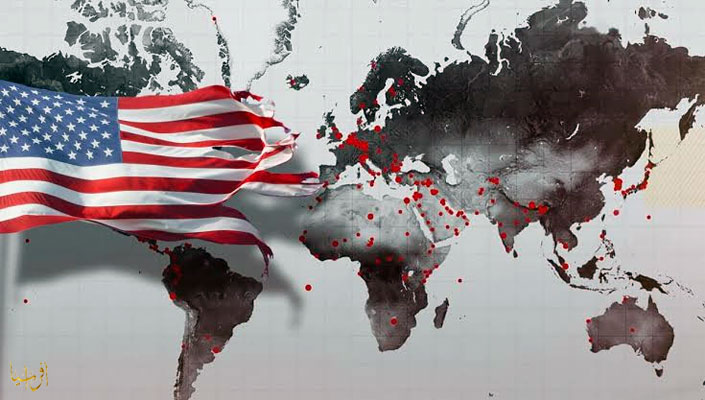
Trump did not invent American selectivity; he is openly pushing it to more crude limits. The danger in this path is that the right of the strongest to make an exception will become a general rule.
Afrasianet - Elhami Meligi - When the President of the United States stands at the United Nations and puts negotiation and the threat of extermination in one sentence, he proclaims a vision of a world in which power gives its holder the right to determine the fate of others. But an empire that fancies that the world belongs to its right, and demands that the peoples recognize their right to subjugate, makes freedom from its authority a common interest among its victims.
In his speech to the General Assembly on September 22, Donald Trump threatened to "annihilate the Islamic Republic" if an agreement could not be reached to end the war. From where he is supposed to discuss ways to spare people the scourge of war, he speaks with the logic of those who have the power to give others a chance to survive or deny them it.
The question of this arrogance is also about the price America itself may pay. Can it continue to wrest obedience without pushing states, including those who need it, to seek ways out of their grasp? Does the abundance of arms produce sustainable influence when combined with a loss of trust and the permissibility of the independence of others?
Legitimacy on the scale of power
Trump's speech combined praise for the Security Council, when he spoke of resolutions supporting his directions, and an attack on the International Criminal Court, to calling on member states to withdraw from it. He refused to subject U.S. military personnel to investigation, while sharply criticizing U.N. human rights officials.
This selectivity, in my estimation, reveals the essence of the relationship he wants with international institutions: legitimacy that upholds the U.S. decision, without accountability that binds its owner. The institution becomes commendable as close to Washington's will, and deserves to be reproached when it upholds its independence. The international order is thus redefined as a means of binding others, while keeping the most powerful state above commitment.
This system was born with imbalances in the balance of power, granting the major powers exceptional privileges, preceded by the veto. But it also recognized the equality of sovereignty, and the prohibition of the threat or use of force against the territorial integrity and political independence of states. These principles give weaker states a basis to protest against the arbitrariness of the powerful, no matter how impaired their ability to enforce.
Trump did not invent American selectivity; he is openly pushing it to more crude limits. The danger in this path is that the right of the strongest to make an exception will become a general rule. What will Washington say to another power that invokes its own interests in order to do to its neighbors what America considers its right to itself?
From Control to Attrition
Trump summed up his logic with a phrase he said during his talk about Venezuelan oil: "The spoils are often the spoils." Here, the outcome of the battle, in the perception of its owner, becomes a title deed, and military superiority becomes the basis for economic entitlement. From a pulpit that brings together independent states, the language of the conqueror who distributes what his hand has fallen on is restored.
This logic has taken on a practical form in Venezuela. After the arrest of Nicolás Maduro by U.S. forces, the U.S. Department of Energy announced in January arrangements for the sale of Venezuelan oil, the proceeds of which would first be deposited in U.S.-controlled accounts and, according to the U.S. government's assessment, in the interest of the American and Venezuelan people.
Coercion thus extends from the head of power to the decision concerning wealth. The ability of a country to dispose of its resources becomes hostage to the will of the party that has imposed the balance of power on it. As for the interest of its people, the external guardian is given the power to define this interest and determine how to achieve it;
A dispute with a regime, no matter how severe, does not transfer the rights of its people to a foreign country. The right of Venezuelans to choose their rulers and dispose of their wealth remains theirs, as do the rights of Iranians and other peoples. Turning the opposition to power into a mandate to deceive the country undermines the principle in whose name the intervention is lifted, and the fate of the people is subject to calculations of power that they cannot be held accountable for.
Washington may reap direct gains from these policies, and it is not right to analyze its power by ignoring them. But the immediate gain alone does not reveal the profit and loss calculation. When a country sees its dependence on a partner that gives it the power to snatch its decision, reducing that dependence becomes a security interest, even if the alternative is more expensive or less efficient.
This creates incentives to seek another arms supplier, an alternative market, or a financial arrangement that eases the pressure. These paths take time and potential, and may stumble for a long time, but excessive coercion gives them renewed impetus. Ironically, by abusing its privileges, a hegemonic state may make reducing its influence a common goal among parties that differ in most other respects.
When maintaining obedience needs to be threatened repeatedly, the cost of control rises. Coercive concessions leave a deferred question of how to get rid of its terms, and its protection may require new interventions.
The power then begins to consume its resources to stabilize the results it has forcibly made, while the space for viable settlements narrows. The ability to destroy alternatives becomes a burden when it is not accompanied by the ability to build a stable situation.
Arrogance and the Ombudsman
Arrogance alone does not answer, and history does not give us a timeline of when states will collapse. A major power can maintain a vast military superiority, while its ability to lead others declines; it can compensate for political losses with economic and technological advantages and a network of alliances that are difficult to quickly dismantle.
The most effective criterion is how much the force achieves, and the cost of achieving and sustaining them. The war machine can destroy a facility in hours, while the transformation of military superiority into an acceptable settlement requires political terms that are not made by bombs. A declaration of victory is less meaningful when it requires additional rounds of war, or an open commitment to protect unacceptable arrangements.
In this sense, Trump's rhetoric can be read as an expression of confidence in the tools of oppression and an exaggeration of its ability to solve problems. When escalation is presented as the natural way out of a policy stumble, interest in understanding the other side's interests and the limits of what it can concede wanes. Compromise becomes a test of submission, harder to accept, and then its stumbling block becomes an excuse for further escalation.
At the opening of the general debate, the Secretary-General of the United Nations warned of the limits of the power of the great Powers, stressing that military power alone does not guarantee peace, and that economic power alone does not guarantee stability. This observation touches on the gap between having the tools of influence and the ability to build a system in which others are willing to live.
From Objection to Protecting Independence
The international platform has seen clear objections. The French president has warned against a return to the law of the jungle, and the Brazilian president has refused to treat his country as anyone's backyard. The question goes beyond silence to why sporadic objections have not been able to build a collective capacity that raises the cost of coercion.
Part of this deficit can be understood in light of the divergent interests and dependence on Washington. One country is betting on its military protection, another is afraid of losing its market, and a third believes that keeping up with the pressure on its opponent will give it an advantage. Thus, the threat is fragmented, leaving each side to pay the price for its opposition alone, while the powerful one benefits from the division of those affected by it.
For the Arabs, this reality requires a serious consideration of the sources of our countries' susceptibility to pressure. Expanding the independence of the resolution begins with reducing dependence on food, armaments, and finance, and by building common regional interests that make the assault on the sovereignty of a country costly to its partners.
The protection of Palestinian rights remains a criterion for testing the seriousness of any talk of international law that applies to all; accepting the Zionist entity's impunity from accountability undermines the principle that other states need to protect themselves.
Waiting for America's decline to improve absolves our regimes of the responsibility of building the causes of their power. A period of hegemony may end and a fiercer competition for disintegrated countries may begin. Therefore, freedom from tutelage requires cohesive states, based on the consent of their people, and possessing the production and knowledge that gives their political decision resilience.
Herein lies the paradox of arrogance: When Washington makes its influence a constant source of threat, it gives others an additional reason to reduce it. Their ability to do so may be delayed, but coercion still accumulates the motivation to get rid of it. What appears to be an immediate victory in the calculation of power may be a deferred loss in the calculation of hegemony.
The world for which we deserve to fight is equal to the sanctity of homelands, and in which human life is protected from the whims of power. America has its place and its rights, within the limits of preserving the rights of others: it has the right to live in safety, and the world has the right to live safely from it.
________________

