
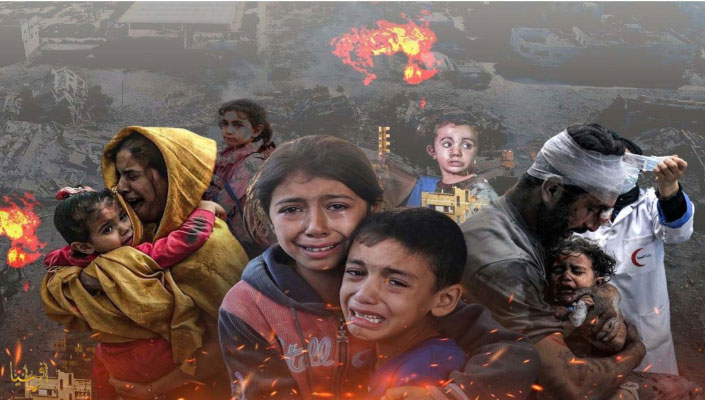
When the Monsters Kill Everything.. Gaza as an Example!
The problem is that Trump, Miller, Hegseth, Ben-Gvir, Netanyahu, and others are reduced to "monsters," because that separates their cruelty from the contexts, institutions, and societies that produced them.
Afrasianet - Henry Giroud - Counterpunch publishes an article about how brutality and fascism go from shocking practices to socially and politically acceptable phenomena when societies become addicted to violence and their ability to reject and resist it is eroded.
The problem lies not only in the rise of leaders he describes as "monsters," but also in the economic, media, cultural and educational institutions and systems that produce them, give them legitimacy, and accustom the public to cruelty.
The following is the article:
More than four decades ago, the Greek composer and thinker Manos Hadgedakis issued a warning that seems more like a prophecy of our time than a reflection on fascism.
He wrote that "the greatest danger comes when we get used to living with monsters," so their presence no longer shocks our conscience, and their violence becomes integrated into the routine of daily life.
Tolerance does not diminish their brutality, but rather multiplies the conditions that allow them to thrive and establish their presence in public life, and then the monsters themselves win the power to rule. In this case, the collapse of conscience is inseparable from the loss of "faith in judgment, inaction from action."
We have reached the moment when monsters no longer hide in the shadows; they occupy the highest positions and ministries of the presidency, lead armies and police forces, control digital platforms, dominate television screens, manage borders, build detention centers, and turn the suffering of others into political theater.
The language of ethnic cleansing, policies of mass deportation, extermination, revenge, and dispossession of human beings is used, without evoking the anger that they might have previously provoked. In doing so, it presents the display of cruelty as strength, humiliation as entertainment, while the spectacle of suffering becomes a source of political pleasure.
What should be intolerable becomes familiar, and what should be motivated to resist is contained under the pressure of the rhythms of everyday life.
Not only do monsters win by committing atrocities, but when their language becomes commonplace, their violence is acceptable, and their weaponization of ethnic and class divisions goes unnoticed, the presence of monsters no longer disturbs the morality of society.
Novelist and activist Toni Morrison has given us another language to understand how the monster becomes ordinary: "dead language," as she called it, is devoid of moral responsibility and enlisted in the service of hegemony.
Repressive language, Morrison wrote, "represents not only violence, but violence, a language that drinks blood, exploits vulnerabilities, hides its fascist shoes under the cloak of respect and patriotism, while moving relentlessly toward the ultimate goal of exhausting minds."
Morrison's insight goes beyond rhetoric; monsters need a language that sets the stage for their violence, dehumanizes their victims, and teaches people how to accept the unthinkable. "Dead language" is one of the conditions that allow brutality to infiltrate everyday life disguised as common sense.
The writer Primo Levy once observed that "monsters exist, but they are too few to be really dangerous. Even more dangerous are ordinary citizens, employees who are willing to believe and act without question." Levy is still right about employees who work without thinking, but the monsters themselves have now gained institutional power and public legitimacy.
Taking advantage of resentment at stark economic inequalities and the mechanisms of advanced technological authoritarianism, they have established their legitimacy in the context of a growing culture of state violence, moving from the margins of politics to the highest positions of power in American society.
Here it is necessary to recall the German thinker Hannah Arendt's warning of its urgency and necessity. The author herself lived through the scourge of Nazism, accurately described the origin and roots of authoritarianism, and warned that brutality flourishes when people stop judging things, when the duty to think becomes an unavoidable burden, and when ignorance turns from a mere absence of knowledge to a deliberate rejection of it.
This can be called "the vulgarity of ignorance," where silence allows people to see suffering without confronting it, and to hear lies without rejecting them. Monsters do not just ask for obedience, they need subjects who have learned not to think about what makes their obedience possible.
However, Manos Hadgedakis' warning raises more troubling questions than simply asking whether monsters are now ruling us: What does it mean for a society to begin to identify with its monsters? What educational forces are working to create and normalize this identification?
Identification does not mean that everyone becomes murderers or fascists, but rather that the habits of thinking, the foundations of feelings, and the forms of apathy on which brutality rests become entrenched in everyday life.
The vulgarity of ignorance then becomes a social condition, a manufactured form of moral blindness, ignorance becomes a refuge from responsibility, and refusal to think becomes a condition of belonging.
But this ignorance does not dwell outside the realm of desire; it is not a cold void in the mind, but a dark passion that has its own emotional and psychological record of accepting tyranny and an upbringing based on terror.
Through it, people learn not only to live with cruelty, but to indulge in its emotional charge, to find their pleasure and belonging in patterns of domination and submission that come together into a single syndrome, and enshrine the belief that human beings are not equal, but arranged in a hierarchical hierarchy; those at the top have the right to lead, and those who are inferior have the duty to obey.
This arrangement imposes specific roles on men and women in the spheres of life, under the pretext that our fathers lived in this way.
The beast has a long history, and it was born in the darkest regions of the social imagination, where fear, difference and power converge. As anthropologist Manveer Singh has observed, monsters have long inhabited the boundaries between the human and the inhuman, between the familiar and the terrifying, between what sustains and what is thrown outside the gate.
But monsters are not just imaginary creatures, they are warnings, projections, and embodiments of collective fears, often tools for determining who belongs to the circle of humanity and who is expelled from it.
What matters politically is what happens when the monster breaks out of the circle of myth and fantasy, takes over the institutions of power, and gains the ability to determine who lives, who should suffer, and who can be eliminated.
But the metaphor of brutality itself is another problem. To portray Donald Trump, Stephen Miller, Pete Hegseth, Itamar Ben-Gvir, Benjamin Netanyahu, or other architects of contemporary authoritarian violence as mere monsters risks taking them out of context, as if their cruelty stemmed from a special disease separate from the society that produced them.
Here, the monster becomes an excuse for the society that created it. Moral anger becomes anger directed at individuals, while the institutions, economic interests, ethnic hierarchies, cultural apparatus, and political forces that make organized cruelty possible disappear.
This is the crux of the argument of the Cuban intellectual Jorge González Arrocha, who argues that turning perpetrators into monsters may in itself become a way of looking the other way. "Reducing the perpetrator to a monster protects us from acknowledging that we ourselves may be the perpetrators, distancing us from what is actually happening, placing us in a position of moral superiority, and providing a way to deny that the power to destroy belongs to us too, and that it is part of the human condition," Arocha argues.
The problem is not that monsters do not exist; the problem begins when brutality becomes an explanation rather than a question. Monsters do not descend on society from a place outside of history, but are produced by these historical trajectories, cultivated through institutions, protected by bureaucracies, legislated by laws, financed by powerful economic interests, amplified by the media, and imprinted by culture.
The political significance of monsters lies not only in the atrocities they commit, but in the social order that makes them possible, useful, legitimate, and ultimately ordinary.
Focusing alone on the deeper beasts of "gang capitalism," a system that prioritizes certain forms of power over the common good, and allows our societies to be gradually dehumanized.
Therefore, the question must change, and we must move from the beast to the machines, from the disease of the individual to the political economy of organized cruelty, and from there to the cultural and educational forces that teach people how to live with the suffering caused by these machines.
Monsters don't act alone. Their power is seen in the institutions that protect them, the wealth that supports them, the laws that empower them, and the violence that follows. We see their effects in the blood-soaked streets, in the migrants brutalized and left to die in detention centers, in the documented torture in Israeli prisons, and in the bodies of children and families torn apart by Israeli and American bombs in Gaza, where human bodies have been reduced to scatters of flesh and bones, and these scenes have become familiar and have lost their ability to shock.
The real horror lies not in the monsters themselves, but in the adaptation of an increasingly growing society to them, in the silence that surrounds their crimes, and in the erosion of the moral and political boundaries that once made their actions improbable.
This silence is never innocent; it is the final hardening of moral and political decay, and the point at which an organized policy on murder begins to pass as a matter of ordinary of day, greeted with indifference, surrender or applause.
The question is: How do people learn to live in the midst of collective suffering, and then look the other way? What forms of power need this silence? What institutions create it? And what culture teaches people to show up for the bodies left behind?
Most of all, what educational machine teaches millions not only to endure cruelty, but to identify with those who perpetrate it, to desire the power they embody, and to experience the suffering of others as the price of their own liberation?
This is where political economy, culture and education converge. The monster becomes inseparable from gang capitalism, educational terrorism, and a culture of cruelty. Guerrilla capitalism does not produce monsters by chance, but increasingly needs them, and it also needs masses capable of loving them.
Arendt's concept of "radical evil" takes this proposition a step further, moving us from an understanding of the failure of governance to a political machine that makes numbers of human beings redundant and unnecessary. Radical evil emerges in a political system capable of stripping human beings of rights, history, and individuality, and then stripping them of their belonging to the human community itself.
The concentration camps represented the maximum application of this logic, but their political significance went beyond the camp itself, because totalitarianism needed institutions capable of transforming human beings into indispensable material.
Arendt says of Adolf Eichmann, the Nazi officer who organized the deportation of Jews to the extermination camps and was executed by Israel in 1961, that Eichmann did not appear to them as a demonic figure with a vague depth of evil, but rather as terrifyingly ordinary, an ambitious and obedient bureaucrat, unable to seriously think about the consequences of his actions.
His "vulgarity of evil" does not mean that his crimes were vulgar, but that exceptional crimes could be conducted through a normal bureaucratic routine, with little to no thought.
Reinhard Heydrich, a senior Nazi officer, one of the most prominent architects of the Final Solution, and head of the Reich's Main Security Office, represents another configuration of the political monster, where ideological fanaticism, managerial intelligence, and enormous institutional power converge.
Eichmann and Heydrich should not be reduced to the same psychological pattern, but both expose the inadequacy of treating atrocities as mere acts of monsters. Modern regimes of terrorism need administrators, lawyers, technicians, police officers, preachers, intellectuals, journalists, and civil servants. Evil becomes more politically dangerous when it is institutionalized, and it has a budget, a language, and an audience ready to accept its axioms.
Primo Levi understood this danger from another angle, rejecting the parallel temptation to simply divide the world between an innocent humanity and a monster we do not understand. As he put it, "It is wrong and stupid to see all the demons on one side, and the saints all on the other."
Dividing black and white means that we do not understand human nature, while in this context the concept of the "gray zone" derives its most disturbing political power. The gray zone does not eliminate the distinctions between victim and perpetrator, but rather reveals the ways in which the system of domination corrupts moral life itself.
The political lesson is particularly disturbing because it takes away the comfort of believing that atrocities belong to another kind of human being. Modern barbarism does not originate outside civilization, but is organized through civilization's institutions, techniques, forms of experience, and structures of obedience.
Novelist Umberto Eco also made a related observation about fascism, arguing that it does not have a single fixed costume, but rather changes its language, symbols, techniques, and institutional forms. He also warned that "primitive fascism could come back in a dress that looks more innocent."
To look only for Mussolini's black shirts or Hitler's brown shirts is to risk not seeing fascism when it comes back in a business suit and tie, carrying a Bible, and speaking the language of freedom, national revival, border security and popular sovereignty. Fascism survives precisely because it learns to inhabit the historical conditions of its time.
The brutality of the present did not suddenly emerge with Trump, but rather spans the long history of the American empire, and has been amplified by the so-called "war on terror," where the United States has launched wars that have killed more than 600,000 people in Afghanistan, Iraq, Pakistan, Syria and Yemen.
The indirect deaths from infrastructure destruction, disease, displacement, and malnutrition are estimated to be in the millions. This devastation cannot be reduced to the language of "catastrophic political failure." It was an enormous machine of blindness built against a racial backdrop, in which entire human groups could be bombed, tortured, displaced, and imprisoned, while the suffering of others went unrecorded in the moral lexicon of American political life.
This was also understood long ago by the poet and anti-colonial activist Aimé Césaire, who said that "imperial violence never remains locked up in the face of its first victims."
He warned that colonial brutality produces a "terrifying regression effect", because the habits of dehumanization, ethnic hierarchy, lawlessness and organized violence, which are cultivated abroad, eventually return to the interior.
The "War on Terror" provides a contemporary terrifying illustration of Caesar's warning. The torture chambers at Iraq's Abu Ghraib prison, the open detention at Guantánamo, the extraordinary rendition of the weak and the strong, drone assassinations, mass surveillance, and the normalization of perpetual war have not only destroyed other societies, but have also helped educate the American public to accept torture, surveillance, camp police, the lawless executive, and to classify entire human groups as threats.
Trump did not invent this political culture, but inherited it, elevated it, and turned it into something acceptable to practice within the empire. In this sense, the beast has come home, because the machine that produced it has been in place for decades.
Under gang capitalism, the imperialist exploitation machine is turned inward, taking a deadly local form: wealth is concentrated, public services are plundered for private profit, and democratic institutions are under the control of billionaires. As the repressive state expands, the welfare system shrinks, and blindness and repression become a co-currency in the structure of the political system.
"Educational terrorism" is the name for this process. It operates across schools, churches, television, social media, podcasts, political rallies, digital platforms, and advertising, all of which contribute to a dazzling spectacle covering state violence.
These cultural apparatus not only transmit ideas, but also regulate attention, form awareness, mobilize desire, learn habits of feeling, and generate the emotional and ideological conditions in which the dispensability of human beings becomes self-evident.
Personal fears give public enemies, unity becomes false solidarity of the tribe, helplessness is redirected to aggression, resentment is elevated to moral virtue, fear is transformed into hatred, and humiliation is transformed into a desire to humiliate others.
Fascism spreads through this emotional economy because it gives personal suffering a common goal, and it shifts the wounds caused by an increasingly brutal social system away from the structures it produces, and toward immigrants, blacks, Palestinians, feminists, intellectuals, homosexuals, dissidents, and anyone else who classifies as an enemy.
A culture of brutality takes root when violence is not confined to the state or its most fanatical leaders, but permeates everyday life, shaping public consciousness, political will, and the limits of the concept of humanity.
Brutality becomes a culture when large numbers of people support forced displacement, collective punishment, starvation, genocidal violence, and the destruction of civilian lives, without regard these policies as a moral catastrophe.
Israel provides a terrifying example of such brutality. In May 2025, a poll conducted by Pennsylvania State University professor Tamir Sourek revealed that 82% of Israeli Jews surveyed supported the expulsion of Palestinians from Gaza, while 54% expressed "strong support."
More worryingly, 47% agreed that when the Israeli "army" seizes an enemy city, it should act as the "Israelites" did when they invaded Jericho, according to the Torah, "by killing all the inhabitants of the city."
These views point to something more terrifying than simply endorsing a specific military policy; This is what a culture of barbarism looks like when the sacrifice of others becomes self-evident, and the destruction of another people is perceived as legitimate, necessary or justified.
Israeli historian Amir Bartov, who specializes in the history of the Holocaust, goes further, arguing that Israelis have become complicit through widespread silence about violence, vulgarity and indifference, thereby putting at stake beyond the crimes of Netanyahu, Ben-Gvir and the Israeli "army" to the educational production of a social order in which the rhetoric of extermination becomes acceptable, collective suffering is tolerable, and genocidal violence can be assimilated into the rhythms of ordinary life.
The purpose of educational terrorism is to create individuals to whom barbarism no longer seems barbaric.
Fascist culture not only tolerates monsters, but transforms them into celebrities, powerhouses, saviors, and symbols of identification, thus entrenching the cult of leadership. Their violations of moral and political norms become evidence of their authenticity, and their cruelty becomes a testament to their strength.
Their contempt for democratic constraints becomes a source of pleasure for their followers, who see every transgression as an illusory liberation from the duties of equality, compassion and mutual responsibility.
Trump made a terrifying display of fascist mobilization, calling on his followers to cheat in next month's U.S. midterm elections. At the Republican Party convention in Dallas, he instructed thousands of supporters to raise their right hands and chant a personal oath of allegiance that included an ad: "I don't care if I'm registered or not, I'm going to try to cheat like hell like they do."
This was not just another attack on democratic norms, but a fascist political ritual in which loyalty to the leader, contempt for the law, and the provocation of collective transgression were combined into a populist landscape. But the incident was ignored in the news vortex, as happens with every other bizarre Trump performance.
The political task cannot be reduced to the removal of monsters or individuals of power. The discourse of brutality weakens politics by reducing and personalizing what is structural, directing attention to paramilitary leaders, while keeping the hierarchy of institutions, economic interests, media systems, the concept of ethnic hierarchies, and the educational forces that produce authoritarian consciousness out of the circle of accountability.
The defining political question of our time is not: Are the monsters back? Rather: What kind of society produces them? What forms of power do they need? What educational machine does people learn to follow?
The beast is not the end of the analysis, but the beginning of it. Fascism cannot be defeated by removing its most visible leaders, while the economic, political, and cultural machine that produced them and their ilk remains intact. The struggle against fascism must also confront guerrilla capitalism, white supremacy, militarism, the punitive state, and the institutions that transform human beings into indispensable groups.
But resistance cannot live on anger alone. It needs language and possibility, and a policy that can make hope tangible, not optimism or a belief that history automatically bends toward justice.
Resistance is a practice born when people reject the isolation manufactured in neoliberal life, discover each other in the struggle, and realize that what they experience as a particular misery is often a general wound produced by almost uniform power structures.
This requires that a culture of resistance be shaped in unions, classrooms, demonstrations, mutual aid networks, protest movements, struggles for the freedom of Palestine, justice campaigns for immigrants, and in organizations capable of turning anger into a collective force.
There are already signs that this policy is struggling to be born in the United States. The extraordinary growth of "democratic socialists in America," the electoral victories of progressive candidates, and the resurgence of labor struggle suggest that increasing numbers of people are no longer willing to accept market tyranny as the horizon of political possibility.
All of this renames capitalism as a political problem, and signals that collective struggle penetrates the dark claim that there is no alternative to what exists.
Hope is dangerous for fascism, because authoritarian power feeds on isolation, historical oblivion, political exhaustion and the conviction that nothing can be changed. Militant hope shatters this conviction, turning private suffering into public anger, onlookers into political actors, and the isolation fed by fascism into collective force.
It stands against the cultivation of fear, it incorporates resistance and civic courage, it stands against the culture of cruelty, it makes solidarity a weapon and justice a collective demand, it is against a society that has made the dispensable of human beings acceptable, and it insists that the value of human beings is greater than the value of markets and profit.
The struggle is greater than the monsters occupying the tops of power. We must destroy the conditions that make them possible, by building a mass democratic policy capable of confronting concentrated wealth, dismantling ethnic and economic hierarchies, defending public causes, breaking the grip of militarism and restoring economic and political power to ordinary people.
Democracy cannot remain a political veneer of capitalism, emptied of its content while centralized economic power rules from within, but must become a way of organizing social life itself, based on equality, collective power, and the struggle for a just future.
More than four decades ago, Manos Had gedakis warned, "When the face of the beast stops scaring us, then we should be afraid, because that means we have begun to resemble it."
His warning has never been more urgent than we need to be aware of now. But resemblance is not destiny. The beast depends on our surrender, our silence, our isolation, and finally on our belief that its resistance is futile, while the most radical forms of hope begin to reject this lie.
Monsters are made by history, and collective struggle can destroy them. This struggle must confront capitalism itself, building a participatory democratic policy capable of wresting power from the ruling elites, returning it to the people, and turning hope into a force to remake the world.
______________
Source: Counterpunch.

