
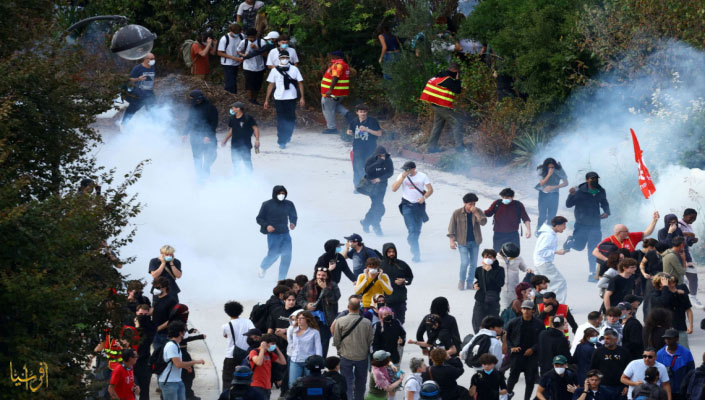
Afrasianet - Hundreds of thousands took to the streets across France, as a wave of protests started by high school students spread to their parents, university students and unions.
A crowd of teenagers marched from the Place de la République in Paris, demanding more resources for schools and a reduction in what they described as police repression.
Police clashed with demonstrators in Lyon, using tear gas in Paris and Marseille and water cannons in Rennes, but the serious unrest of previous protests has not been widely repeated.
Prime Minister Sebastien Le Cornu condemned the previous violence, saying that since the protests began, 215 students and 85 staff had been injured, as well as 715 police officers.
The government said 891 secondary schools witnessed unrest on Tuesday, accounting for nearly a quarter of all secondary schools in the country, and added that more than 250,000 protesters took to the streets during the day.
Student unions estimated the number of participants at 450,000 and said that students closed the entrances to 1,800 high schools, while the protesters called this phase the "third phase" of their protest movement.
In Marseille, thousands of demonstrators moved around the city, sometimes stopping to chant before continuing the march as police changed direction.
A number of masked protesters used barricades and garbage cans, and tried to set up barricades separating them from the police. Riot police fired tear gas, and the protesters dispersed.
Alyssa, a student in Marseille, said: "Most of us are not violent. We take to the streets because they have closed our schools... and schools are falling apart".
Her friend Sacha added that the ceilings of schools in Marseille are leaking water and that conditions are generally bad, "so we can't really study for long periods." "We will continue to do so until appropriate measures are taken".
In parliament, the prime minister accused the radical left-wing Father France party of seeking to "sow chaos" ahead of presidential elections due in seven months.
President Emmanuel Macron is nearing the end of his second and final term, while Jean-Luc Mélenchon, leader of the far-right National Rally party, is currently second in the polls behind Marine Le Pen, the leader of the far-right National Rally party.
Macron was due to chair a meeting of ministers at the Elysee Palace on Tuesday evening to assess the situation.
Education Minister Edward Jeffrey said he had called from the beginning for dialogue rather than school closures or sieges, and complained that "very violent elements have infiltrated student movements in secondary schools."
He is now under pressure to respond to students' demands. But the measures proposed so far, including the creation of an online platform that allows students to express their problems and devote Friday afternoons to internal discussions in schools, have had little impact.
The chances of the protests ending soon appear slim. France's largest trade union, the General Confederation of Labour, announced that more protests involving school and university students were planned for Thursday.
There are widespread concerns about allegations of police use of "disproportionate force", and the French Police Inspectorate General has opened investigations into a number of cases.
Prosecutors charged a police officer who fired a tear gas canister at a high school student in Sainte-Ouen-Lumont, northwest of Paris, last week, with "practicing violence ... resulting in mutilation or permanent incapacitation."
Eden, 14, was in a group that was closing or besieging Chateau DeBloch High School for 15- to 18-year-olds when he was hit in the face. His lawyer said he suffered a broken jaw, shattered upper teeth and four of his lower teeth.
On Monday, a 15-year-old boy lost his hand after a bomb used by police to prevent a surround was fired in unclear circumstances near a school in the northern city of Lance.
Authorities say he picked up the Sting Ball bomb before it exploded, but the students claim he hit it immediately after it was fired by a police officer.
The grenade is a non-lethal weapon, and the local governor said the incident occurred when police confronted a group of between 200 and 250 students who were throwing stones and fireworks.
What started as a local outrage over overcrowded classrooms, a lack of teaching staff and the deterioration of school buildings in the suburb of Seine-Saint-Denis, north of Paris, has since spread across the country, and has also spread to some universities.
Late on Tuesday, France's interior ministry said a total of 6,547 people had been arrested or detained by police since September 28.
People of all ages took part in Tuesday's protests. A couple in their 70s, Alain and Michel, joined the march in central Paris in support of young students, explaining that, as former teachers, they are aware of the problems facing the French education system.
"We are the grandparents of three students who have all taken part in these protests. They have protested peacefully in front of their secondary schools in Paris in recent days, but they have been subjected to tear gas nonetheless," he told the BBC.
________________

