
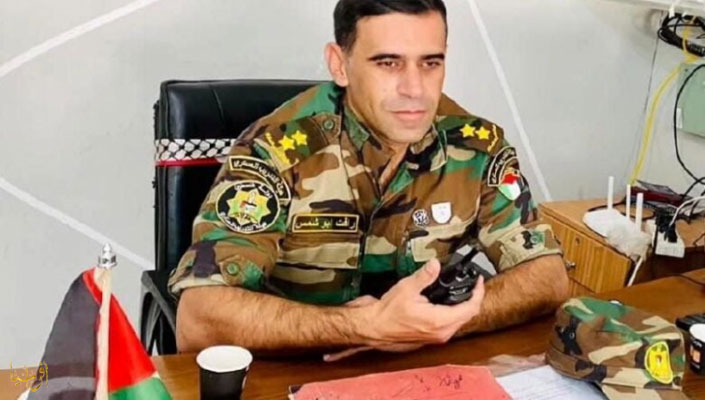
Afrasianet - Captain Raafat Khairy Ahmed Abu Khalil, known as Raafat Abu Shams, from the town of Attil, north of Tulkarm, was martyred while he was in custody at the Annab military checkpoint east of Tulkarm in the northern West Bank, in an incident that was met with a faint obituary issued by the Ramallah Authority.
The incident brought to the fore embarrassing questions about the way the Ramallah Authority and its security institutions deal with the occupation's attacks on its members and affiliates, and about the difference between the scale of the attack on Palestinians at the checkpoints and the level of official coverage of it.
According to official media sources, Abu Khalil, 45, was martyred on Sunday afternoon while in detention at the checkpoint, while the Palestinian Red Crescent said that its crews received a report of a critical condition, and went to the scene and found him in a state of cardiopulmonary resuscitation following his cardiac arrest, before announcing his death and transferring his body to the Martyr Thabet Thabet Hospital in Tulkarem.
Official sources confirmed that the martyr Abu Khalil was working as a captain in the Military Training Authority in the city of Jericho.
However, local accounts added a more serious detail, saying that Abu Khalil was beaten by the occupation soldiers while he was being held at the checkpoint, and that the attack was preceded by a stroke and the loss of his life. Palestinian reports quoted local sources as saying that the soldiers severely beat him, while the Red Crescent crews continued to deal with him in a critical condition.
This is where the paradox that has sparked anger and criticism in Palestinian circles emerges: the man is not just a citizen who had a medical accident at a military checkpoint, but also a member of the Palestinian security establishment and holds the rank of captain in the Military Training Authority. However, the obituary issued by the commission merely obituated him without mentioning the conditions of his detention or the assault he was subjected to at the checkpoint.
This limited official wording opens up a political and moral question that goes beyond Abu Khalil's own case: Why do Palestinian institutions' statements seem so conservative when it comes to an Israeli attack on a member of their security services? Why doesn't the fact that a Palestinian officer was killed while in the custody of the occupying forces turn into a political, legal and media issue commensurate with its seriousness?
Sacred Security Coordination
Observers say that the Ramallah Authority, which has established huge security services, pays the salaries of thousands of its employees, and treats these agencies as an essential part of its institutional structure, is supposed to be the first to document what its members are exposed to, especially when the attack is emanating from the occupying power.
Simply a brief obituary that does not explain the circumstances of the death leaves a lot of room for ambiguity and gives the Israeli narrative, even in the absence of an Israeli account of the incident, too much space.
The incident is all the more sensitive because the incident took place at the Annab checkpoint, one of the military checkpoints through which the occupying forces control the movement of Palestinians in the northern West Bank. On the same day, other areas in the West Bank witnessed incursions, arrests, closures and attacks, making the Abu Khalil incident part of a broader context of the military restrictions imposed on Palestinians.
In Ramallah, the case raises a more troubling question: If an officer of the Palestinian security establishment was assaulted, detained, and then died at an Israeli checkpoint, what prevents the PA from treating the incident as an attack on a member of its official institutions, and demanding an independent investigation and holding those responsible accountable?
The issue here is not related to Abu Khalil's position or his affiliation with any particular apparatus, as much as it relates to the principle of protecting the Palestinian citizen and the ability of the PA to defend its employees when they are attacked under the occupation authority. The official statement, which merely records the death without documenting its context, reduces a political, security and human rights incident to ordinary death news.
The paradox is heightened when a member of the Palestinian security services is himself the victim of an Israeli checkpoint. These services, which are supposed to be part of the community protection system, find one of their members dying while being held at an Israeli checkpoint, while the official response appears to be limited in terms of obituaries and documentation.
The indisputable fact remains that Rafat Abu Khalil came out of the Anab checkpoint with a body, after he entered it alive, and that the Red Crescent treated him while he was in cardiac arrest, while Palestinian sources speak of an attack by beating him before his death. As for the details of what happened inside the checkpoint, there needs to be an independent and transparent investigation, which makes the silence of official institutions or their sufficiency with a brief statement more questions than an answer to them.
________________

