
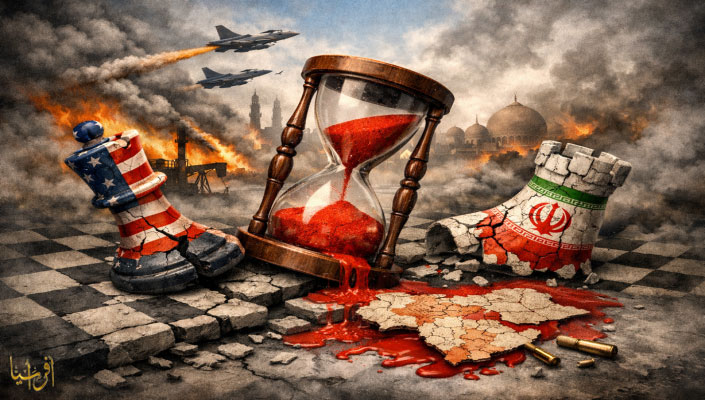
Afrasianet - Mohamed Jaradat - What worries some Israeli elites is not that the United States has lost Iran, but that Washington has moved from a strategy of decisiveness and confrontation to a strategy of managing balances and coexistence with Israel's central adversary.
The current juncture in the Middle East goes beyond Nixon's moment towards China in the 1970s, as well as Eisenhower's intervention in curbing the tripartite aggression against Egypt in the 1960s, because the US-Iranian understanding to be signed comes at a historic milestone in which Iran faced the most powerful country in the world and with it the most powerful country in the Middle East, and the limits of their power were exposed in exchange for a solid Iranian steadfastness, which did not reveal its full strength, for example, it did not use the Bab al-Mandab card despite the fact that it It was his willingness, while the aggression used all its strength and all its tools.
There, in Tel Aviv, the Israeli media is almost unanimous that what is happening is a full-fledged regional coup in favor of Iran at the expense of Israel, and the reason, according to Israeli media professionals and elites, is the following:
1. The American transition from the policy of overthrowing or fundamentally weakening Iran to containing it, a policy that Netanyahu sponsored several decades ago until it gained a semblance of Israeli consensus, until it was organized in the form of an implementation plan with the Mossad, which brought America with all its strength and regional tools into the alliance with Israel and the declaration of war on Iran since the end of February until now. He moved towards stopping the war and opening a negotiating track, which means that it is a frank and practical American acknowledgment of the Iranian regime's survival and dealing with it at the height of its power, which it has gained from its astonishing steadfastness despite the deep damage it has suffered.
2. Gradual lifting of economic pressure on Iran, through the easing of sanctions or the release of Iranian funds to restore Iran's economic and military capabilities in the long term, as it is suggested that the upcoming agreement guarantees the provision of $300 billion in compensation to Iran in the name of reconstruction, with the release of $120 billion of Iranian funds frozen since the victory of the Islamic Revolution.
3. The decline of Israel's centrality in the American strategy, because since the Iranian Revolution in 1979, the American-Israeli coordination has been based on considering Iran as the main adversary in the region, while this understanding between Washington and Tehran represents a shift that makes the United States more willing to manage regional balances independently of the Israeli vision, which means that American interests are given precedence in a relative detachment from Israeli influence, and this is clearly evident with the preference for understanding with Iran in a reality in which its military capabilities have been strengthened through missiles The ballistic missile that defeated the Iron Dome, and a reality in which it strengthens its economic weight by controlling the Strait of Hormuz and the duration of its impact on global energy supply chains.
4. Excluding files that Israel considers essential, and the negotiations have been concentrated or even limited to the nuclear file, the cessation of the war, and freedom of navigation, while they do not include in any way the Iranian missile program, the forces of the axis of resistance, and Iran's regional relations, which indicates the strengthening of the ring of fire around the Israeli entity.
5. Fearing a return to the model of the 2015 nuclear deal, or even worse, which was previously opposed by Netanyahu himself, the new agreement is seen as a retreat from the policy of "maximum pressure," which represents a complete defeat of Netanyahu's political project, even if it pretends that it prevented Iran from acquiring the nuclear bomb, and the fact that many Israelis repeat that Iran's nuclear capabilities have not declined with this war, if not strengthened.
6. Restructuring the region, in light of a broader regional military truce that establishes this understanding, with a gradual economic openness to Iran, especially in light of the decline in the prospects of all-out war, and the United States' transition from a policy of confrontation to a policy of managing balances.
There are reasons why some Israeli commentators use terms such as "the new Middle East" or "strategic coup," because they believe that the region may move from an open conflict with Iran to a stage of coexistence and understanding with it, which would place the Gulf and many other active regional hotspots under its direct influence.
The feeling of shock in Tel Aviv is still reacting, which is why the discourse of the elites there is dominated by harsh names for what is happening, such as the coup or defeat, the disintegration of the alliance, isolation, and the like, but the closest to describing the situation of Israel and the Arab and Islamic countries of influence in the face of Iran's sudden steadfastness, as well as the situation of America as it markets its understanding with Iran as it promotes its interests in the world, is to describe it as "the moment of strategic bleeding."
Why is it a strategic hemorrhage and not a total coup?
1- The phrase "coup" assumes a comprehensive change in the structure, alliances, and rules of the region, which is not yet clear and unexpected in the near term, and the closest to explaining the situation arising from the US-Iran understanding, is to be described as a "strategic bleeding in the US-Israeli alliance" or "a gradual erosion of the strategic gains accumulated by the US-Israeli alliance", which may be closer to reality.
2- The United States did not move to an alliance with Iran, but to managing the conflict with it.
3 - Israel remains Washington's most important ally in the region, and no regional power has emerged to replace it.
4- The new Arab alliances and normalization agreements have not collapsed.
5- Iranian influence itself has been greatly drained in recent years, and therefore the understanding does not mean a complete Iranian victory.
However, Tel Aviv believes that some of the goals it sought, such as completely isolating Iran, regime change, or eliminating its regional project, have not been achieved, while Washington has opted for a compromise that is less ambitious than the Israeli vision, which means bleeding in the umbilical cord of this vision.
To use the language of history, the scene may not be a fall of myth, but the beginning of an erosion of its ability to impose its own vision on its larger ally, or symbolically, Israel is not like waking up to find the Middle East turned upside down, but rather discovering that the river that had been running in the direction it had wanted for decades was suddenly veering in a different direction.
From the perspective of strategic thought, what worries some Israeli elites is not that the United States has lost Iran, but that Washington has moved from a strategy of decisiveness and confrontation to a strategy of managing balances and coexistence with the central adversary of the Israeli entity.
Therefore, Iran insists on linking the Lebanon front to the understanding, while Tel Aviv insists on preventing this, realizing from both that this hot file is an indication of the direction of the repercussions of the understanding, and it is a destination that inaugurates and prepares for the stage of the strategic coup at the moment of its reflection on Gaza, because Gaza is the origin of the story in the current war, which is the criterion of overwhelming victory and the denial defeat. Europe and the world have already turned their backs on this war, which will decide the fate of the world for at least half this century.
________________

