
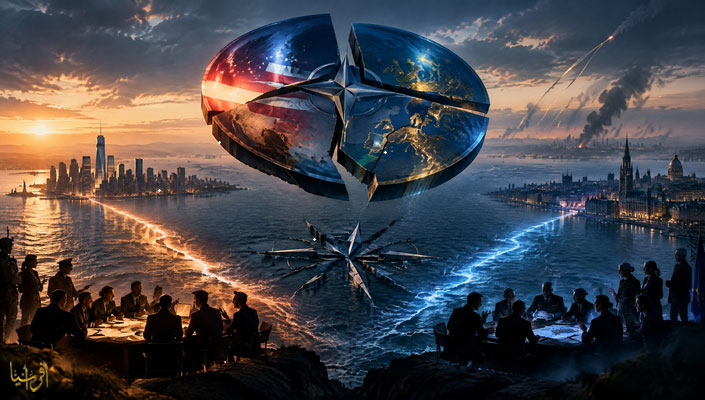
If Washington withdraws from NATO.. What future for the Orphan Alliance?
Afrasianet - Dr. Ayman Samir - There is anger in the administration of US President Donald Trump over the refusal of Europe and NATO countries to engage with them as a single military bloc in the ongoing military operations against Iran since February 28, 2026. This is why Trump warned on March 15 that NATO faces a "very bad" future if allied countries fail to help Fatah The Strait of Hormuz, in a direct message to European countries to join it in the war on Iran.
Europe's refusal to use military bases against Iran, or to help secure the Strait of Hormuz, has contributed to a different image of the alliance between the two sides of the Atlantic, as Washington has come to see its European and NATO partners as not reliable allies. In this context, questions remain: How do Europe and NATO justify their position on the war on Iran? What scenarios await the relationship between the two sides of the Atlantic?
Washington's Shock
The disagreement between the two sides of the Atlantic has intensified to the point of accusing U.S. officials of "treason" and "backstabbing" because wartime neutrality means "betrayal" from the point of view of Washington, which believes that it has been protecting Europe since the end of World War II, but Europe failed it when the United States needed it.
A number of members of the U.S. National Security Council accused European countries of choosing "political opportunism" over "strategic responsibility," indicating that the war on Iran has increased the space for mistrust and deepened the gap between the United States on the one hand, and its allies in Europe and NATO on the other.
The US administration under Donald Trump was shocked and disappointed when Spain refused to use the US military bases Rota and Morrón bases in strikes against Iran, when Prime Minister Pedro Sanchez said that Spain would not give the United States a "blank check" to use its infrastructure in the war in the Middle East, prompting Washington to move about 15 military aircraft that were in Spain to other bases.
The same scenario was repeated when British Prime Minister Keir Starmer refused to use the Diego Garcia base in the Indian Ocean by the United States, before returning and allowing the US military to use the Raf Fairford and Diego Garcia bases "for defense only", without carrying out air strikes against Iran.
France, for its part, allowed the United States to make "temporary use" of its bases in the Middle East, and refused to engage in what it called "preemptive wars." German Chancellor Friedrich Merz's motto was, "Yes to coordination, no to direct combat," which is why Germany allowed the use of Ramstein Air Base to coordinate U.S. operations, but refused to participate in the ongoing war on Iran. Romania agreed to the U.S. military's request to use its bases in logistical aspects that serve the war.
The Europeans also sent a joint message to the Trump administration, during a meeting of EU foreign ministers in Brussels on March 16, that an attack on Iran is not a "war of Europe" and that EU countries will not help Washington secure the Strait of Hormuz.
Causes of anger
The US administration's anger over the position of Europe and NATO has prompted many in Washington to demand a review of the accounts with their European partners, in light of the US feeling that Europe is seeking protection by activating Article 5 of the NATO Charter in any crisis related to European security, while abandoning Washington in the current war on Iran. The US anger against Europe and NATO is due to a number of reasons, as follows:
1- Security selectivity: The White House has been rumoring that Europe has been exploiting the U.S. security umbrella for decades, and that the U.S. alone spends nearly $1 trillion on defense, accounting for 3.7 percent of U.S. GDP, while the rest of NATO countries spend about $600 billion.
However, the Europeans are pursuing so-called "security selectivity", in the sense that they are asking for American protection and support, as happened in the Russia-Ukraine war, where the United States poured about $185 billion into support of Kyiv, while Europe rejected the majority of American demands related to the war on Iran, which in the view of the US administration represents a violation of the "NATO spirit" based on solidarity in times of crisis and wars.
2- Burden-sharing: U.S. calculations are based on the fact that eliminating Iran's missile and nuclear programs is in Europe's interest, because since 2007, the U.S. has established bases in Bulgaria and Romania to counter the threat of Iranian solid-fuel ballistic missiles, which can reach European soil. Washington also believes that the refusal of NATO and European countries to engage in military operations against Iran means that the Europeans will abandon the principle of "burden-sharing" in the face of a common danger, and leave U.S. soldiers alone to face Tehran.
3- The free passenger: In light of the positions of Britain, Spain, and Italy on the war, and the position expressed by Mark Rutte, the secretary general of NATO, of not fully engaging or participating in the attacks on Iran, the White House accuses the Europeans of playing the role of a "free passenger" who wants to take advantage of all the advantages of the current international order protected and led by the United States, without paying the price for the advantages and gains that he reaps as a result of his presence in this system.
More than one U.S. official has accused the Europeans of wanting oil, securing shipping lanes, ensuring supply chains, and dismantling Iran's missiles and nuclear weapons, without participating in military operations that achieve all these goals, and that Europe, from the White House's point of view, is content with practicing what can be described as "moral professorialism"".
4- Wrong message: Perhaps the most common reason for American anger is that the lack of support from its European allies for its military operations in Iran will send the wrong message to Washington's rivals, China and Russia, and that NATO, which was founded to be against the former Soviet Union and Russia, is practically losing its importance to the United States because it has not supported it in its war against Tehran, which is seen as the "weakest link" in the Iranian-Russian-Chinese partnership.
Thus, the United States believes that if it decides to enter a war with Russia or China, it will have to be sure that Europe and NATO are with it or not, because the non-participation of the alliance as a single bloc in the current war against Iran sends a message of weakness and distraction about it. There are even those in Washington who have said that the lack of participation of Europe and NATO and the non-use of the Diego Garcia base from the first day of the war is the indirect reason for Iran's steadfastness and the prolongation of the war so far, and that the "cracking of the Western Front" is a gift to Tehran.
5- Strategic paralysis: The United States viewed its military bases in Europe, along with European military bases and NATO bases, as a unified system, but the European refusal to use these bases, or to place strict restrictions on their use, is, in the view of the Pentagon's war planners, a "strategic paralysis" unprecedented of Western capabilities since the end of World War II. It went so far as to say that Washington's lack of use of European bases had lost the "element of surprise" of the U.S. military operation.".
6- European insurrection: The United States reads the European position as not an accidental or tactical position; it represents a rebellion against American leadership with the goal of achieving what Europeans call "strategic independence." The Americans accuse their European counterparts of seeking to play the role of soft power, leaving Washington alone to pay the price of "rough paths"".
7- Europe's selfishness: The Trump administration accuses European countries and the rest of NATO of basing their positions on selfish equations in which Europe only considers its trade interests and energy security, without considering the far-reaching dangers that Iran poses to the countries of the region and Europe itself, from Washington's point of view.
Europe's motives
There are many motives and justifications that European countries have relied on in refusing to provide unconditional support and direct involvement in the current war alongside the United States and Israel, which is considered a "pivotal moment" in the history of Europe-NATO's relationship with the United States. These justifications are:
1- Illegal war: The majority of European countries and NATO members believe that the war on Iran is illegal for more than one reason: first, that it has not been adopted by the UN Security Council, and that this war was launched by Trump and Israeli Prime Minister Benjamin Netanyahu, outside the scope of the international consensus that supported the negotiation process.
The second reason is the absence of a specific strategy for the war, as the goals announced by the White House varied, from destroying Iran's nuclear and missile programs, to changing the behavior or face of the ruling regime, to overthrowing the regime, or even dismantling the Iranian state among different ethnicities.
2- Iran's retaliation: European countries fear a retaliatory retaliation by Iran against European interests, both in the Middle East and even on European soil.
Spain and Italy have voiced these fears, with a number of their agencies assessing that there are Iranian cells in Europe ready to carry out reprisals if European countries participate directly in the current war.
3- The refugee crisis: European countries base their position on the war in Iran on the need for calm and return to the negotiating table, because the continuation of this war and the possibility of the disintegration of the Iranian state may push millions of refugees to EU countries that have not yet recovered from previous waves of migration due to wars in the Middle East.
4- Energy supply: European countries believe that they are the ones who are paying the price for this war after the rise in oil and gas prices, while the United States is self-sufficient in energy and exporting it.
Therefore, European countries believe that their non-participation in military strikes on Iran may contribute indirectly to the search for political solutions and not prolong the war, while direct participation and absolute support can encourage the United States and Israel to expand their goals and raise the ceiling of their demands from Tehran, prolonging the time of the war and prolonging the energy crisis and inflation in Europe, especially in light of the record prices of oil, gas, shipping, and transportation from the Middle East to Europe.
Four scenarios
In light of the US political charge towards European countries, and the latter's insistence on not changing its position on the war in Iran, four scenarios can be formulated for the future of relations between the two sides of the Atlantic, as follows:
1- Disciplined withdrawal: means the United States gradually reducing its security and military responsibilities in Europe within NATO, reducing the number of American troops in Europe to about 100,000 troops, and reaching the stage of withdrawing the American "nuclear umbrella" from Europe.
2- A small NATO: This scenario is based on building alliances between Washington and European countries with which they share their ideology and policies, including NATO's eastern flank countries such as Romania, Poland, and Bulgaria, and the three Baltic Sea states, namely Lithuania, Estonia, and Latvia. These allies could be more obedient to the White House, both in terms of military spending and Washington's support in various circumstances and crises.
3- Military and economic restrictions: Washington, especially under the Trump administration, may resort to restrictions on the sale of military technology and advanced aircraft, such as the F-35, to Europe, and to reduce intelligence cooperation and the availability of intelligence to Europeans; it could even stop selling American gas and oil to Europe.
4- Turning to the Indo-Pacific: This is the most dangerous scenario for Europeans, which is based on the withdrawal of the United States of its armies and security umbrella from Europe, and the focus on the Indo-Pacific, which mainly includes countries such as Japan, South Korea, Australia, the Philippines, Vietnam, India, and Singapore.
In conclusion, it can be said that the American anger over the non-participation of Europe and NATO in the war on Iran is not a "passing dispute"; rather, it indicates the widening gaps between Washington and its European allies, which threatens to damage the "NATO spirit" that has existed for nearly eight decades, and has been based on collective solidarity and joint action to confront any threat to any of the alliance countries. All of this may prompt the United States to replace long and costly alliances such as NATO with alliances in times of need.
________________
Dr. Ayman Samir - International Relations Expert, Future Center for Research and Advanced Studies.
