
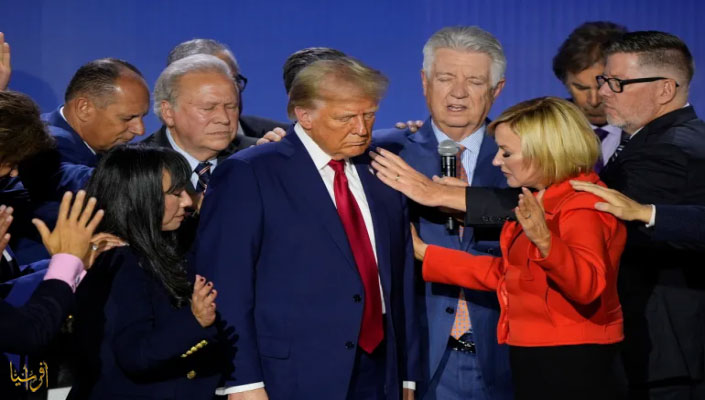
Christian nationalism is a phenomenon that is strongly rearing its head in politics and society in the United States, especially in light of the rise of Trump and his current
How does this nationalism view Israel as an authentic part of a sacred Christian history?
Afrasianet - Azza Karam - Christian nationalism is reshaping the American landscape beyond electoral politics. The movement brings together established right-wing organizations, modern "charismatic" networks, defenders of biblical law, Catholic advocates seeking a sectarian public order, as well as politically active local churches.
This article maps these diverse actors, outlines their ideas, and examines how their growing influence can cast a shadow over American democracy, diplomacy, and relations with non-Christian countries, from support for Israel to the war on Iran.
Christian nationalism is not a single organization or theology, but rather an ideological environment in which its members share a firm conviction that America is, or should be, a Christian nation par excellence, and that its laws, institutions, and public identity must reflect their preferred interpretation of Christianity.
This is not synonymous with the Christian religion per se, Christian political involvement, or even religious conservatism. Christians have long been involved in various movements, from calling for the abolition of slavery and supporting civil rights, to anti-war activism and economic justice campaigns.
But Christian nationalism begins when it goes beyond Christianity as a mere source of personal conscience to become a criterion that determines who represents the true America, determines the values that the government should prefer, and classifies those who deserve full belonging to the nation.
The movement is not born of the moment, as its roots extend to purgatory ideas about the "chosen nation," the religious language of the concept of "manifested destiny," the biblical defense of apartheid, and the rise of the religious right in the late 20th century.
What is new, however, is the institutional diversity and speed at which the movement's ideas are moving through churches, campaigns, digital platforms, school boards, and even the corridors of government.
From the Religious Right to a Wider Space
The most present and familiar face is still the conservative evangelical establishment, which became a formidable political force in the late 1970s and 1980s.
Organizations such as the Family Research Council and the Faith and Freedom Coalition seek to mobilize voters on issues such as abortion, sexuality, gender, education, and religious freedom demands. Conservative evangelicals, however, do not form a cohesive bloc; the point of contention arises when the call for certain policies goes beyond the limits of the United States, into a claim that the United States has an authentic Christian identity that the government must formally defend.
The traditional religious right has relied heavily on national organizations, lobbyists, voter registration campaigns, and strong alliances with the Republican Party. The newer space also includes independent churches, local political groups, media entrepreneurs, homeschooling networks, legal advocates, and social media influencers, many of whom operate independently of any traditional sectarian oversight.
Academic studies are increasingly treating these currents as multiple "Christian nationalities" – disparate theological currents that are capable of convergence and political cohesion.
"While charismatic hegemonists speak the language of prophecy and spiritual warfare, Calvinist nationalists often tend to invoke concepts of order, covenant, hierarchy, and law. Although their paths diverge, both currents envision a state that nurtures a single form of Christianity"
________________
The "Charismatic" Theology of Hegemony and the "Delegation of the 7 Mountains"
A growing trend emerges from independent "charismatic" and Pentecostal networks, which emphasize concepts of prophecy, spiritual warfare, divine healing, and direct divine intervention in political matters. In this context, power may not derive its legitimacy from traditional denominations, as much as from influential pastors, apostles, prophets, and digitally interconnected religious institutions.
The principle of "delegating the seven mountains" promotes the idea that Christians are required to influence or dominate seven vital areas according to the most extreme interpretations: government, education, media, business, family, religion, and arts and entertainment.
This approach goes beyond simply urging civic participation, and with it elections, school board competitions, and media campaigns become arenas for spiritual struggle. Political opponents may be seen not as fellow citizens with different views, but as enemies of the will of Heaven. When the goal becomes a divine mandate, any settlement is considered disobedience, and electoral defeat is tantamount to persecution or corruption.
Calvinist Nationalism and Christian Reconstruction
A second trend emerges from the womb of some sections of the Reformed tradition. This current, in its more rigid version (Christian Reconstructionism or Theocracy), holds that all life, including civil government, must be subject to divine law. This approach, historically associated with Rosas John Rashdoni, makes a systematic argument for the reorganization of public institutions in accordance with biblical law.
Although most Calvinists and Reformed Christians reject the Reconstructionist movement, some of its theses are now more widely known, such as the idea that religious neutrality is impossible, that liberal pluralism gives secularism undeserved privileges, and that Christians should regain control of national institutions.
While charismatic hegemonists speak the language of prophecy and spiritual warfare, Calvinist nationalists often tend to invoke concepts of order, covenant, hierarchy, and law. Although their paths diverge, both currents envision a state that nurtures a single form of Christianity and restricts practices that are contrary to its moral system.
Catholic advocates of a sectarian public order
A third face emerges within a small, but intellectually influential community: Catholic intellectuals (often called integrators), who advocate a sectarian public order. They reject the assumption that political power must remain religiously neutral, arguing that public institutions are obliged to uphold Catholic moral and religious truth, while subordinating temporal authority, in certain respects, to the directives of spiritual authority.
They do not represent Catholics as a whole; many Catholics remain faithful to constitutional pluralism, religious freedom, and the institutional separation of church and state. What distinguishes this trend is its questioning of the ability of liberal democracy, with its commitments to religious neutrality and individual autonomy, to sustain the common good.
Despite the deep chasm that separates him from charismatic Protestantism, they are able to converge and cooperate in opposition to secularism, abortion, gender and sexual rights, and loose interpretations of individual freedom.
The local church as a political machine
Perhaps the most influential new face is the church with local roots, which simultaneously serves as a community of worship, a platform for media production, a cultural hub, and a political network. Rachel Monroe's 2026 report on Mercy Culture Church in Fort Worth illustrates this model. Its political arm, Freedom and Justice, supports candidates committed to a vision of a government imbued with religion, and has helped more than 100 candidates win public office.
In this context, worship creates a cohesive community identity, while sermons provide political explanations, digital platforms disseminate the message, and affiliated organizations recruit and support candidates. The church is thus transformed into an alternative civic infrastructure, framing political participation as a sacred religious duty.
Legal limits are disputed: The Johnson Amendment prohibits tax-exempt organizations, including churches, from endorsing or opposing candidates. In 2025, the Internal Revenue Service proposed treating certain forms of endorsement during religious rituals as protected internal communications, but a federal judge refused to approve the settlement in March 2026. The law remains in place, although lax enforcement and political pressure have had its deterrent effect.
"The theological question is no less dangerous than its democratic counterpart: once Christianity becomes an instrument of political domination, religious testimony may give way to coercion, and faith may be hidden in favor of collective identity"
________________
Ideas that unite the movement
These movements, despite their differences, share a range of commitments. The first is the narrative of national origins: America was founded as a Christian nation, but its original purpose has been obliterated or confiscated. This vision subordinates the religious diversity of the early founders, the constitutional refusal to establish an official religion, the dispossession of indigenous peoples, the history of slavery, and the disputed problems of citizenship into an overarching narrative centered on the loss of the Christian compass.
The second commitment is the policy of cultural boundaries, linking the concept of "real Americans" to conservative Christianity, traditional gender roles, heterosexual family construction, and a specific narrative of Western civilization. According to this perspective, Jews, Muslims, non-believers, progressive Christians, immigrants, and other minorities may have official citizenship, but they remain on the margins of an imagined moral nation.
The third commitment is populist grievance, which portrays the loss of cultural hegemony as systematic oppression of secular elites, universities, the media, immigrants, or sexual minorities. Thus, concern for a collective goal is impossible, and the quest to regain political power becomes a religious restoration.
The fourth obligation is the identification between religious authority and state authority. The goal is not limited to the freedom to practice and proclaim Christian rites but also goes beyond it towards the acquisition of preferential authority that allows for the contouring of national identity and the consolidation of a monolithic moral vision in the fabric of law, education and administration.
Finally, as long as these currents tend to embrace the idea of "Providence leadership," they rely not so much on the behavior of the leader as on the belief that Providence has lined him up or harnessed him to restore the nation's glory. This explains the long-standing political loyalty that withstands behaviors that contradict the movement's stated moral standards.
Map influence and power, not just belief
Polls, such as the Center for Research on Religion and Public Life's Atlas of American Values, measure the extent to which Americans embrace or assimilate Christian nationalism, or even resist and reject it. However, these surveys fail to reveal the true extent of their penetration.
Drawing a power map requires questioning who trains candidates, finances court battles, produces media content, controls educational curricula, advises officials, and translates theology into politics. A highly organized minority can wield far more influence than their own.
Attention should not be limited to prominent figures, but should extend to school board appointments, curriculum formulation, voting rules, and judicial strategies, as well as efforts to extend religious exemptions to public health care, employment policies, or anti-discrimination requirements.
Although religious conformity is a vital protection of freedom of conscience and minority beliefs, concerns arise when it is expanded, allowing institutions to impose the consequences of their beliefs on employees, patients, or the general public.
The democratic question is therefore not whether religious citizens should engage in the political arena; it is their duty as equal citizens in a pluralistic society. Rather, the fundamental question is whether a particular society has the right to a privileged right to determine the criteria of belonging and monopolize state power.
The theological question is no less dangerous than its democratic counterpart: once Christianity becomes an instrument of political domination, religious martyrdom may give way to coercion, and faith may be disguised in favor of collective identity.
Ironically, some of the fiercest critics of Christian nationalism are themselves Christians, who see this fusion as a corruption of religion and even a deviation that amounts to biblical paganism. Clergy, theologians, and secular movements that advocate for pluralism are an integral part of this map.
"Perhaps the most serious international consequence for Christian nationalism is its ability to make political choices seem divinely decreed. But the war on Iran reveals something bigger: a radical shift in how contemporary geopolitics is understood now"
________________
When Christian nationalism shapes foreign policy
The influence of Christian nationalism does not stop at American borders; just as it sets the criteria for belonging domestically, it also defines the identity of countries that appear to be natural allies, those that are viewed with suspicion, and classify conflicts to decide which is merely a political dispute and which amounts to a conflict between the forces of good and evil.
But this nationalism does not result in a unilateral foreign policy whose trajectories are easy to predict. While one faction encourages the idea of foreign intervention, believing that America is an exceptional nation tasked with defending the banner of freedom, another supports the "America First" slogan, expressing its apprehension of alliances, international organizations, and foreign commitments. Both currents, however, assume that America has a special place in history, and that it should have exceptional freedom to decide when, how, and on what rules it uses its influence and its strength.
Matthew McCullough's book The War Cross: Christian Nationalism and American Expansion in the Spanish-American War offers an eloquent historical warning. It highlights how Christian leaders justified the intervention of 1898 as national self-sacrifice, arguing that America was not gasping for power, but rising up to serve the oppressed. McCullough calls this approach "messianic intervention," the firm belief that America is capable, and even obligated, to intervene altruistically on behalf of other nations.
However, that war, which was justified by the liberation of Cuba, eventually brought the Overseas Territories, foremost the Philippines, under United States rule. Religious confidence at the time helped to advance the national interest, military power and territorial expansion, in the form of selflessness and noble service.
This historical narrative does not assert that contemporary Christian nationalism will reproduce the same scenario, but rather highlights the danger of sacredness of military action as a divine mission; diplomacy may then appear weak, compromise appeased, and opposition resistant to righteousness.
These scenarios are not far removed from the current rhetoric of the current U.S. Secretary of Defense, Pete Hegseth, as well as the rhetoric across the U.S. political spectrum at the time of writing.
Paul D. Miller offers a related caveat in his book The Religion of American Greatness, describing an "appropriational attitude" in which Christians see themselves as the first architects and principal custodians of America, giving them the right to determine its future. Elsewhere, he draws a comparison between an America defined by shared political principles and one with a cultural and religious heritage. The latter model tends to embrace zero competition, and to express deep suspicion of alliances, international cooperation, and multilateral institutions.
Miller's framework raises a diplomatic question rather than a tested outcome: If religious affinity becomes a measure of belonging at home, will it apply to the selection of trusted countries abroad? Under this perspective, countries classified as so-called "Judeo-Christian" may be treated as members of a common civilization, while Muslim-majority communities are primarily seen as hotbeds of threat.
Effective diplomacy requires acknowledging other countries' histories, interests, and moral agency; however, religious nationalism risks dividing the world between those within America's preferred system and those outside it.
Research by Andrew Whitehead, Samuel Perry, and Joseph Baker reinforces this concern: support for Christian nationalism is linked to growing suspicion of Muslims, immigrants, and refugees in the Middle East. While individual positions cannot simply be projected onto government policy, they can shape public support for policies that interpret Muslim-majority countries through the lens of extremism, cultural incompatibility, and enduring danger.
"Until international law can constrain the strong as much as the weak, moral realism is not just one way of interpreting global geopolitics, it is the clearest explanation of a world governed by the character and choices of leaders"
________________
Israel and Iran. Sanctuating conflict
America's relationship with Israel requires special care. The work considered in this context does not establish a direct causal line linking Christian nationalism to American politics, but rather leads us to ask: What happens when Israel is seen not only as a strategic ally and a state entitled to security, but as an inherent part of a sacred Christian history?
In the process, the modern state may be confused with biblical Israel, while retreating The rights of Palestinians, including Palestinian Christians, are secondary compared to a sacred and predetermined narrative.
Although he views Iran and its allies as a serious threat and describes the Israeli-Palestinian conflict as a proxy confrontation between Israel and Iran, he insists on subjecting Israel to the requirements of justice in war, insisting that peace include both a "sovereign, secure and sovereign Israel" and a "sovereign, secure and independent Palestine." Supporting an ally does not obviate the duty to scrutinize its use of force, or the settlement it seeks to reach.
The prospect of war on Iran makes this danger all the more urgent. Although these authors do not offer a collective explanation of the war, their contributions help to expose the danger of portraying a geopolitical conflict as a pernicious religious conflict between Christian America, biblically significant Israel, and an Islamic enemy.
In the context of an apocalyptic narrative or providence, negotiations become betrayal, restraint a failure in the face of evil, and escalation in obedience to a higher end. Iran's government, its complex society, and its diverse population disappear behind a veil of religious threat Undifferentiated.
Perhaps the most serious international consequence for Christian nationalism is its ability to make policy choices seem divinely decreed. But the war on Iran reveals something bigger: a radical shift in how contemporary geopolitics is now understood.
"A country's security is ultimately determined by the strategic choices of its leaders, not by blind structural forces. Examining Gulf security through the lens of moral realism allows us to develop a clearer picture of the contemporary geopolitical landscape, one that is crucially shaped by individual decision-makers."Professor Jan Xiaotong.
As Professor Xiaotong explains, this proposition is at the heart of the claim of "moral realism ." Geography, military capabilities, alliances, and institutions combined set the conditions for which states operate, but they do not determine the choices of leaders. The conditions surrounding Iran, Israel, and the Gulf have gone on for decades without producing such a war. What has really changed is the leadership of Donald Trump and Benjamin Netanyahu. He argues that moral realism explains the present more convincingly than theories that treat leaders as doctrine in the hands of impersonal structures.
If individual leaders are now deciding the fates of war and peace more decisively than treaties, institutions, or legal prohibitions, then we are witnessing the end of the era of international law, not because its texts have disappeared, but because its claim to constrain powerful states has been rendered meaningless.
By combining national exceptionalism with divine purpose, Christian nationalism is accelerating this rupture: by combining national exceptionalism with divine purpose, it can free leaders from the burdens of ordinary moral and legal accountability, making diplomacy weakness, compromise treason, and violence a supreme calling.
But wars remain human decisions, and enemies are human. Until international law can constrain the strong as much as the weak, moral realism is not just one way of interpreting global geopolitics, it is the clearest explanation of a world governed by the character and choices of leaders, and a clear warning that the era of the rules-governed international order may already be over.
Geopolitical theology. Huckabee and the New American Policy
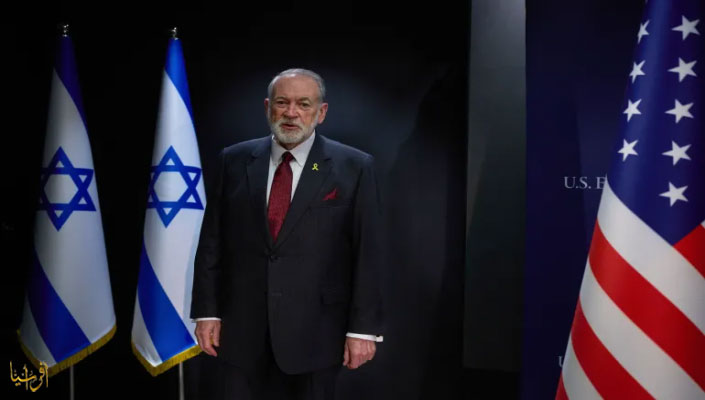
U.S. Ambassador to Israel Mike Huckabee (Associated Press)
Mike Huckabee was not an ambassador by chance, nor was he just a former governor rewarded with a diplomatic position, he represents the spirit of the times; his appointment as U.S. ambassador to Israel is not a new turning point in U.S. policy toward the Middle East, but rather reveals a deeper shift in the moral, religious, and geopolitical imagination on which American power is based.
Huckabee was born in Hope, Arkansas, the same small town that gave birth to former U.S. President Bill Clinton. Yet both have become the embodiment of a different political trend in American politics.
Huckabee's political and intellectual consciousness was shaped within the world of Southern Baptist evangelicals, where he studied at Ouachita Baptist University, a liberal arts institution affiliated with the Baptist denomination in Arkansas, and then attended Southwestern Baptist Theological Seminary in Texas.
Before entering politics, he was a pastor, an important fact because for Huckabee, theology was not just a special religious background or a personal devotional practice, but rather an unwritten grammar of political battle.
Huckabee rose through the political spectrum in Arkansas, serving as lieutenant governor and then governor from 1996 to 2007. He then ran for the Republican nomination in the 2008 and 2016 presidential elections, building a national image as a friendly conservative with a preacher, populist and television star.
He has hosted programs on Fox News and later on Christian media platforms, becoming one of the most prominent evangelical voices in the Republican Party's political circles.
His political stances were conservative in the traditional sense of the word, manifested in his opposition to abortion, his defense of the right to bear arms, his rejection of same-sex marriage, his support for prayers in schools, his apprehension of the expansion of the federal government's powers, and his constant emphasis on what he described as the Judeo-Christian roots of the United States. The most theological aspect of his political discourse, however, was his view of Israel.
For Huckabee, Israel is not just a U.S. ally, nor a strategic partner, a biblical truth. He has long rejected the term "West Bank," preferring to call it "Judea and Samaria," and has defended Israeli settlements in the Occupied Palestinian Territory.
He also questioned the legitimacy of Palestinian statehood, and repeatedly suggested that Palestinian demands elsewhere in the Arab or Muslim world be met, rather than being achieved through Israeli territorial concessions. According to this conception, geography is not subject to negotiation, but is an inevitable reality that must be accepted and adapted to.
"Mike Huckabee's appointment as ambassador is not just an ordinary diplomatic appointment, but a warning. He suggests that the future of U.S. foreign policy may increasingly be shaped not only in the language of security, markets, and alliances, but also in the language of sacred entitlement"
________________
This is why his nomination and confirmation as U.S. ambassador to Israel is so important: his appointment was confirmed by the Senate in April 2025, and the vote was largely based on partisan affiliation without bipartisan consensus.
For his supporters, it was the appointment of a man who "knows" Israel, has visited it countless times, and understands the depth of the U.S.-Jewish state's relationship. For his critics, it marked the instillation of Christian Zionist ideology at the heart of the U.S. diplomatic machine.
The controversy intensified during Huckabee's interview with Tucker Carlson in February 2026. Carlson, who has become increasingly critical of America's relationship with Israel, urged Huckabee to clarify his position on Israel's biblical borders.
The discussion turned to the land promised to Abraham's descendants, which some Christian Zionists and Jewish extremists interpret as extending from the Nile, or the valley of Egypt, to the Euphrates River.
Carlson noted that such a claim includes not only present-day Israel and Palestine, but also large parts of Jordan, Syria, Lebanon, Iraq, Egypt and Saudi Arabia.
When asked if Israel had the right to own the land, Huckabee replied, "There would be no problem if it took all of it." He later returned to play down the impact of his statement, saying that Israel does not seek to control the entire area and that his words were exaggerated.
But the damage had already been done. Many Arab and Muslim governments condemned the statement as dangerous, provocative and contrary to international law.
However, the significance of this dialogue lies not only in what Huckabee said, but also in what he revealed.
It showed the extent to which some U.S. foreign policymakers have become willing to blur the line between religious text and sovereignty, between sacred memory and modern international law, and between religious covenant (the Charter) and military invasion. The question is no longer just Christian Zionism as a theological belief, but Christian Zionism has become a geopolitical theology.
Huckabee's broader political vision reflects this integration. Internally, he belongs to a conservative tradition that sees the United States as morally threatened by secular liberalism, multiculturalism, feminism, LGBT rights, and what he and others see as a regression of Christian values.
At the international level, Israel is seen as both a strategic ally and a sacred partner. In this perception, the United States and Israel are not only tied to intelligence cooperation, military technology, common enemies, or regional strategy, but also a valued relationship with God's will.
"The danger before us is not the presence of religions in politics; religions have long contributed to the formation of the political imagination, moral language, and collective identity. Rather, the danger lies in the moment when religious claims merge with imperial power"
________________
This is why Huckabee and his like-minded people often describe Israel as not just a country that is useful to the United States, but an indispensable one. For them, it is the advanced democratic position, the military partner, the biblical homeland, the prophetic sign, and the moral test of America's faithfulness to its principles.
Opposition to Israeli policies is therefore not presented as an objection to the behavior of a state, but as standing in the face of a sacred narrative.
This also helps to understand Huckabee's positions on Iran. Iran appears in his rhetoric not only as a rival state, but as a civilizational and theological enemy, in his view, as an anti-Israel force, a sponsor of militias, a destabilizing force in the region, and the heir to old enmities that have been repackaged in modern strategic language.
The recent U.S.-Iran war was therefore not a military and diplomatic crisis, but an arena in which conflicting narratives about the claim to divine mandate, national destiny, the decline of empires and the struggle for civilizational survival were presented.
The latest reports indicate a very fragile situation. Negotiations are underway between the United States and Iran under the auspices of a number of mediators in order to de-escalate, reopen the Strait of Hormuz and the nuclear file, and ease some of the pressure of sanctions, but the agreement faces a number of challenges, including the renewed Israeli aggression against Lebanon, and the resulting destruction and damage.
All of this is happening at a time when the internal division in the United States is reaching unprecedented levels, amid accusations that many members of the U.S. Congress are under the influence of funding for the American Israel Public Affairs Committee (AIPAC). The Washington Post asked a straightforward question: Has the U.S. gained anything from the war with Iran?
If the war was waged under the pretext of removing the threat, and only produced a more volatile diplomatic environment, then it did not solve geopolitical problems, but rather increased the presence of theology by other means.
"The war exposed the limits of American power, demonstrated the dangers of Israeli strategic dominance over American decision-making, and underscored the absurdity of the belief that military bombing could create a stable political system"
________________
Mainstream media
At the same time, the American public receives conflicting stories. One narrative is that the use of force forced Iran to sit at the negotiating table. Another is that Washington fought a costly war only to eventually return to negotiations that resembled, in some respects, diplomatic arrangements that it had previously denounced.
The third narrative, espoused by some independent military analysts and former officials, argues that the war exposed the limits of U.S. power, demonstrated the dangers of Israeli strategic dominance over U.S. decision-making, and underscored the absurdity of the belief that military bombing could create a stable political system.
Mainstream political analysis has not paid enough attention to the religious vocabulary that underpins these debates. Most of the coverage focuses on missiles, sanctions, nuclear enrichment, oil routes, ceasefires, elections, and political figures.
All of this is indeed important, but it is not enough. The deeper question is how to use certain religious narratives to sanctify political violence, normalize regional expansionism, and turn diplomatic settlements into treason.
Religions, at their best, can place limits on power, hold empires to moral accountability, protect the weak, and remind rulers that sovereignty does not belong to presidents or prime ministers. But when religious language is hijacked by political nationalism, it becomes highly explosive.
When a sacred text becomes a property, the other becomes an encroacher on the ground. When sacred memory is weaponized, the Palestinians become a demographic problem, Muslims are a civilizational threat, the Iranians are enemies in the apocalypse battle, and war turns from a political failure to a sacred duty.
Radicalization is thus reproduced within the mainstream. Racist or xenophobic rhetoric no longer needs to present itself as outright hatred; it can present itself as faithfulness to the faith. Hate speech can be washed away through theological language. Occupation can be renamed as a legitimate legacy, annexation of territory as restoration of rights, and dispossession of others as an inevitable fate.
Traditional news sources fail to adequately monitor this; they report statements, reactions, and diplomatic results, but they rarely analyze the religious structure that gives such statements their political effectiveness.
It treats Huckabee's ideas as "controversial," "pro-Israel," or "evangelical." But the issue goes much deeper than that. The real issue is the transition of absolute theology to the realm of state-government.
"When a sacred text becomes a title, the other becomes an encroacher on the ground. When sacred memory is weaponized, the Palestinians become a demographic problem, Muslims are a civilizational threat, Iranians are enemies in the apocalypse battle, and war turns from a political failure into a sacred duty"
________________
Geopolitical Earthquakes
All of this is happening at a moment of profound geopolitical transformations. Western hegemony is no longer a given. The United States remains a formidable military, economic, and diplomatic power, but it is no longer the only one with these components, and perhaps more importantly, it no longer has compelling moral authority.
The wars of the past quarter-century, the failures in Iraq and Afghanistan, U.S. support for Israel that has led to ongoing genocide in Gaza and ethnic cleansing in the West Bank, the use of sanctions as a political weapon, and double standards in the application of international law have all contributed to the erosion of the credibility of Western claims to universal values.
In this context, geopolitical theology becomes a substitute for legitimacy. If the liberal international order is no longer able to persuade, then sacred history can be invoked. If international law becomes a nuisance, biblical geography can be invoked. If the empire is in decline, Providence can be made to speak for it.
And that's why Huckabee is so important, not because it's a unique case, but because it's a symptom of a broader phenomenon. He represents a trend in American politics in which Christian Zionism has moved from religious pulpits, pilgrimages to embassies, and policymaking. It embodies a new American foreign policy in which theology is not only to bless the strategy after it's been formulated, but to co-shape it from the start.
The late Palestinian thinker Edward Said warned against the temptation to think about the concept of civilizations. In his response to Samuel Huntington's thesis on the "clash of civilizations," Said argued that such frameworks reduce complex histories and living peoples to crude abstractions. They do not explain conflicts, but rather create mental templates that make conflict seem inevitable. What we face today, in Said's words, is not a clash of civilizations but a "clash of ignorance."
This ignorance is not innocent, it is made by politicians, it is sanctified through selective religious interpretations, it is amplified by the media, and then it is translated into politics and wars.
It thrives when Americans learn to view Israel as a theological issue, Iran as a harbinger of the end of the world, the Palestinians as an absence rather than a threat. This ignorance deepens when the press merely reports on violence and fails to examine the ideas and beliefs that fuel it.
The danger before us is not the presence of religions in politics; religions have long contributed to the formation of the political imagination, moral language, and collective identity. Rather, the danger lies in the moment when religious claims merge with imperial power, stripping away the virtue of humility, and harnessing it to sanctify hegemony.
Mike Huckabee's appointment as ambassador is therefore not just an ordinary diplomatic appointment, but a warning. He suggests that the future of U.S. foreign policy may increasingly be shaped not only in the language of security, markets, and alliances, but also in the language of sacred entitlement.
As I have repeatedly argued and warned, when politics claims to have divine mandate, it becomes much easier to justify war, and it becomes more difficult to imagine peace.
________________

