
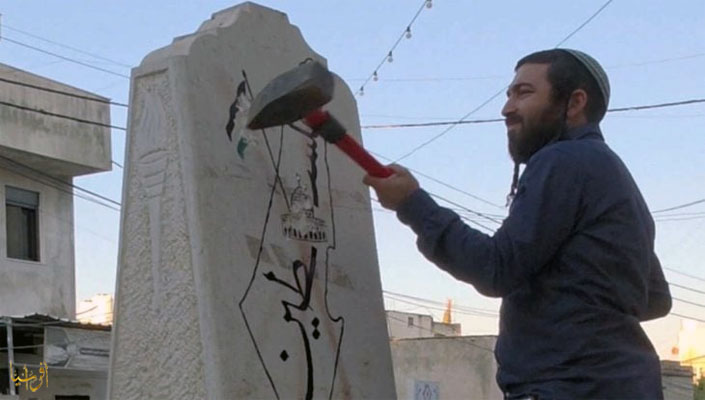
Afrasianet - Saeed Abu Mualla - Israeli forces demolished a Palestinian national monument bearing Palestinian symbols and the names of martyrs in the cities of Nablus and Qalqilya in the northern occupied West Bank.
Afrascent documented the demolition of 12 monuments to the martyrs in the governorates of Nablus and Qalqilya, including 11 monuments in towns in Nablus governorate, and one monument in Qalqilya.
These attacks come in the context of the escalation of targeting Palestinian monuments and symbols that document the names of the martyrs and commemorate them in Palestinian towns and villages.
According to local sources, the demolitions targeted monuments in the villages of Azmut, Rujib, Iraq Burin, Beit Furik, Madama and Beita in Nablus.
The occupation army also demolished Martyrs' Square in the town of Kafr Qaddum, east of Qalqilya.
In the village of Burin, south of Nablus, the incursions of the occupation forces continued since the early hours, and included raids on dozens of houses, the detention of about 60 Palestinians, in addition to converting houses into military barracks.
The Israeli occupation forces also raided the villages of Sarra, Tal and Salem in the Nablus governorate, raided houses, including the homes of released prisoners, and carried out field searches and interrogations, before withdrawing from the village of Salem.
These attacks come in the context of the escalation of targeting Palestinian monuments and symbols that document the names of the martyrs and commemorate them in Palestinian towns and villages.
Last week, the Commission for Resistance to the Wall and Settlements said that the occupation forces and settlers have carried out 18 attacks on Palestinian monuments and symbols in the West Bank, including occupied Jerusalem, since the beginning of 2026, not counting Tuesday's attacks.
In the monitoring and documentation data, the Commission explained that the attacks included 16 attacks on monuments and memorial edifices, an attack on a mausoleum, and another targeted murals of Palestinian figures, noting that some of the attacks affected more than one monument or site.
The attacks documented by the Commission were distributed in six governorates, led by Nablus with six attacks, followed by Ramallah and Al-Bireh with four, and occupied Jerusalem with three, while Hebron and Jenin recorded two attacks each, and Tulkarm with one.
The distribution of the aggressors shows the direct role of the occupation army, which carried out 13 incidents, compared to three carried out by settlers, and two incidents carried out by settlers under the protection of the army, one of which was carried out with the participation of MK Zvi Sokot in Madama.
The militarily protected facts illustrate the field relationship between the settlers' entry into the Palestinian community and their ability to attack within its public space. The different means of implementation, including a military bulldozer, a hammer and acts of vandalism, are associated with the common result of weakening the visual presence of memory and subjecting its survival to the balance of power.
The significance of the damage varies depending on the manner in which it occurred. Parts of a monument are smashed that leaves a witness to the attack, while removing and seizing it will remove its site from its original material. In both cases, residents are faced with the question of restoring the monument, including the inscriptions, names, and shape they knew.
The seizures in Beit Duqo and Birzeit reveal that the intervention may continue after the demolition, as the recovery of the components of the edifice itself becomes part of the battle to preserve memory.
The commission said that the month of October stands out in chronology with nine incidents recorded during its first 20 days, half of the attacks recorded in the register. These incidents extended from Birzeit University, Sila al-Harithiya, Nablus, Ya'bad, al-Rayhan, Abu Falah and Jalazun, all the way to Cyrenaica.
The convergence of dates reveals that the targeting of monuments has been repeated over a short period of time in several governorates, affecting educational institutions, camps and towns. This makes the symbol's presence in the public sphere vulnerable to repeated interference, the effects of which are renewed with each new incursion or attack.
In the Jerusalem governorate, the sequence included the demolition of the monument of the martyrs of Qalandia camp during the storming of the 26 January, the destruction and seizure of the Arafat Daoud Monument at the entrance to Beit Duqo on 11 March, and the destruction of the Shu'fat Martyrs' Monument on 23 March.
These events are significant because the monuments are linked to the memory of communities that live under restrictions on movement, organization, and urbanization. In the camp, the monument bears the names of those who belong to the same families and neighborhoods, and at the entrance to the village, it becomes a marker identifying the place and its history, which is frequently presented to residents and visitors.
In Nablus, the sequence began with the destruction of Muhammad Abu Bakr's mausoleum in al-Junaid on 21 June, and then the attack on the shrine of Muhammad al-Junaidi in the same area on 31 July, by colonists protected by the army. The targeting of the edifice and the mausoleum shows that the intervention extends to the place of commemoration and burial.
In both cases, memory is linked to a specific person, family, and social environment, and the impact of the attack reaches the ability of the people to keep a place to visit and remember, and the sense that their testimonies are vulnerable to compromise even after the death of their owners.
The incident of Madama on August 25 carries political significance, with Zvi Sokot participating in the destruction of parts of the monument of the martyrs of the village with a hammer, in the presence of the occupation soldiers. The appearance of a Knesset member carrying out the attack connects the political position within the Palestinian community.
In this scene, the village square becomes a place to show the power to intervene in the symbols of society. Military protection also gives the aggressor the ability to reach and execute, while the residents bear the loss of a monument that has been erected to commemorate in their local space.
The targeting continued in Nablus by destroying the edifice of the martyr "Al-Sa'idi" in the central suburb on October 6, and then demolishing a monument and removing pictures in the city on October 7, including the areas of Al-Dawar and Ras al-Ain. The incident in Cyrenaica on the 20th of this month comes within this geographical extension.
The movement between the city's neighborhoods and the governorate's villages reveals that the targeted landmarks belong to multiple levels of local memory, and that the attack affects evidence distributed within the residential, traffic, and gathering spaces, where people's connection to the names they bear is renewed.
In Jenin governorate, the army demolished a monument in Sila al-Harithiyya on the evening of October 5, and demolished the Yasser Diab Hamdouni monument in Ya'bad on October 7, coinciding with the removal of the portraits of the martyrs in the center of Jenin. The demolition of the Ya'bad monument was preceded by a notice of removal.
The succession of notification and execution of the incident gives an additional dimension, as the symbol becomes the subject of an intervention that determines its fate in advance and then executes it by force. The local community is thus faced with a decision that addresses the names and images it displays, the impact of which goes beyond the loss of the material from which the monument was made.
Tulkarm provides an example of the extent of a single attack, after the destruction on August 4 of the monuments of George Habash, Ziad Daas, the Martyrs' Monument and other landmarks, and was accompanied by the vandalism of Tyre in Kafr al-Labd and Shuwaika. The multiplicity of locations and names shows that the operation touched a network of signs distributed in the streets, roundabouts, and gatherings.
This leaves simultaneous voids in the public scene, and touches memories that relate to different generations and experiences. It also explains why the value of these monuments goes beyond the limits of their design, as they bear names through which residents evoke their political and social history.
In Ramallah and Al-Bireh, the October sequence began with the demolition of the monument of the martyrs of Birzeit University and its seizure on the 5th of the month. The meaning of the edifice here is related to the university's function as a place of education, the formation of awareness, and the accumulation of student experiences. The names affixed to it connect generations of students with those who preceded them, and place the institution's national history on its campus.
The Birzeit incident was followed by three attacks in the governorate, namely the destruction of the Muhannad al-Halabi monument at the entrance to al-Rayhan suburb on October 9 by colonizers, the demolition of the Martyrs' Monument in the center of Khirbet Abu Falah with a military bulldozer on the 12th, and the demolition of the Martyrs' Monument in al-Jalazun camp on the 14th.
These sites connect the landmark to a place that people use daily. Therefore, residents see the impact of the attack on their usual way, and the absence of the monument continues after the attackers leave as an apparent change in the square or entrance.
In the southern West Bank, settlers targeted the Suleiman al-Hazaleen Monument in um al-Khair in Masafer Yatta on May 24. The edifice is associated with defending the land and confronting uprooting in the Palestinian consciousness, making the assault on it an infringement on a local symbol with a national reach. Its location within a rural community also gives it the function of holding the story in place.
The memory here is linked to the land on which its owner lived, and to the community that chose to keep his name within the place to which he belongs.
In Tabqa, in the town of Dura, on June 29, the army smashed murals of Palestinian symbols, including Bassel al-Araj, Naji al-Ali, and Ghassan Kanafani, forcing citizens to complete the demolition. This incident expands the circle of targeted landmarks to forms of artistic expression that place the biography and idea on the walls of the village.
Forcing the residents to complete the destruction also adds an effect related to the way in which force is exercised, as it forces residents to participate in the removal of symbols that they have chosen to attend, and the erasure of the image makes it an experience for the community.
The Commission said in a press release that the diversity of the targeted names reveals the breadth of the content of the memory that is being compromised. The register collects monuments to local martyrs, political names, and photographs of writers and artists, reflecting the multiplicity of experiences that society chooses to evoke.
This means that the means of expressing a diverse Palestinian history are harmed, in which the personal biography and the cultural experience are juxtaposed with the cultural experience. Each of these signs carries a different approach to understanding the place, which makes their loss a poor view of the scene and the possibility of reading its stories.
According to the commission, these facts show that monuments, photographs and murals serve as an open archive, allowing memory to circulate outside of books and official headquarters. Residents read names while using the place, ask about their owners, and pass on their stories to children and newcomers.
Through this circulation, the square or road acquires a content that goes beyond its physical function. When a monument is demolished, one of the means by which the community preserves the continuity of the story is damaged, and it bears the cost of rebuilding it or finding another form to show it.
The targeting of symbols is linked to controlling the scene by determining what Palestinians can show within it. The force that removes a name or image interferes with the content of the place and imposes a presence that can change.
This effect can be read in the visual occupation of Palestinian space, where signs that express identity are subject to military intervention or colonial aggression. The relationship is concretely embodied when a bulldozer reaches a camp yard, a politician uses a hammer inside a village, or the names of students are removed from their university campus.
The right of institutions and communities to manage their cultural affairs is also harmed. The university, the village and the camp choose their symbols from within their own experience, giving them a place that is commensurate with their relationship with people. Armed intervention disrupts this relationship, and forces the owners of the place to deal with a loss they have not chosen.
Thus, the reconstruction of the monument or the restoration of the mural restores the community's ability to express itself, preserves the link between the name, its biography and its location, and prevents the teacher's presence from ending at the moment of the attack.
The 18 incidents, along with the demolitions on Tuesday, as Israeli elections are taking place, place Palestinians with the issue of the preservation of their history in their land. In Jerusalem, Nablus, Jenin, Tulkarem, Ramallah and Hebron, attempts are made to subjugate local evidence to the act of force, while these testimonies carry stories and experiences that people have chosen to keep among them.
The importance of protecting them stems from their connection to the life of the community and its ability to transmit its memory. Every name that is reaffirmed, and every image that is restored, reconnects the story and affirms the right of its owners to present their history to future generations.

