
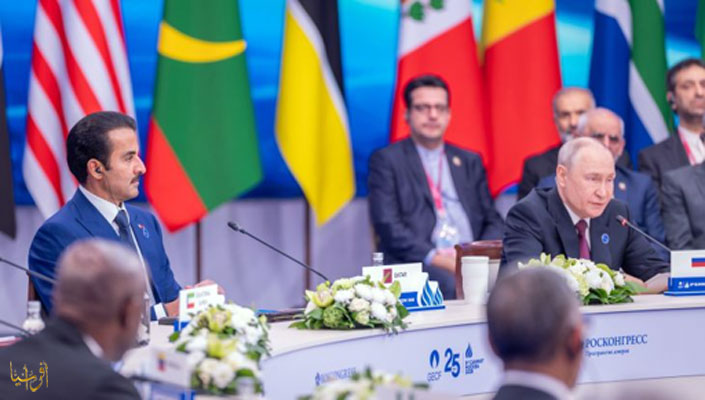
Afrasianet - Russian President Vladimir Putin said that "the role of gas as the basis of global energy will be strengthened in various sectors", calling for finding new ways to transport gas through cooperation between producing countries, while Qatar's Emir Sheikh Tamim bin Hamad Al Thani stressed that his country will continue to contribute to enhancing global energy security.
During the opening of the eighth summit of heads of state and government of the Forum of Gas Exporting Countries in Moscow on Tuesday, Putin stressed that Russia is working to strengthen its sovereignty in the field of gas and takes decisions on new fields, stressing the importance of coordinating efforts among producing countries.
The Russian president pointed out that global demand for gas is expected to rise to 3.5 trillion cubic meters in the coming decades, with production expected to double, which reinforces the importance of developing production and transportation capacities and expanding partnerships between exporting countries.
Putin explained that the member countries of the forum produce about 70% of the world's gas production and contribute about 40% of exports, which gives them weight in determining market trends and makes coordination between them an important factor in the stability of supplies.
Putin warned that attempts to exclude Russia from international markets and restrictions on the energy sector could reflect on companies and consumers, calling for the strengthening of technological capabilities and long-term investments to give producers and consumers a clearer vision for the future.
For his part, the Emir of the State of Qatar, Sheikh Tamim bin Hamad Al Thani, expressed his happiness to participate in the summit of the Gas Exporting Countries Forum in Moscow, stressing that the summit was an opportunity to enhance coordination and exchange views on the challenges facing global gas markets and the concerted efforts they require.
In a tweet on his account on the X platform, he stressed that Qatar will continue to contribute to enhancing global energy security and consolidating partnerships based on trust and mutual interests.
In a reading of the context of the summit, Al Jazeera correspondent Amin Darghami pointed out that the talks are taking place in light of geopolitical complexities, including Russia-Ukraine War and the sanctions imposed on Russia andIran, along with tensions in Asharq Al , Awsat and its implications for energy markets.
The importance of coordination between producers is highlighted in light of the weight represented by Russia, Iran and Qatar, as data from the summit's deliberations indicate that the three countries collectively account for about a quarter of global gas production and more than 26% of its exports.
Supply disruption
For his part, Gas Exporting Countries Forum Secretary-General Philippe Ruffalo said that geopolitical tensions and unilateral restrictions necessitate strengthening international cooperation to ensure the stability of supplies, warning that the repercussions of the disruption of gas transportation through the Strait of Hormuz extend to the global economy.
Ruffalo explained that energy security and the provision of affordable and sustainable energy is a priority, along with fighting poverty and promoting economic development, noting that natural gas can contribute to reducing air pollution and emissions when used as an alternative to coal.
Meeting future demand requires long-term investments in production, liquefaction, storage, transportation, distribution networks and power plants, the Secretary-General stressed, calling for equitable distribution of risks among producers and consumers to ensure continuity of supply.
In the same context, Iranian President Masoud Bezeshkian said that geopolitical tensions and the targeting of Iranian energy facilities have caused disruptions in energy transmission and affected global economic security, accusing the United States and Israel of launching attacks on his country during political negotiations.
Bazeshkian criticized the unilateral sanctions and US pressures, in addition to what he described as the naval and air blockade imposed on Iran, considering that interventions in the Gulf region are reflected on energy prices and supplies, and their effects go beyond the producing and consuming countries in the region.
The Iranian president called on member states to strengthen cooperation in strategic management, technology and joint investment, starting from production to transportation and export, stressing his country's readiness to participate in gas development projects, noting that its production has reached 300 billion cubic meters despite the sanctions.
Equatorial Guinean President Teodoro Obiang Nguema Mbasogo called for the protection of the sovereignty of countries over their natural resources, stressing the importance of gas in Africa's development and combating energy poverty, and warning that recurring crises and international tensions are adding to the uncertainty in the gas industry.
Energy Partnerships
Mbasogo outlined priorities for international cooperation, including intensifying diplomatic efforts to end conflicts, protecting energy facilities and maritime security, abandoning unilateral sanctions, supporting investments and technology transfer, as well as strengthening communication between producers and consumers to ensure balanced contracts and competitive prices.
The President of Equatorial Guinea noted that the disruption in gas supplies is reflected in fertilizer production, agriculture andFood Security and operation, reviewing his country's projects in the Alba, Allen and Egai fields, and cooperation with Cameroon andNigeria To develop resources and expand productive capacities.
Supply disruptions, price volatility and the safety of infrastructure pose common challenges for producers and consumers, especially developing countries that are less resilient to economic shocks, said Libyan Presidential Council Chairman Mohamed al-Menfi.
Al-Menfi reviewed Libyan projects to increase gas production, including the development of the Sabratha offshore platform for the investment of the Bahr al-Salam field, and work on the exploitation of associated gas in the Al-Buri field, which aims to reduce emissions by about 1.5 million tons per year.
Algerian Prime Minister Sefi Gharib said the overturn in legislation is confusing markets and hindering investments, calling for a stable regulatory framework and fair gas valuation over long-term decades, and warning against burdening developing countries with energy transitions that restrict their right to development.
Gharib highlighted his country's commitment to promoting African development through the Trans-Saharan Gas Pipeline (Trans-Saharan Gas Pipeline) as well as efforts to consolidate its position in exporting hydrogen to Europe via the Southern Corridor, calling for the use of technology and artificial intelligence to reduce emissions and develop carbon capture technologies.
In his speech, Egyptian Minister of Petroleum and Mineral Resources Karim Badawi stressed that demand security is no less important than the security of supplies, calling for the protection of vital facilities and shipping lanes, stressing the link of gas to food and water security and the development of fertilizers and petrochemicals.
Badawi pointed to Cairo's efforts to consolidate Egypt's position as a regional hub for gas trading, by taking advantage of the liquefaction plants in Idku and Damietta, and linking the resources of the Eastern Mediterranean and Africa to global markets, in a way that enhances supplies and opens the way for partnerships that achieve mutual benefits.
These interventions come at a time when the forum is discussing the "Moscow Declaration", the draft of which was approved by energy ministers, which is based on the principles of equality in the field of energy, technological neutrality and equal access to it, in preparation for its adoption during the summit, amid calls for expanding cooperation and protecting investments.
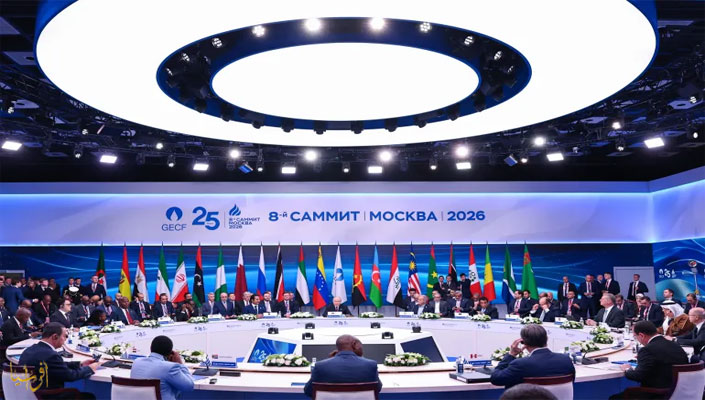
Participants at Moscow summit discuss challenges facing global gas markets (Reuters)
The "Green Transition".. Moscow Gas Summit Faces Three Challenges
In this context, Ilya Okhov writes: Moscow witnessed a landmark event for the global energy export system, as the Russian capital hosted the eighth summit of the Gas Exporting Countries Forum from October 25 to 27, 2026.
Over the past years, the Forum has established itself as one of the leading global platforms for coordinating the policies of major gas-producing countries. The agreement to establish the Gas Exporting Countries Forum came into force on September 30, 2009, and its full membership includes countries such as Algeria, Bolivia, Egypt, Equatorial Guinea, Iran, Libya, Nigeria, Qatar, Russia, Trinidad and Tobago, theUnited Arab Emirates , and Venezuela.
The forum is based in Doha, and it is important to note that the organization itself is already beginning to take shape after Russian President Vladimir Putin's visit to Qatar in 2007 and his talks with the late Father Emir Sheikh Hamad bin Khalifa Al-Thani. The organization's member states account for more than 70% of the world's proven gas reserves.
Announcing the start of preparations for the summit, Russian officials stressed that Russia attaches great importance to partnership-based cooperation within the framework of the Gas Exporting Countries Forum, coordinating efforts to promote the legitimate interests of gas exporters in global energy markets, addressing unilateral economic constraints, as well as enhancing the role of natural gas in global energy resources markets due to its availability, reliability, versatility and environmental suitability.
The OPEC gas summit, also known as the Gas Exporting Countries Forum, is taking place amid a major restructuring of global gas trade. Russia is redirecting its exports to Asian markets, expanding liquefied natural gas supplies, and developing new pipeline projects, but at the same time still facing sanctions and infrastructure constraints. Instability in supplies from the Middle East has also become an additional factor.
In this context, I suggest that we look more closely at the domestic gas production indicators with which Russia enters the eighth summit of the Gas Exporting Countries Forum.
According to data from the Russian Statistical Authority, gas production in Russia at the end of the last eight months of this year reached 446.5 billion cubic meters, an increase of 3.4%, or 14.7 billion cubic meters, compared to the same period of the previous year, when it reached 431.85 billion cubic meters.
Meanwhile, Russian government agencies are putting forward the following projections for the coming year: 696.1 billion cubic meters are expected to be produced. Forecasts for 2028 indicate production of 710.5 billion cubic meters, and in 2029 to 740.1 billion cubic meters.
Now let's evaluate Russian gas exports, which are one of the most important indicators that shape budget revenues from oil and gas and contribute to Russia's macroeconomic stability. The LNG market has become the engine of growth for Russian gas exports. According to data from the analytics service Kpler, Russia exported about 25.35 million tons of LNG during the first nine months of 2026, an increase of 14% compared to the previous year. In September, exports of Russian LNG plants reached 3.36 million tons, an increase of 35% compared to September 2025.
It is important to note that Russian LNG sales in global markets are growing thanks to the expansion of transportation through the North Sea route by gas tankers. Meanwhile, EU countries, which have imposed sanctions on Russian gas exports and decided to refrain from buying LNG from Russia from next year, are frantically rushing to fill their storage facilities before the restrictions go into full effect.
Between January and September, Russia increased its share of sales to Asia. Supplies to Asian countries in nine months amounted to 12.82 million tonnes, an increase of 16.9 percent compared to the previous year.
Its share of total exports rose to 50.6% in nine months from 49.4%. China was the largest contributor to Asian supply growth, accounting for 29% of total exports. In nine months, China received about 7.43 million tonnes, an increase of 60% year-on-year.
The development of new sources of energy and the reduction of human impact on nature are leading to gas, along with solar, wind and hydropower, becoming the engine of the so-called "green transition"
Let's now move on from Russia to more general issues, and in particular to the issue of global gas consumption growth. According to the estimates of the Gas Exporting Countries Forum's own analysts, contained in the World Gas Outlook 2055 report, the Forum's long-term forecast assumes that global gas demand will increase from 4.14 trillion cubic meters in 2024 to 5.42 trillion cubic meters by 2055.
It is important to note that the share of LNG in global consumption will rise from 46% currently to 65%. The development of new sources of energy and the reduction of human impact on nature are leading to gas, along with solar, wind and hydropower, becoming the engine of the so-called "green transition". Gas consumption is playing an increasingly important role in the energy systems of developing countries in Asia, Africa and the Middle East.
However, in addition to the purely economic, objective and rational premises for the growth of the role of LNG and gas in general in the global energy balance, there are also geopolitical factors that impose a series of challenges and threats on the member states of the Gas Exporting Countries Forum.
• First, there is undoubtedly the ongoing conflict in the Middle East, which, according to some estimates, is escalating to higher levels in the spiral of escalation.
In this case, the main factor in the supply decline is the de facto closure of the Strait of Hormuz, through which large cargo tankers cannot pass normally. In particular, LNG exports from Qatar's Ras Laffan have declined sharply , where key gas liquefaction capacities are concentrated. Damage to Qatar's production infrastructure creates an additional challenge.
As a result of the strikes on March 18 and 19, two liquefaction lines with a total capacity of 12.8 million tons per year, nearly 17 percent of Qatar's export capacity, were damaged. According to a statement issued by QatarEnergy in September, it would take about three years to restart these lines.
If, before the outbreak of the crisis, about 6.6 million tons per day passed through the Strait of Hormuz, the quantities have now dropped to about 1.4 million tons. All of this, of course, harms gas exporters and consumers alike, as they do not receive the contracted shipments, while prices are rising everywhere.
Volatility in global gas markets is increasing, along with rising long-term demand for gas. In this context, the importance of the Gas Exporting Countries Forum is growing significantly. The Forum is becoming a platform for formulating joint decisions, modifying the general price policy, and formulating a unified position in the face of attempts to dictate by force and impose external restrictions on the Forum countries
For example, prices in the Asian spot market for liquefied natural gas (LNG) have risen to more than $29 per million British thermal units (MMBtu), nearly tripling the pre-conflict level.
• Second, European restrictions on gas exports from Russia are stagnating the EU's only relatively available and cheap alternative. As of January 1, 2027, the EU has imposed a ban on the purchase of Russian gas, rejecting at the October 19 EU summit a US proposal to abandon such restrictions as part of a broader process to resolve the Ukraine conflict. All of this is already redirecting Russian supplies to Asian markets.
Volatility in global gas markets is increasing, along with rising long-term demand for gas.
In this context, the importance of the Gas Exporting Countries Forum is growing exponentially. The Forum is becoming a platform for formulating joint decisions, adjusting public price policy, and formulating a unified position in the face of attempts to dictate by force and impose external restrictions on the Forum countries.
Russia is at the forefront of this process, offering other energy-exporting countries a model for creating a fairer and more diverse infrastructure that takes into account the legitimate rights and interests of countries exporting gas and other energy resources.
Thus, it can be confidently said that the global gas sector, with the launch of the Moscow Summit of the Gas Exporting Countries Forum, faces a set of interrelated challenges. The main challenge is the increasing dependence of trade on geopolitical risks, which directly affect the availability of supplies, the cost of transportation, and the stability of long-term contracts.
The crisis over the Strait of Hormuz is the clearest example. Before the conflict, about 20 percent of the world's LNG supply, particularly from Qatar and the United Arab Emirates, passed through this route.
The actual suspension of normal navigation in the spring of 2026, followed by the subsequent partial resumption of flights, and the damage to Qatar's gas infrastructure have shown how vulnerable the market is to the closure of a single transport corridor. Even with production capacity, exporters cannot guarantee timely delivery of products.
According to data from the International Energy Agency, the volume of LNG shipments from Qatar and the UAE between March and June decreased by 35 billion cubic meters, compared to the same period in 2025. The costs of insurance, shipping, and ensuring the security of transportation operations are also increasing.
Another structural challenge is the pressure of sanctions on Russia's gas sector. EU restrictions on the reshipment of Russian LNG, the maintenance of specialized vessels, and the supply of equipment and liquefaction technologies complicate logistics and the launch of new projects.
The main task of the Gas Exporting Countries Forum is not to coordinate short-term market estimates, but rather to seek mechanisms to ensure uninterrupted trade, technological cooperation, and predictability of investments
The European Union's decision to halt imports of Russian LNG from early 2027 adds to the uncertainty. Redirecting shipments to Asian markets requires reorganization of trade routes and linkages, increases transportation costs, and sellers may be forced to offer price discounts. At the same time, European consumers are becoming more active in competing for alternative LNG shipments, reinforcing regional price volatility.
The third challenge relates to the potential for a change in the balance of supply and demand. According to estimates by the International Energy Agency, new liquefaction capacities are expected to be introduced during the period 2025-2030 with a total productivity of more than 330 billion cubic meters per year.
New projects, particularly in North America, can increase competition among exporters and put pressure on prices. However, construction delays, financing constraints, and military conflicts create the opposite risk of temporary supply shortages. This is where a complex dilemma arises: investment decisions are made for decades to come, while prices and the availability of key export routes can change sharply in a few months.
Finally, uncertainty remains about long-term demand. Renewable energy expansion, requirements to reduce methane emissions, and climate regulations complicate the justification for capital-intensive projects with long payback periods. In contrast, developing economies in Asia and Africa remain interested in reliable gas supplies.
As noted above, the Gas Exporting Countries Forum predicts that global gas consumption will increase by 2055, but the pace of the energy transition and the availability of alternative energy sources remain highly controversial.
The divergent interests of producing countries also make it more difficult to formulate a unified position within the Forum: some focus on accelerating the increase in exports, while others focus on maintaining price stability and protecting existing markets.
Therefore, the main task of the Gas Exporting Countries Forum is not to coordinate short-term market estimates, but rather to seek mechanisms to ensure uninterrupted trade, technological cooperation, and predictability of investments. To achieve sustainable market development, a dialogue with importers is also necessary.

