
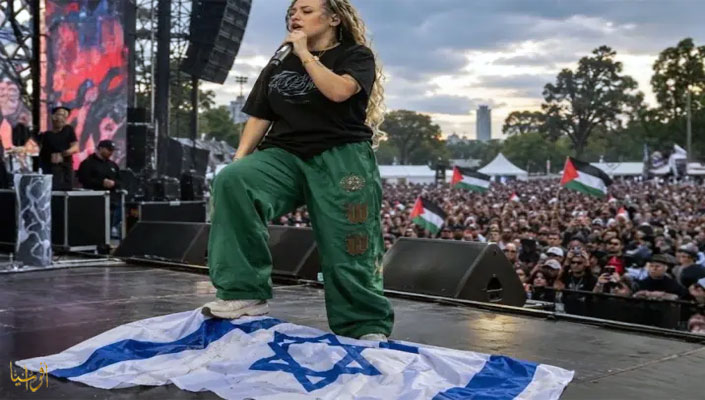
Afrasianet - Faiza Hindawi - In a striking artistic and political stance in solidarity with Palestine, Colombian rapper Cello Hop sparked widespread reaction after she refused to raise the Israeli flag during a concert in the capital, Bogotá, before stepping on it and chanting "Palestine is free", in a scene documented by videos circulating on social media platforms.
The incident came during the cello hop's participation in the "Hip Hop Al Parkie" festival, which was held on the 24th and 25th of this month at Simón Bolívar Park in the Colombian capital, with the participation of a number of hip-hop artists.
According to a report published by the "Roya News" website, the situation was recorded during her singing segment, after she performed her new song "Anatomy", which she presented in collaboration with the music producer Astral Pass.
The footage circulating showed the artist trampling on the Israeli flag, chanting "Free Palestine", in a direct expression of her rejection of Israel, in light of the ongoing war on the Gaza Strip and the human losses and widespread destruction it has caused.
The incident takes its significance from the artist's choice to express her position in front of the festival audience, through a clear act that does not need explanation, turning a moment from the musical performance into a political message that went beyond the boundaries of the concert and spread widely online.
Cello Hop belongs to the Colombian rap scene, which in many experiments has been associated with the expression of social and political issues, and the use of music as a space to ask questions of identity, justice, and protest. This context gives her position additional importance, especially since rap originated and developed as an artistic expression capable of transferring anger and rejection from the street to the stage.
Its stance also comes in a country whose government has taken clear political steps in protest of Israel's war on Gaza.
Colombia recalled its ambassador to Israel in November 2023, and then announced in May 2024 that it was severing diplomatic relations with Israel, against the background of the war and the Israeli government's positions. This context reflects the presence of the Palestinian cause in the Colombian political debate, although the artist's position is an expression of her personal choice.
The incident reaffirms the breadth of solidarity with Palestinians in international artistic circles, where attitudes are no longer limited to statements or flag-raising, but are now appearing at concerts and festivals, and in artists' choices and performances in front of the public. In these cases, the image and video give the situation the ability to spread and reach followers outside the usual circles of political discourse.
For Cello Hope, her stance did not require a long speech; she chose to declare her solidarity with Palestine in action and cheer, becoming a moment of her participation in a music festival that was recently discussed about the relationship between art and the political situation, and about the artist's ability to use his presence in front of the audience to express issues that go beyond the boundaries of music itself.

