
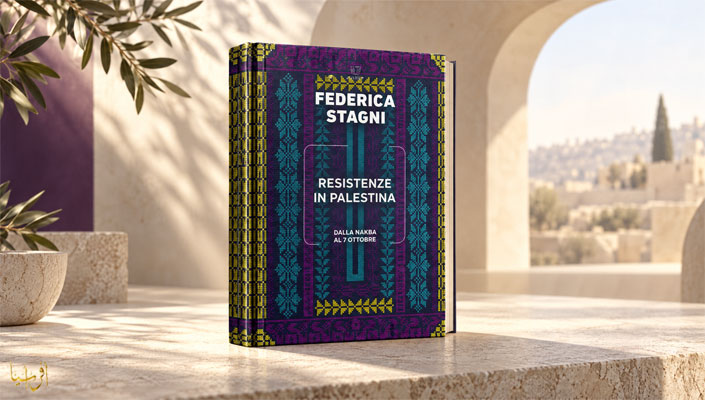
The cover of the book "Palestinian Resistances from the Nakba to October 7" published in Milan by the Italian researcher and academic Federica Stanni
Afrasianet - Amel Bouchareb - The book "Palestinian Resistances – From the Nakba to October 7th" by Federica Stani, recently published in Milan, is not just an academic work based on field studies that spanned about ten years inside Palestine, which carries through its pages the Italian reader from the beginnings of Palestinian resistance work in the first half of the twentieth century to October 7, but a brave radical research that delves into the roots of Western colonial thought and places the Zionist movement and its transformational project in Palestine within the settler colonialism projects known to the world, such as French colonialism in Algeria and colonialism in America, Australia and South Africa.
Metaroots
The author was keen to distinguish between it and settler colonialism, which is based on plundering wealth, such as British colonialism, while settler colonialism focuses on land grabbing, displacing populations, and changing the demographic structure of the occupied countries.
This idiomatic classification, as the author recalls, is new to the Western knowledge system, which has only recently begun to recognize it. Therefore, the author opens her work with a chapter in which she identifies the most important terms used in the work, especially "settler colonialism" on which the scientific hypothesis of the study is based.
Here, the researcher returns to historical references that traced the roots of Israeli colonialism, where Staniyi stands at Ilan Pappé's book "Ten Myths About Israel", a work translated by the same researcher in 2022 into Italian, in which Pappe emphasizes that the establishment of Israel is part of the quest to empty the Holy Land of Muslims.
This was due to the emerging Islamophobia in Britain, which was bitter at the loss of the Crusades, and the deep-rooted anti-Semitism in which Britain wanted to drive Jews out of its territory to solve the "Jewish question", all of which were part of the British imperialist agenda that sought to weaken the Ottoman Empire from within by strengthening the Jewish presence.
"The author warned that Israeli colonialism does not deviate from the Western colonialism projects known to the world, which, although they have ended according to international law in most regions of the southern world, still exist in Palestine"
________________
Settler substitution community
Stanney recalled Rodinson's groundbreaking 1973 book, "Israel: A Settler Substitution Society," in which he described "the establishment of the State of Israel on Palestinian land as the culmination of a path that was fully integrated into the Euro-American expansionist movement of the nineteenth and twentieth centuries, whose goal was to settle new populations among other peoples."
In this chapter, Stanie returns to the roots of colonial thought in the West and the epistemological system that established Western supremacy and racism, which the author attributes to the scientists and philosophers of the Enlightenment who were known as "humanist thinkers", starting with names that made the history of modern science such as Bacon and Darwin, to great writers and philosophers such as Descartes, Rousseau, Voltaire, and Victor Hugo.
The latter recalled how his sense of superiority that he had passed through the style of guardianship had always been expressed as "a love for the good of mankind." Stanie called on Western scholars to question the Western system of thought from within in order to engage in a genuine effort to dismantle colonialism from its roots.
Western Feminism and the "Seventh of October" Test
After going through in-depth chapters that explain the history of Palestinian resistance action within the perspective of the popular struggle against Israeli settler colonialism from the beginning of the Arab revolution until October 7, the researcher pauses at length at the predicament of the feminist movement in supporting the Palestinian struggle as a national struggle for the liberation of the land against fierce settler colonialism.
Western feminism is perhaps one of the most metaphors for the term decolonization, so it was expected that the author would devote a lengthy chapter on "feminist movements", in which the author reached the peak of her critical work, dedicating a paper entitled "A History of Mistakes", in which Stanni explained how October 7 exposed the contradictions of the feminist movement in the West, focusing on the Italian model.
Stigny spoke bitterly of the confusion that befell Italian feminists after October 7 and fell into the trap of believing the propaganda of the rape of Israeli women by members of the Islamic Resistance.
"Deep-rooted Islamophobia that portrays Muslims as monsters has torpedoed decades of attempts to "decolonize" the ideology within the feminist movements that fell on the October 7 exam"
________________
To make matters worse, the Israeli banners carried by Iranian feminists living in Italy, whom the authors described as close to Western feminist circles, made it clear that the supposedly "decolonizing" movement does not even have the cognitive tools to discern what colonialism itself is.
The severe rift within the feminist movement was evident through the researcher's attempt to transfer testimonies from inside Palestine during her last visit in December 2024, similar to the testimonies she collected during her previous field trips, but Staniyi confirmed that this time the feminists of the 48 territories refrained from sharing their opinions and stories.
She suggested that the atrocities that were still going on in Gaza created a climate of suspicion and prevented many women from sharing their stories for fear of repercussions on their personal and professional lives, and one Palestinian feminist spoke only about the "divisions of struggle" and the lack of unity with Israeli feminists, which would put the future of the movement as a whole at stake.
Mortality and the Legitimacy of Armed Struggle
Federica Stanni's critical impetus did not stop there, but was crystallized in the fifth chapter entitled "The Armed Struggle", in which the Italian scholar returned to Franz Fanon and his argument about the legitimacy of the armed struggle of the colonized peoples, citing the Algerian experience in his iconic book "The Torturers of the Earth" (1961), and the researcher recalled Fanon's speech in Accra in 1960 in which he said that "the Algerian people have chosen the only solution left for them."
Fanon does not romanticize armed struggle, but rather presents it as a bitter antidote to colonial poison, and a "necessary evil" for colonial peoples who are subjected to all forms of violence, as Fanon believes that "the colonized man has no freedom except through violence." "It is necessary to recognize that settler colonialism is an intrinsically violent path, and that it will necessarily only generate violence."
"October 7 was not an isolated island of violence that erupted suddenly, but a carefully planned and calculated operation," and "for oppressed peoples, violence is a form of defense, and its exercise is the exercise of the right to self-defense."
________________
"Even those who have long practiced nonviolent resistance have found it difficult to denounce the Hamas operation in October 2023. Fanon's words may be the best response to those who continue to denounce what happened on October 7."
Field Living and Academic Blockade
At the end of this article, the Italian researcher quoted militant statements from the Popular Front for the Liberation of Palestine in which she stressed her "happiness and deep pride in the fighters who rose up on October 7 against their oppressors, despite her ideological differences with them."
Thus, Federica Stanni has shown through her bold study that resistance in Palestine is not a monolithic project, but rather a dynamic set of practices that are constantly evolving and shaped by historical circumstances, material reality, and the political aspirations of the Palestinian people. Recognizing this plurality is essential to counter simplistic narratives that delegitimize Palestinian struggles, or integrate them into frameworks that deprive them of their specificity or impose their own agendas.
Federica Stani is an Italian researcher with a doctorate from the Faculty of Political and Social Sciences from the Higher School of Professors in Pisa. Her research work focuses on the movements against demolitions and evictions in Palestine, relying on extensive fieldwork and empirical studies in Palestine and Israel, and she was barred from entering Israel in 2025 to continue her research work as she stated in the introduction to her book "For Security Reasons".

