
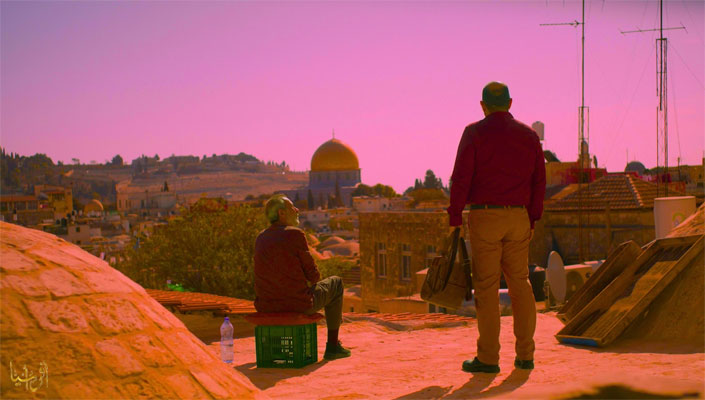
From the film, modified.
Afrasianet - Basma Al Takruri - Even in the cemetery, Muraq Rouch tells him that he has strategically located soil, right in front of the gate of the hereafter: you will enter the hereafter first. Thus, the film does not leave a detail in the pain of the Jerusalemite, even the idea of his "envy" of his grave itself, except to pass through it and reflect on the trace of its scar a little.
While the living cannot guarantee a room or a stone in a city that is confiscated from threshold and window every day, the deceased gets one piece of land over another, a piece of land in which he is not threatened by rent, a municipality, or a settlement fund. The grave is his only stable property in his land until the Day of Judgment.
"The Israeli police know that Kamal went to prison in America, but they don't know that his son died at sea." With this sentence, Palestinian director Muayyad Alayan's "Dialogue with the Sea" puts the entity state in front of us: a meticulous memory when it comes to a charge, and a big hole when it comes to Palestinian pain.
Wael has been absent for twenty years and swallowed up by the sea, leaving behind a mother and sister who hold on to a certainty that is barely enough to grieve, and a doubt enough to keep the door open for his father, when a postman shows up with a financial claim for debts that are not usually accumulated by corpses.
Official records show Wael alive enough to collect money from his father, but as for his death, this is a separate procedure that needs to be proved. It doesn't matter what the story of his family who buried him with their own hands says, the institution wants a document, and without it, Wael will still be fit to be collected.
Based on this black irony, the film opens up its harsher question: it is simpler to suffer to prove that your son was born as a Jerusalemite, than to get a confession that guarantees you his peace in his grave, when it comes to collection bills.
The mobile camera runs behind Kamal, the film's protagonist, played by Palestinian artist Kamel al-Basha, in Jerusalem, as if the city and the man were late for a secret date.
Kamal moves throughout the film without reassurance of any detail, sound, or movement. Hesitation appears as a ghost in his stand at the doors, in reading the tone of his interlocutors, and in pounced to defend himself before he hears the accusation.
After decades of attrition and exhaustion of Jerusalemites, the Israeli authority in Jerusalem no longer always needs a physical barrier. You watch the barrier get the body dressed: in the way you stand, in calculating the distance between you and the person who is talking to you, and in your attempt to act naturally when you know where you are before you enter.
Even Kamal's own memory moves with such nervousness. In one of the scenes of the film, Kamal finds a video of the child's birthday, Wafa, which this memory traps him and haunts him throughout the film.
The camera dances in the video and in Kamal's head, and it is reflected as if the past does not know where to put Wael, or is afraid to put him in a final place. The camera's nervousness in evoking the memory does not subside until Kamal sees the grave and believes it. Then the pictures of the children playing in the Old City come back quieter, clearer and more steady.
It was as if an angel had landed on the memory and filled it with contentment. The memory is the same, but it is the father's ability to deal with it and look at it that has changed. We see the grave closing the small outlet of doubt that the image turmoil was leaving a little open for Wael, and he returns from it.
As the procession of mourners carrying the cross passes, the mourning creeps into a full soul as the words of the hymn flow: "Oh my love, my beloved, what are you in?"
As if it were the moment of his greatest defeat, here, the difference between a disfigured corpse that no one believes and a disfigured soul from within whose wounds bear institutional scars at every step, melts away. Who mourns whom? "What condition are you in?" is the question he dares not ask himself.
The people in the procession know their direction, and they have a ritual that carries their grief to the end, but he walks among them, carrying on his back the weight of a corpse that he cannot believe, without having a moment after which he can say that the wait is over.
Then he collapses, the collapse of a man who discovers that everything he has returned for has become on the other side: the son is on the side of death, the daughter does not want to hear the word "my father", and the neighbor, the neighbor and the far carry too much weight for looks or words to do justice to. No one, no story, no son, no country. From the bottom of this defeat, Kamel connects with Marwan. The defeat of his feeling that even the house itself does not want him either.
There, between the procession and the call, the film says a lot about the displacement of Palestinians in Jerusalem. Uprooting takes place slowly, bill after bill and treatment after transaction, and the daily becomes a punishment that the Jerusalemite is accustomed to with a bitterness that no one else knows.
Between a government that restricts his livelihood and a municipality that consumes his nerves, and a policy that continues to confiscate what little he has, Marwan appears at the right moment carrying money and the promise of a life of grass, greenery and a good face, unaware that they are temptations that mean nothing to a soul that has been thickened by a deferred mourning and the heaviest of which is a burden that it can no longer handle.
The settlement funds and the government operate in a space that allows each side to deny what the other is doing to facilitate its goals, while the result is clear in the land registry: another Arab house is removed from the list. Life is like a game of cat and mouse, and the house in Jerusalem is always the mouse.
The leak begins long before the contract is signed, when the city succeeds in convincing its owners one by one, that the departure stems from his own decision, and he imagines that the sale is the last power he has left over his life. Here Marwan buys the city defeat after defeat, whenever one of them settles on that quiet fire, he lands to shoot a solution that gets its owner out of his grip.
The same denak that the occupier's arms cook for him in all its lengths and shapes, every day, and it is engineered with a devilish calmness under the feet of the city's Palestinians.
When Kamal "Lentils" and dials Marwan's number on his phone keypad, he arrives with a defeat greater than the defeat of losing his son. The man borrowed money from near and far and went to America in search of an opportunity to extricate his family from the hardship of living in Jerusalem. He left with a promise greater than himself, and he was swallowed up by the lie of the American dream.
He became homeless, hungry and failing, and after failure he was chained by chains of shame, making the idea of his return empty-handed heavier than staying away. Chains that turned months into years that prolonged turning his failure into an excuse he kept repeating to himself until he could no longer comprehend the size of the chasm created by his inability to face his defeat.
When his daughter asks him, "How did you get my phone number?" She asks him about his right to return from his origin. The word "I am my father" is no longer valid as an entry card with no expiration validity, and the word stands at the door with no life to support it. Even the use of the word for appeal seems to Kamal like a knife that cuts through his daughter's chest. He does not yet understand whether his absence really deserves all this anger and denial.
The riddle of this anger is solved only when Marwan puts the missing piece in it, revealing with his arrogance how he pressured Kamal's wife and daughter, and how he took advantage of the void left by his father's degeneration.
Only then does Kamal understand his daughter's anger and discover that his failure preceded him in going to Jerusalem and destroyed his family, and Marwan strikes as if he is beating the self that allowed all this.
The whole film is a piled up debt bill, as Kamel's indebtedness does not stop at the financial claim or what the people owe. As soon as the financial debt book is opened, other debt books are opened, and after the journey of searching for a thread that leads to his son's death, he realizes that his son's debt to the government, despite his injustice, is the lesser.
His debt to his daughter, and his debt to his wife, is greater than a financial claim that can be paid and redeemed. When he says the word "sorry" to his daughter, he confesses to her a bill that she thought he would never know the size of his debt, a bill through which he lost his daughter's childhood and the purity of her hopes for it irrevocably.
Near this wound stands Bisan, the only witness, when the memory of her hiding in the boxes of the past is awakened as soon as Kamal stands at the door of her house. Her old fear of her family, the words of the people, and the blame for Wael's death awakens.
The occupation narrows life outside the house, and the society that revolves around it is complete. When we look at the scene through this lens, the details of her hiding his identity card for two decades are no longer a crime that someone holds against her.
The film deliberately does not portray Palestinians as pure victims, revealing them as they inherit fear, and carry the weakest price of secrets, always praying after the loss becomes much greater than regret.
On the other hand, the film does not present a single block of Israeli society, which makes its image even more condemnable. The landlord is not a soldier, but she treats Kamal as if she were standing on a barrier: she asks in a commanding tone, and he obeys.
Nothing in the law gives her the authority to take his identity or photograph him, but his body has been trained to obey him without thinking:
Give me your identity. Here the film shows how the soldier comes out of his barracks and settles into the body of the Israeli citizen as well.
Amnon, the "non-extremist" academic, presents a softer version of the same relationship: he invites the Arab into his home and then does not sit him down at the table with his guests. His open image requires Kamal's presence, but not to the extent that he sits with him on the same level.
This is what Kamal's body captures before he even enters, and he is overcome by his hesitation and tries to refuse. At the table, Amnon talks about "Israeli wine," including the wine that Gaza produced hundreds of years before Israel's existence. He erases and changes the man's history as he sits listening to him.
He then invokes words spoken by Mahmoud Darwish in the same way, turning them with the ability of Qadir to become a witness to his culture, transforming the meaning into a recognition that Israel has always been the center of attention. Even when the Palestinian writes about his experience, the Israeli changes the interpretation of what he wrote to suit his whims comfortably.
The calmness with which Amnon speaks like a snake provokes a narcissism that transcends itself in this scene: to read the words of the man who lost his country, and to pay lip service to the conviction that he is praising you.
The extremist man who expels Kemal, insults him, and insults his son is a mirror of all the personalities combined. He says what the landlord says in her loud voice, what Amnon says with the hiss of academic malice and the arrangement of the seats, and what the young soldiers say when they ride the bus with weapons older than their age.
Then Anna, who arrived nine years ago, comes and speaks to him with the confidence of the landlady, while he is the son of Jerusalem and the owner of the place, confused at the door.
Even in the cemetery, Muraq tells him that he has strategically located soil, right in front of the gate of the hereafter: You will enter the hereafter first.
Thus, the film does not leave a detail in the pain of the Jerusalemite, even the idea of his "envy" of his grave itself, except to pass through it and reflect on the trace of its scar a little. While the living cannot guarantee a room or a stone in the city that is confiscated, a threshold and a window every day, the dead get one piece of land first, a piece of land in which no rent, no municipality, and no settlement fund threatens him.
The grave is his only stable property in his land until the Day of Judgment. The irony is surreal here: the afterlife is more secure than the world, and the dead are more closely connected to Jerusalem than a neighborhood that may receive a paper in the morning telling him that he has lost his ownership of the place where he has lived all his life.
In the end, Kamal leaves. He leaves the country and leaves the life he tried to return to, so the city does not stop to say goodbye to him. In front of another sea, the father who spent his journey in search of his dead son sits next to a living daughter he has forgotten how to look for.
The camera watches as each of them plunges into their defeats alone, close enough not to touch. There is no healing of a rift of this magnitude. What is lost will not return, and there will be no waiting. The camera remains fixed on them from behind: the sea is in front of them, and life in all its complexity and pain is behind them.
Kamal disappears, to remain loyal to the sea, while cakes baked by others are baked in a new morning.

