
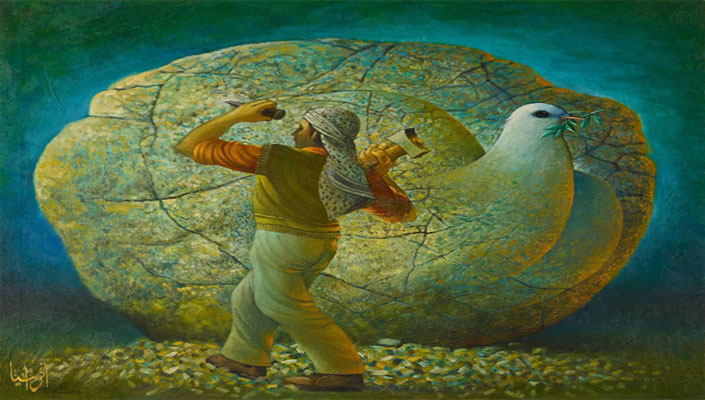
Sliman Mansour Peace 1990
Afrasianet - Salim Abu Zahir - In his paintings, Palestine was not a distant country that we looked at with nostalgia, but something that entered the room with us wherever we went, just as it entered that room with us at the Beirut airport. She was sitting among us, waiting for them to let her through; she was in our passports, in the questions we were asked, in our confused attempts to explain the difference between visiting a place and being a child of the place. She was in the sea that we had not reached, in the city where we had waited on her doorstep, and she was, in another way, present in Suleiman Mansour, who entered the room for us.
Some of the absence begins when the owner leaves, and some departures don't end until he comes back to us as a memory that we didn't know when we lived it would remain. The news of Suleiman Mansour's departure reached me, so I returned, in a way I didn't expect, to a small room at Beirut airport. Not to one of his exhibitions, not to a painting hanging on a wall, not to a picture of "camels of bearings," a copy of which perhaps a Palestinian house, or Palestinian memory, is not without a copy.
All of these images came later, successively, as if they came out of a distant place in memory, but the first image that came back to me was completely different: a narrow room where we were waiting for a small fate at an airport.
About ten years ago, we arrived at the airport with that feeling of pre-entering Beirut, something like postponed joy, or nostalgia for a city that doesn't take a lot of time to convince you that it knows how to greet strangers. It was enough to know that we were close to Beirut to feel like we had arrived, or so we thought.
But getting to the cities is not always a matter of a plane landing on time, no stamp on a passport. Sometimes it is enough to be a Palestinian from Palestine for the trip to turn into a long question about where you came from, how you got there, why you were there. Our charge was, simply, that we had visited the "occupied homeland" or, more precisely, that we came from the place where we live, the place where we live.
We tried to explain to the passport officer what seemed to us to be a basic fact that didn't need all that explanation; we are not visitors to the land we live on, we didn't go to the occupation like a traveler goes to another country, it was the occupation that came to us. He was the one who broke into the place, renamed things, and forced the Palestinian to give a brief account of himself every time in order to cross to another place.
There was a great deal of absurdity in it, but it was a familiar Palestinian absurdity. To stand in front of a man who doesn't know you, or maybe doesn't want to know you, and try to convince him that you're the owner of the place, which in the papers looks like an accusation.
Beirut was on the other side of the door, but we didn't make it, and we ended up being held in a small waiting room. I don't know if the word "detention" was quite appropriate, but it was closer to what we felt. We weren't allowed to go out to Beirut, and we didn't know, exactly, how long the wait would be.
The sea, which has always been associated with this city in my imagination, was somewhere very close, behind the walls and the glass and procedures that had nothing to do with us, and away from us as if it were on the other side of the world. It was in that room that Suleiman Mansour appeared, where I first met him. I remember his white beard, the simplicity of his presence, his calmness that needed no introduction.
He was heading to Beirut with another artist, before he found himself, like us, in the same room, accomplice in the same charge.
There was something paradoxical about it that didn't need much explanation; an artist who had spent his life painting Palestine, and carrying it to galleries, homes and books, found himself required, even for a moment, to explain his relationship to it. It was as if the presence of a Palestinian in Palestine always needed an accompanying narrative, a witness, and an additional explanation.
He sat with us simply not like the image we usually make of great artists. Suleiman Mansour was not the artist we know from paintings, catalogues, and awards, as much as he was another Palestinian man who was stranded at a "checkpoint", although this time the shape of the barrier was different.
He didn't talk much, and he didn't need to fill the silence with what people knew about him. There was that calm that accompanies some people, making their presence in the place more obvious than the words themselves.
We talked about many things and few things at the same time, as in waiting. It was not a pre-arranged session, nor a cultural meeting, nor an event with a platform and a microphone; a group of Palestinians stuck in a room at an Arab airport, and an artist going to Beirut as usual, so he was waiting with us.
Perhaps what is left of that coincidence, after all these years, is the simplicity that makes you forget, after a while, that you are sitting with one of the most important Palestinian artists. We talked, and then we ate falafel, and I don't know, to this day, if this is really the best "falafel sandwich" I've ever eaten, or if memory is what gives some things a flavor that wasn't there.
Maybe we were hungry, maybe the Beirut we arrived in and didn't enter added something to the taste. Maybe the sea, so close to temptation and far away to the cruel extreme, made everything look different. Or maybe, simply, because talking to Suleiman Mansour was really appetizing.
After that casual encounter, Suleiman Mansour brought me together with other events and initiatives, most of which revolved around culture, heritage and the preservation of Palestinian memory. I worked with him in different spaces, and the conversation always came back to the same question, one way or another: How do we preserve what is left of us?
He knew that memory, for the Palestinian, is not a luxury, that it is not just old songs, or embroidered dresses, or pictures of villages hanging on the walls, but another way of resisting disappearance and saying that what happened did not erase what was here. Perhaps this is why his work was understandable and did not need much explanation, even for those who had never studied art or had never entered an exhibition in their life.
Although we do not know, specifically or confirmedly, when and how it was transformed from a work of art into a part of Palestinian emotional furniture, we can be sure that almost no Palestinian home has known "Bearings Camels," or that at least there is something in it that we have seen hanging in homes, offices, on book covers, and in many places we have lost the sense that it is just a painting.
The man was bent under the weight of the city he was carrying on his back, but we saw more than that. We saw the peasant, the refugee, the worker, the exile, and the Palestinian who carries what he can carry. He was more like us than he should be, and he was no longer just a figure painted by an artist, but a symbol and an image that the Palestinian knows, even if he does not remember when he saw it or experienced it for the first time.
Every Palestinian, in a way, knows how to carry a house that no longer exists, or a place he cannot return to, or the names of people who have disappeared, the roads that have changed, and the pictures he keeps on his phone for fear that things will be lost again.
Suleiman did not paint the "Palestinian" only as a victim, nor as a label, nor as a logo that needed to be hung on a wall, painted as if it were part of the body, something you could not take off even if you tried. In recent years, especially after everything that happened in Gaza and in the West Bank camps, the image of the man carrying his city is no longer just an artistic metaphor; we have seen Palestinians carry the remainder of their lives from one place to another: bags, children, memories, and little things that are worthless to anyone, but become heavier than the world when you are the last thing left of your home.
Reality did not imitate the painting, but perhaps the painting captured, a long time ago, something profound in the Palestinian experience: that the Palestinian learns, time and time again, how to carry on with his life and move on, in the hope that this will not be the last one, and perhaps that is why the works of Suleiman Mansour have remained close to us.
In his paintings, Palestine was not a distant country that we looked at with nostalgia, but something that entered the room with us wherever we went, just as it entered that room at Beirut airport. She was sitting among us, waiting for them to let her through; she was in our passports, in the questions we were asked, in our confused attempts to explain the difference between visiting a place and being a child of the place. She was in the sea that we had not reached, in the city where we waited on her doorstep, and she was, in another way, present in Suleiman Mansour, who entered the room for us.
We were just waiting, we wanted to get out of the room, to see Beirut, and maybe to get to the sea. And the whole thing seemed to be, at the time, just a fleeting annoyance of those inconveniences that Palestinians know how to deal with, because their lives have taught them that waiting is part of the journey.
But the departure of people rearranges memories, and suddenly the little details become more precious than we thought. The tone of voice becomes important, the way of sitting, the calmness, the white beard, even the "falafel sandwich" that I don't know, until now, whether it was good because of hunger, or because of Beirut, or because we ate it in the presence of a man who, many years earlier, had made Palestine visible.
When I think about it now, the whole scene seems closer to one of the paradoxes of our Palestinian life. We were simply waiting for Beirut, and there was a sea, a falafel, and a coincidence that made Suleiman Mansour be among us. At the time, I didn't think that I would sit down years later to write about that encounter after he left, because some encounters don't seem important at the moment, they simply pass, and then life goes on.
But the years come back to them from time to time, and they add to them what we didn't know at the time. Not because what happened in that room was a big event worth telling, not because Suleiman said something extraordinary, but because some people, when they leave, leave behind little details and things that regain their meaning belatedly, and remain, not as things from a bygone era, but as witnesses to a time that could not end.

