
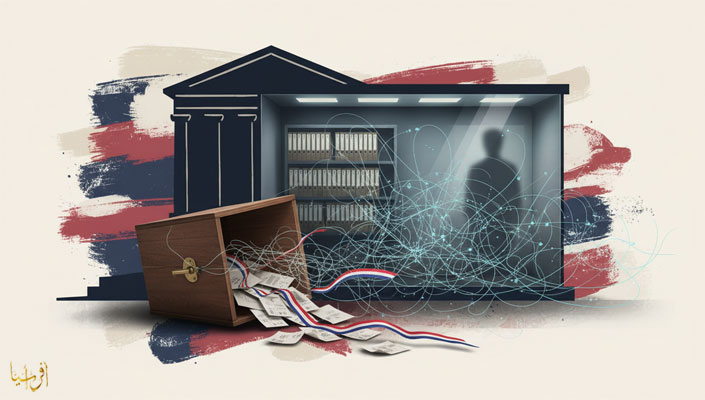
Afrasianet - Mazen Al Najjar - The election results represent a personal rejection of Trump on a scale not expected by the president or his advisers; young voters who supported the "America Great Again" movement abandoned the Republican Party.
The tsunami of the results of the US midterm elections wreaked havoc on Trump's agenda, domestic and foreign policies, and the promises of "America First" and "end America's forever wars" that he made in his presidential campaigns in 2016, 2020, and 2024, promises that formed the thread of his "MAGA" grassroots base, and the king appeared completely naked.
Although he began his election campaigns as the "populist" antithesis of the deep state, corporate interests, lobbies, cartels, and corridors of dark elites, Trump later proved that he was not a politician independent of the rest of the ruling class. During his first term, he threatened some imperial consensus, particularly with regard to NATO and Russia, filled his administration with figures from the ruling establishment, bombed Syria, assassinated Qassem Soleimani, and capitulated to the Israel lobby.
Since his first presidential campaign, he has sold his position and powers to the Zionist billionaires for hundreds of millions of dollars, in exchange for recognizing Jerusalem as the capital of Israel, annexing it to the occupied Syrian Golan, and moving the US embassy to occupied Jerusalem, each step in exchange for known and announced sums of money.
In an interview with former New Jersey Supreme Court justice and constitutional expert Andrew Napolitano on Professor Glenn Dizen's "Greater Eurasia" platform, Napolitano argued that Donald Trump's resounding defeat in the recent election signals the collapse of his "America First" agenda and exposes the deep crisis of American democracy.
While voters have rejected Trump's foreign wars and economic policies, the intelligence services remain unruly, and the military-industrial complex is out of control, perpetuating America's eternal wars and conflicts, making any fundamental change in foreign policy extremely difficult.
Will Trump's defeat reshape U.S. politics?
The election results represent a personal rejection of Trump on a scale not expected by the president or his advisers: Young voters who supported the "America Great Again" movement abandoned the Republican Party, not necessarily because they adopted progressive policies, but because the war on Iran is exhausted and its economic fallout.
Napolitano argues that it will take the Republican Party 15 to 20 years to recover from defeat, and that Democratic control of Congress and his administration will expose Trump and his administration to extensive investigations, as congressional committees can scrutinize the president's and his family's finances, business relationships, and the activities of senior officials. Ministers such as Defense Secretary Pete Higgseth could face impeachment proceedings, however, Trump's own impeachment portends a more serious political confrontation.
Congress can force the government to end the war with Iran; the Democratic majority has a powerful constitutional tool to constrain presidential military operations: control of federal spending.
It can restrict defense appropriations and force U.S. troops and equipment to leave the Middle East. Although Trump will resist these restrictions, continuing military operations without legislative funding would cause serious constitutional difficulties.
Ironically, congressional opposition could provide Trump with a convenient political way out of the war with Iran: he can claim that U.S. forces have achieved an achievement while blaming Democrats for preventing further military operations.
For Napolitano, reaching a negotiated settlement requires Washington to recommit to the memorandum of understanding with Tehran, which has declared that implementing the agreement will allow for the rapid reopening of the Strait of Hormuz.
The judge warns that Benjamin Netanyahu will continue to pressure Trump to resume the war, including allegations — not supported by U.S. intelligence — about Iranian chemical weapons. The danger is that Trump's weakened political position makes him more vulnerable to Netanyahu's pressure and blackmail, rather than more willing to compromise.
Is Washington replacing one war with another?
Democratic control of Congress will not necessarily lead to disciplined U.S. foreign policy and less intervention, and things may move toward reducing military support for Israel and withdrawing U.S. troops from the Middle East, while resuming direct military aid to Ukraine. This arrangement may end one confrontation while escalating another.
Napolitano points out that Russia has little confidence in Trump's diplomatic commitments, and at the same time Washington is seeking trade agreements related to Russian energy imports, while U.S. intelligence is assisting Ukrainian operations against Russia's energy infrastructure.
These contradictions undermine the credibility of U.S. negotiations and show that normal diplomatic relations with Moscow may remain impossible for the current administration.
Why did the "America First" policy fail?
Trump returned to the presidency in 2024 promising to end eternal foreign wars and put U.S. interests above foreign military commitments, but instead, he surrounded himself with neoconservative advisers and officials committed to confrontation with Russia and support for Israel.
Napolitano attributes Trump's reneging on these promises to several reasons: one is his political and financial dependence on major pro-Israel donors and lobbyists, and the other is the influence of his advisers, who constantly promote interventionist policies.
There is also speculation that malicious information related to Trump's past behavior could be used to pressure and blackmail him, although no evidence has emerged.
Whatever the reason, Trump has failed to exercise independent strategic leadership. Vice President J.D. Vance remains an exception in an administration dominated by interventionist ideology, but his political fortunes have been damaged by the Republican Party's electoral defeat.
Central Intelligence Breakdown
Napolitano believes that the deeper problem goes far beyond Trump; U.S. intelligence agencies have developed institutional interests and operational capabilities that allow them to pursue policies with limited presidential oversight.
The Central Intelligence Agency (CIA) was founded to gather and analyze intelligence, but it later expanded to include covert operations, political interference, and paramilitary activities.
Even its founder, President Harry Truman, later — a month after President John F. Kennedy's assassination — criticized this shift. Today, the CIA collaborates closely with British intelligence (MI6) and Israel's Mossad, as it continues its extensive engagement in Ukraine.
Replacing the CIA director will not fundamentally change the organization, because real institutional power lies in the hands of highly experienced and competent officials.
Napolitano asserts that a president seeking real reform needs a thorough knowledge of the intelligence establishment and a willingness to replace multiple levels of senior leadership, but Trump does not have the understanding or the desire to engage in such a confrontation.
Alastair Crook, a former British diplomat and intelligence officer, confirms this trend, noting that the CIA is waging its own wars against Russia, while Washington's foreign policy is increasingly dysfunctional as the intelligence services operate completely independently of the president's goals.
While Trump wants to improve relations with Vladimir Putin and demand that Ukraine stop attacking Russian oil refineries, the CIA continues to facilitate Ukraine's operations against Russia's energy infrastructure. Intelligence independence is supported in part by presidential decrees authorizing covert operations, and previous authorizations remain in effect unless explicitly revoked, giving the intelligence broad operational freedom.
CIA Director John Ratcliffe remains committed to confronting Russia, reflecting a long-standing anti-Russian tradition within the U.S. foreign policy establishment, while Trump's inability to rein in these operations undermines both diplomacy and his efforts to lower America's energy prices.
Vance between the hammer of elections and the anvil of politics
Trump's defeat in the midterm elections represents a personal rejection of his leadership, and reflects discontent with corruption, the state of the economy, and the war on Iran.
Kroc argues that Vice President J.D. Vance understands that restoring Republican support requires a radical change of direction, including accepting Iran's proposed diplomatic settlement, lifting the naval blockade and sanctions, releasing Iranian assets, and recognizing Iran's management of the Strait of Hormuz.
Trump will need to address the high cost of living and reconsider the U.S. intervention in Ukraine. Still, he defends the decision to attack Iran and refuses to rule out another military operation, so the risk of renewed war remains, even as young Republican voters increasingly reject foreign interventions.

