
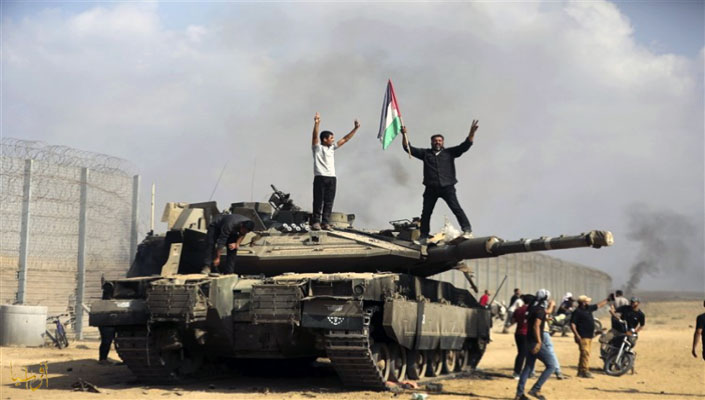
The writer believes that the Palestinian resistance remains, but it must renew its tools in order for the struggle to continue
Afrasianet - Oraib Al Rantawi - The "flood" has not yet ended, and the multi-frontal wars and the dynamics that have spawned from it continue to strike the length and breadth of the region, and the fragments of that history, which began on October 7, 2023, are hitting the world's economies, navigation, supply chains, energy reserves and prices, leaving not a single country spared from the crashing waves.
Whenever the ship of diplomacy and its good offices seemed to be anchored almost on the shore of safety, the threat of war, escalation and bloody confrontation reared its ugly head again.
The region, from the Caspian to the Eastern Mediterranean, is still a moving track for a fierce race between war and peace, and the beating of war drums continues to rise, while the channels of diplomacy seem to be crowded with initiatives and movements. No one knows when, how, and at what "finish line" this race will end, and there is a degree of "urgency" to provide forward-looking answers to future questions, of the kind to which this article is dedicated.
In any case, however, there are rules governing when looking at the question of the future of the Palestinian resistance, which help a lot in charting the parameters of the path and providing a deeper and more accurate understanding of the outcomes and transformations of the Palestinian national project, its political carriers and its tools of struggle.
"After three years of the flood, the Palestinian resistance must return to the people, all the people, and in its various places, without canceling or marginalizing the role of forces and factions, which have always experienced the fields of confrontation with the occupation, in an impressive way, leaving indelible imprints in the collective memory of the Palestinian people"
________________
On the threshold of a new phase
There is a consensus among the various parties at different levels, at different levels, and in all arenas, that what was true before the flood is not the same as after it, and that talking about the new phase in terms of the stages that preceded it, can only be interpreted as a "detachment from reality" and a denial of its data, and that what was true before October 7 is no longer necessarily true after it.
This means, among other things, that the first priority of the Palestinian resistance is to strengthen the steadfastness and steadfastness of the Palestinians on their land.
The resistance here is not an act exclusive to one or several factions, nor is it limited to one of its forms, October 7 was the "peak of its hump", and by that I mean the armed struggle, and the Palestinian resistance in its original (historical) sense, is not an elitist act carried out by factions in the name of and on behalf of the people, nor is it one of its forms, even if the Palestinian narrative surrounds weapons and armed resistance with an aura of sanctity, elevates them to the level of the goal, and even replaced them, after they were merely a means to raise the costs of the occupation and make its departure the least costly option for it.
After three years of the flood, the Palestinian resistance must return to the people, all the people, and in its various places, without canceling or marginalizing the role of forces and factions, which have always experienced the fields of confrontation with the occupation, and in an impressive way, leaving indelible imprints on the collective memory of the Palestinian people, and October 7, the most important and influential of these milestones ever.
In the abstract sense, Israel can overcome a Palestinian faction or a wave of struggle at one stage, and this has happened more than once in the journey of 100 years of conflict, but the conclusions of those successive rounds of wars, uprisings and revolutions have never led to the defeat of the Palestinian people, who have proven time and time again that they are capable of extracting new waves of struggle and inventing new ones in their forms and tools, that they are incapable of uprooting and dissipating, that they are becoming more and more clinging to their identity and entity, and that the fourth generation of the Nakba, its sons and daughters, is the one who raises the flags of resistance today, in the cities and capitals of the West, and in the refugee camps and the diaspora.
He is the one who carried the banners of October 7, is the one who linked around Al-Aqsa and took refuge in the "Lions' Den," formed the brigades and groups in the West Bank, and brought back the cities of the Nakba, which were almost forgotten, from the memory of history, to the heart of politics at the time of the swords of Jerusalem.
We say this not in order to spread illusions or raise morale, especially to the people of Gaza and the West Bank, who are in dire need of them in the battle to confront the genocide, cleansing and displacement, but from the perspective of an objective reading of the current era of the Palestinian-Israeli conflict.
Although Israel has succeeded in imposing scorched land and carpet destruction over a large area of the Gaza Strip, the Palestinian people are still steadfast on the soil of their homeland, and the Palestinian resistance has not raised a white flag, and it is surrounded by a balanced part of its people and the peoples of the nation and their friends in the region and beyond.
"The resistance, as factions, has filled the land and skies of Palestine in the past two or three decades, and it is still a difficult Palestinian number, much heavier than the forces that decided to leave the resistance action, even in its most peaceful forms in Ramallah and the West Bank"
________________
Israel has "excelled" in the practice of extermination, cleansing and destruction, it has eradicated people, trees and stones in large Palestinian areas, and it is still practicing its, permissibility and violations of every custom, logic and morality, but according to the testimonies of those who remain rational among its intellectuals, it fails to "dispense" these "achievements" on the ground into strategic political gains, and that it is still face to face, with its existential questions related to the existence of a Palestinian majority on the land of historic Palestine, and in a way that strikes at both the "Jewishness" of the state and its "democracy".
But it does so after the flood, in very difficult circumstances, it pays a heavy price in terms of its status and narrative, and it finds itself one day after another, in the position of a "political pariah", and its image in the world, which has not reached this bottom since its inception.
The figures of the global public opinion polls about it are now read in the vocabulary of the "national security theory", amid a general fear that it is approaching the moment with which it will turn from a colonial asset to a burden on it, especially after the shifts in American public opinion, including American Jews, and the presence of a majority of two-thirds of Europeans who maintain a "negative" view of it, in contrast to a majority that has begun to accept and adopt the Palestinian narrative.
This is not a detail at all, and we are talking about the future of the resistance of the Palestinians, as this is where one of the most important tools of their struggle and resistance lies in the next strategic stage, and always under the slogan of dismantling fascist Zionism as a form of racial discrimination, as the British Green Party decided, in an unfamiliar historical precedent, especially from Britain, where the idea of a "national home" has moved from a promise to an experiment in implementation.
Those who called on Hamas and its sisters to lay down their arms in the early days of the flood in order to avoid the worst and alleviate the burdens of terror, starvation, displacement and shock, forgot, and most of them forgot, that the Palestinian resistance is a cumulative act, inherited from generation to generation, and that the transfer of its flags, even if it is soaked in blood, is the guarantee to maintain its permanence, and to keep its roots burning in the chests of future generations who will continue to march until the rights are restored and taken away.
It is not possible to talk about the "future of the Palestinian resistance" in isolation from talking about the "future of the Palestinian national project", and the intense need to review and redefine it, and the expansion of the circle of those who call for it, the resistance is one of the constants of the Palestinian people, while its tools, forms and factions fall into the circle of the "variable"
________________
Resistance Remains and Turns
The resistance as factions, which has filled the land and skies of Palestine in the past two or three decades, and it has survived and adapted, and the formulas and tools of its resistance have adapted to it, and despite the painful and destructive blows it has been subjected to, it is still a difficult Palestinian number, much heavier than the forces that decided to leave the resistance action, even in its most peaceful forms in Ramallah and the West Bank.
The resistance here is a political-cultural and social structure, in which its factions overlap with its social base, and although it has witnessed a fluctuation in its popularity, between ups and downs, it will remain incapable of uprooting and dissipating, and that whoever sat for three years, waiting for its demise, has been disappointed, and his arrows have fallen, and that if he had used this time to do useful things, he would have done good for himself and his people.
The resistance as factions does not reduce or reduce the Palestinian people, as the people are larger than its scattered and combined factions, and its vital pluralism accommodates other forces and emerging currents, and in this let the competitors compete, but those who have considered integration and coordination of roles (even in terms of security with the occupation) have no right to adopt a "zero option" in their relations with the resistance factions, and the result will never be in their favor, if they "ride their heads", meaning that they face stubbornness in managing their relations with their allies and sponsors on the one hand, while their circles of support on the national scene are declining and shrinking on the other hand.
It is not possible to talk about the "future of the Palestinian resistance" in isolation from talking about the "future of the Palestinian national project", and the intense need to review and redefine it, and the expansion of the circle of those who call for it.
The factions and forces that are most aware of the nature of change and the titles of the new phase, and are the most able to adapt to it, and adapt their actions and tools accordingly, are the forces and factions that are most qualified to cross the new stage.
The resistance, forces and factions, are called upon today, as they search for answers to the questions of the future, to choose from their tools what the Palestinian people can tolerate and accept from their toolbox. The "engineering" of the resistance and its tools must be based on raising the cost of the occupation on the enemy and enabling its people to remain steadfast and steadfast on their land.
This engineering also assumes that the Palestinian resistance is not alone in the field, that there are armies and legions in various arenas and across the five continents that are fighting with it, and that there is a "Jewish legion" that has become involved as never before, in the fields of confrontation with apartheid, genocide and fascism.
In fact, there is a growing awareness among the Palestinian people of the need to renew the resistance, the national movement, and the Palestinian political system, and that this realization extends to balanced national and Islamic factions, and that in-depth dialogues have recently taken place with some of their most prominent leaders, revealing a deep understanding of the "jurisprudence of priorities" and the titles and necessities of the stage, which allows optimism that a rehabilitation process is underway to reach the thresholds of the new strategic stage, even if tomorrow is imminent.
________________

