
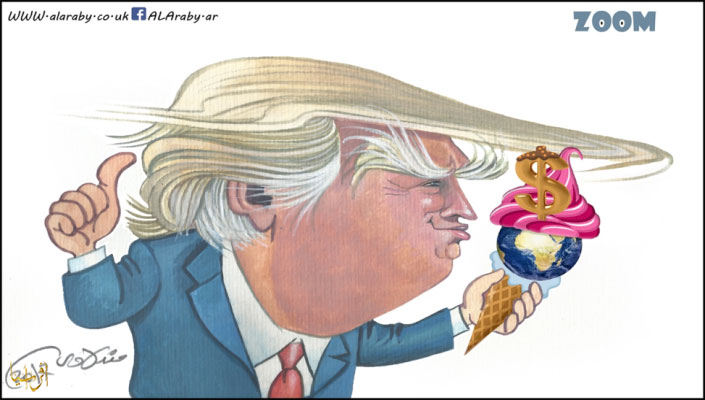
About Trump's Trust
Politico: Loyalty and personal trust trump experience and independence in the Trump administration
Afrasianet - U.S. reports and analysis are tracking a shift in U.S. President Donald Trump's government during his second term, as it appears to be more attached to the president's persona, with loyalty, trust trumping experience and independence at some of its highest levels.
Based on interviews with dozens of current and former administration officials, Politico reveals that Trump has surrounded himself with a circle of officials with whom he has accumulated close ties over the years, at a time when proximity to the president does not necessarily mean greater influence, as ministers may be surprised by decisions that affect their files or assign them tasks that are far from their competence.
In a New York Times op-ed, author Molly Jung-Fast argues that this environment has fostered a culture of pleasing the president within his own circle, amid competition to show support for him and attempts to dissuade him from his decisions.
Between the criteria for selecting officials, the limits of their authority, and the way decisions are made, the two articles paint a close-up of how the Trump administration is run from within.
Loyalty is a criterion for choice
Jung-Fast argues that the selection of members of the Trump administration did not focus on the most qualified for the job, as the president reportedly watched clips of the candidates' appearances on television channels, while the focus was on who could impress him the most.
Once a member of the government is appointed, she says, the most important thing is to continue to tell the president what he wants to hear, or to say what he likes on television rather than to give sound advice that serves the country.
Politico provides a broader picture of this shift, explaining that while Trump's first term began with an ambition to build his administration along a corporate model, where specialists are looking for the strongest resumes for senior positions, his second term is closer to a "family business," with a small circle of trusted and believing figures chosen for their closeness and loyalty to him than their objective qualifications.
This is reflected in the selection of Education Secretary Linda McMahon, who received a call from Trump after he won a second term offering her the job, even though she told him she did not work in education.
The report argues that the president was not looking for someone with educational qualifications, but rather a business leader who would achieve a "return on investment" at the Ministry of Education.
Agriculture Secretary Brooke Rollins studied agricultural development at Texas A &M University, but it was her record of loyalty to the president and his political agenda that made her choice for a second term "almost decisive," with a senior Trump administration official quoting Rollins as saying that Rollins was "willing to take risks and put her reputation on the line for Trump."
The report notes that Trump's transition team has prioritized candidates who support the president's decisions and agenda, and who have a political relationship with him, in an effort to avoid the traditional establishment figures that troubled him in his first term.
The loyalty test did not stop with the ministers themselves, with a number of them requesting trusted staffers to work with during the selection process, but the White House Office of Presidential Personnel rejected some of the names they provided, including media advisers and former campaign staffers, as they were not sufficiently loyal to the MAGA movement.
Ministers under the President
"If you bring a problem to the president, and it's not entirely within your purview, and it's not really within the purview of anybody else, then that problem becomes your responsibility," Homeland Security Secretary Marqueen Mullin said, adding that Trump listens to the official and then says, "Okay, go fix it."
Many members of the government seem willing to relinquish some of their power in exchange for closeness to the president, while those who have succeeded in their roles treat themselves as advisers rather than independent policymakers, and may sometimes wait for Trump's social media posts to find out where he stands.
A former secretary of the first Trump administration summed up this relationship by saying, "The most important lesson for a member of the government is that you are an employee, not an independent decision-maker."
While Trump's current ministers have a personal closeness to the president that many of their predecessors lacked, and as a result are more involved in the day-to-day work of government, some have become less influential than former ministers who complained about their constant removal from the Oval Office.
White House officials and members of the government are vying to show their support for the president, to the point where she called it an "Olympics of flattery," the New York Times writer said, adding that members of his inner circle do not miss an opportunity to praise him during televised government meetings.
The article quotes a report by Axios that those around Trump are no longer trying to dissuade him from making his decisions, explaining that Trump does not want to hear dissenting opinions, which has become clear in the way he manages it.
Centralization of Decision
The centrality of the decision about Trump is directly reflected in the work of ministers and agency heads, who in recent months have found themselves facing decisions they were not aware of, the president overstepping their positions, or having to rush to implement his decisions on some of the most sensitive files within their area of responsibility.
Politico quotes a former senior Trump administration official as saying that what governs the administration is "a figure with very strong central authority, everyone is trying to stay in his circle of satisfaction and keep him happy on a personal level," likening Trump to a "strong king" surrounded by "weak" personalities who need to constantly turn to him before doing anything.
With his phone number and direct access to him, the door remains open to lawmakers, donors, journalists, old friends, and businessmen seeking to influence his opinion, sometimes diminishing the influence of officials legally tasked with implementing policies in their areas of competence.
The overlapping roles extend to the ministers themselves, many of whom are now taking on tasks that are far removed from what was expected when their appointment was confirmed by the Senate.
The website highlights the case of Secretary of State Marco Rubio , who combines his position with that of acting national security adviser, along with responsibilities related to the U.S. Agency for International Development and the National Archives.
A senior administration official believes that this environment has turned most members of the government into people who are close to the president, saying, "Everybody wants to keep their job, and those who have not had a previous relationship with the president do not have the ability to tell the truth to him."
________________
Source: Politico + The New York Times

