
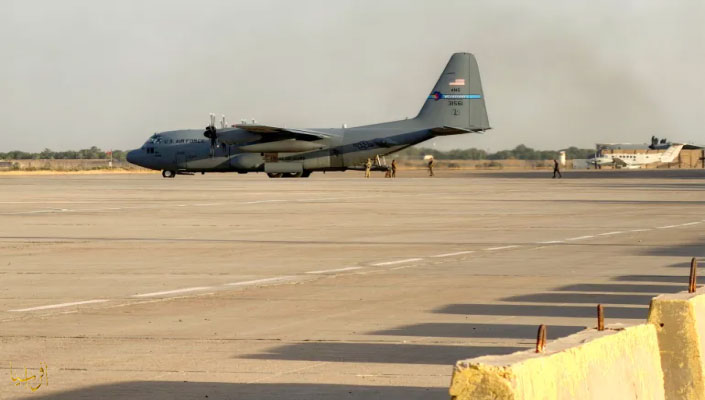
A U.S. military transport plane prepares to take off from Victoria Base near Baghdad International Airport, September 29, 2026 (French)
Afrasianet - Oraib Al Rantawi - As soon as US President Donald Trump announced the withdrawal of the last American soldier from Erbil Air Base, and the end of Operation "Hard Determination" that Washington began at the head of an international coalition in 2014, a balanced group of Iraqis took to the streets to celebrate the restoration of "sovereignty", and these celebrations gained more momentum, given that they coincided with the celebrations of the "First Independence Day" in 1932, as if Iraq had two independence holidays instead of one, like the rest of the peoples and countries of the world.
In contrast to this team (the majority) that viewed the American withdrawal as a historic day, its presenter has always been hasty, there is another group and other Iraqi components that have not looked at the issue from the same perspective, and have always encouraged the Americans to stay, and criticized their government's haste and haste to withdraw, and even looked at the withdrawal with mixed feelings of anxiety, a sense of abandonment, and fear of unknowns that will be inherent in the coming days and years, and a story that we will go through in the context of this article.
The US announcement of the withdrawal and the Iraqi celebration of the "restoration of sovereignty" raises a number of major questions for Iraq and its neighbors, as the story did not end on September 30, so what are the implications of the US decision and its effects on the equations at home and abroad?
What about the question of "stability" that is more important than the questions of "sovereignty", and what are the challenges that Baghdad will face in its new phase?
"Iraq has not yet regained direct control over its oil resources, and its revenues, which are the backbone of the Iraqi economy (approximately 90% of the state's operational and investment budget), are still deposited directly into the accounts of the Federal Reserve in New York"
________________
From the Pentagon to the Treasury
There is no doubt that September 30, 2026, will enter its modern history as a historic day and a milestone in its internal and external dimensions, and that Iraq and its prime minister in particular can celebrate the restoration of sovereignty, even if it is within symbolic and legal limits.
The American presence in Iraq, which seemed decisive in its importance and played a very important role in the war against the "Islamic State-Daesh", caused internal divisions that deepened and conflicts with a nearby neighbor, which was seen as a source of threat and a continuation of the "encirclement" and "siege" episodes beaten by the United States and the "West" around Iran.
In this sense, Iraqis have the right to celebrate "Sovereignty Day", at least in this interval between a past era and another that is knocking on doors, although an urgent question still hovers in the skies of the various Iraqi elites: is the era of American influence in the country over, will the Iraqis be able to exercise "sovereignty", has the "American sword been lifted from their necks", or has this sword changed its shape and methods of operation?
Here we open brackets to point out four of the tools of economic and financial domination, which will transfer the sword of authoritarianism from the hands of the Pentagon and a few thousand of its soldiers deployed in Iraq, to the hands of the American "treasury" with its soft and coarse tools:
• First, Iraq has not yet regained direct control over its oil resources, and its revenues, which represent the backbone of the Iraqi economy (approximately 90% of the state's operational and investment budget), are still deposited directly into the accounts of the Federal Reserve in New York.
This financial "dictate" that has been ongoing since the invasion in 2003 gives Washington the authority and ability to control cash flows and delay transfers when needed, thus putting any government in Baghdad in front of a scenario of not being able to pay its employees without American approval.
• Second, Washington has tightened its close control over the Iraqi banking sector through strict electronic platforms to ensure financial compliance, and the Federal Reserve and the Treasury are now able to restrict dollar cash shipments destined to the Central Bank of Iraq under the pretext of combating smuggling and preventing their access to entities and countries subject to US sanctions (Iran). In summary, the Iraqi "money tap" is still, and will remain for an indefinite period, in Washington's hands.
• Third, the sanctions system on banks and political and military figures has proven to be a heavy stick that is raised in the face of those who "crack the stick of obedience," and that it has often succeeded in "turning the sharp corners" of the positions of parties, groups, and personalities, which are expediently linked to the SWIFT regime.
• The fourth is to move out of the world of money and money to the energy spaces, where Iraq is at the mercy of the "periodic exceptions" granted to it by Washington to allow it to import gas and electricity from Iran to fill a chronic shortage of electricity.
"The insistence of one of the factions on the equation of "the weapon of resistance versus the weapon of the Peshmerga" may lead to the breeding of civil conflicts between two main components, as the Kurdish team is unanimous on the "constitutionality" of the Peshmerga, while the factions challenge the matter, and the Kurds view the targeting of the weapons of their fighters as a "coup" against the federal"
________________
The United States uses these exemptions as a bargaining chip and pressure to extract concessions in security and political files or to achieve profits for its companies, and any American decision to stop these exceptions may plunge Iraqi cities into darkness, and may generate popular anger that reproduces the "2019 uprising", perhaps more broadly, and inevitably affects Iraq's credit rating , the global investment environment, and the desire of international companies to enter the local market.
In addition to all of the above, and despite the transition of the US-Iraq relationship from the "international coalition" to a "bilateral strategic framework", Washington has maintained significant security and intelligence assets, whether in the name of "bilateral cooperation" or for the purpose of protecting its diplomats and its largest embassy in the world.
Thus, the US-Iranian conflict in Iraq is about to change its tools without its results being decided, and while Iran, through its allies, can advance to fill the vacuums left by Washington in the Iraqi space, it will continue to face the latter's influence and dominant influence until further notice.
From Restoring "Sovereignty" to Maintaining Stability
We will not spoil the joy of the restoration of "sovereignty" for Iraqis, and we will not argue for a long time about the "history" of the day witnessed on September 30. But the challenges facing the state and society continue to haunt Iraqis and their friends in the world, especially in the countries of the near and distant neighborhood.
Here, there is a striking consensus, among Shiite entities within or outside the Coordination Framework, "especially the Sadrists", to welcome and celebrate what happened, but it is a consensus that hides further and deeper divisions between these parties, and their leaders in particular.
The five main factions within the framework of the so-called "Islamic Resistance" refuse to obey the decision of the "exclusivity of arms", and they do not view the extended deadline until next June as an end or a holy date, and they are still looking for excuses and justifications to keep their weapons, and perhaps God willing.
It promotes the theory of "complementarity of roles between an ideological army parallel to the national army," and magnifies Iran's experience in combining the army and the IRGC, and for this purpose, invokes a number of fears (some see them as scarecrows) of the kind: that Washington has not completely withdrawn, that it is redeploying its forces close to Iraq's borders, that the "Israeli factor" may act at any moment, and that the "Islamic State" may rears its ugly head again.
She adds that there is an army parallel to the National Army in northern Iraq, and that the Peshmerga is nothing but a "militia" that represents a military arm independent of the state, which follows the two main Kurdish parties and commands their orders, and that its recent unification under the umbrella of the "Ministry of Peshmerga" does not give it a different constitutional status from the Popular Mobilization Forces, which has been "codified" as part of the "legitimacy" of the commander-in-chief, and that although it retains another "mission" mission that distinguishes it from the Hashd: the resistance, it is part of it, and it does not have to approach its weapons.
More than five months have passed since Ali al-Zaidi was tasked with forming the government, without succeeding in filling its remaining nine vacancies, due to divisions and power struggles, mainly within the Shiite spectrum of the "Coordination Framework", and with other components and entities, Iraqis have doubts about the ability of this government to survive and continue, despite the great American and international support for it, and despite its support from a significant segment of Iraqis themselves.
"Despite the transition of the US-Iraq relationship from the square of the "international coalition" to a "bilateral strategic framework", Washington has maintained significant security and intelligence assets, whether in the name of "bilateral cooperation", or for the purpose of protecting its diplomats and its largest embassy in the world"
________________
Adherence to the slogan of "one law, one state, one weapon," and the ability to translate it, without gambling on igniting a "civil war," limited to one component or extended to other components, is the biggest challenge facing Iraq after the restoration of "sovereignty" and in order to promote stability.
Since the outbreak of the October uprising (in 2019) in particular, it seemed that the Shiite political entities are living in a state of discord and separation, which will be exacerbated if the government continues to translate the "exclusivity of arms" project by force, and if the "Islamic Resistance" factions continue to reject and challenge the state's decision.
Moreover, the insistence of a group of factions on the equation of "the weapon of resistance versus the weapon of the Peshmerga" may lead to the breeding of civil conflicts between two main components, as the Kurdish team unanimously agrees on the "constitutionality" of the Peshmerga, while the factions challenge the matter, and the Kurds view the targeting of the weapons of their fighters, as a "coup" against the federal constitution of Iraq in 2005, and an attempt to dismantle the region and reconnect its provinces to the center, in a turn back nearly a quarter of a century of the clock.
The Sunni component has fears that parties will continue to carry weapons, many of which are heavy, for the Shiites "Hashd" and their factions heavily armed and ideological, and for the Kurds their tried and armed "Peshmerga", and they alone do not have an armed Dahir, and that most of what they were allowed to do was not go beyond local and tribal formations affiliated with the Popular Mobilization Forces, and there are no ones among them who demand the formation of a military arm for fear of accusations of "terrorism" and "calling the Islamic State", which exacerbates the anxiety about the unknowns of the future.
After the U.S. military vacuum, Sunni parties seek to fill it by strengthening their relations with their Arab neighbor or Turkey, and relying on a "regional backer" in the absence of a local backer.
But Turkey, in turn, will leave Iraq within two months or two, and will dismantle its base in the Bashiqa camp according to the New York understandings between Zaidi and Erdogan, and Ankara already maintains the closest ties with Erbil and Baghdad, which leaves many questions in the minds of the leaders of this Iraqi team.
How the Iraqi leadership will send messages of reassurance to all its citizens, entities and components, is the most prominent challenge that Iraq will face in the "second independence" phase, in addition to another, no less serious challenge, which is mainly related to the core of the economic, financial and social crisis that is plaguing Iraq, especially in the climate of the war on Iran and its repercussions, and how the Iraqi government will manage its internal balances and foreign relations.
As for the scenario of the "return of ISIS", although its chances and possibilities have declined, it is still rearing its head from the extended Syrian-Iraqi valleys, and it is fed by "grievances", and the conclusion is that the recovery process of Iraq is still long and thorny, and that the restoration of sovereignty, or some of it, is still without obstacles and challenges of maintaining stability.
________________

