
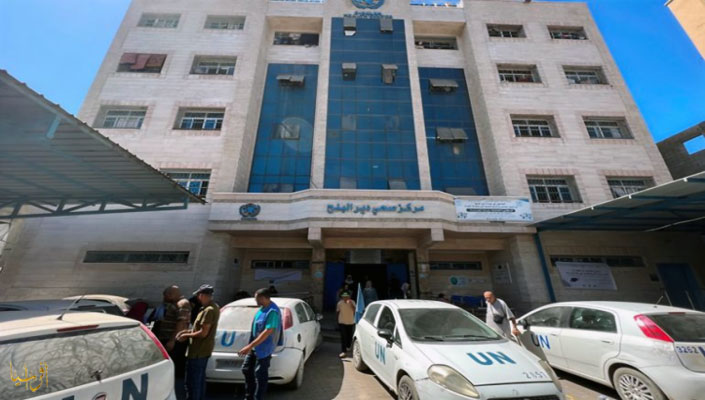
UNRWA clinic in Deir al-Balah camp provides health services to large numbers of residents and displaced people
Afrasianet - Mahmoud Al Hanafi - The debate over UNRWA is no longer limited to its funding or the performance of some of its staff, but has reached the point of trying to exclude it from Gaza's future. Does the Peace Council have the power to evaluate an agency established by the UN General Assembly or to suspend its mandate granted by Resolution 302?
The article attempts to answer these questions, distinguishing between what cannot be done legally and what may be enforced in practice.
UNRWA exclusion.. Humanitarian assessment or political decision?
On 25 September 2026, the Peace Council announced its position on the participation of the United Nations Relief and Works Agency for Palestine Refugees (UNRWA) in its arrangements for the Gaza Strip. This position came after the Council presented, on the sidelines of the United Nations General Assembly meetings in New York, a recovery and reconstruction plan that included 66 projects, with a proposed value of about $2.4 billion. Despite the inclusion of a number of UN agencies as partners in the plan, UNRWA was absent from this list.
This position reveals that the Peace Council did not assess UNRWA on the basis of an independent humanitarian review, but rather tied its eligibility to two concepts it unilaterally identified: "trust" and "contribute to the de-radicalization of Gaza," and then decided that it would not pass without publishing the evidence on which it was based.
The concept of "trust," if not accompanied by clear criteria and verifiable facts, becomes a political subjective judgment. Linking humanitarian action to making Gaza "free of extremism" shifts agencies' assessment from the humanitarian to the political and security sphere. UNRWA's mission is to provide education, health and relief to refugees, not to implement a security project or reshape population attitudes.
"The Peace Council published a statement on its official account in which it confirmed that its policy towards UNRWA's participation in Gaza "has not changed", adding: "We will only work with trusted partners who provide services to the people of Gaza and contribute to making the Gaza Strip free of extremism, and UNRWA does not pass these two tests."
________________
The council's position also confuses allegations of a limited number of employees with sentencing the entire organization. Even if individual wrongdoing is proven, justice requires that the perpetrators be held accountable, not that some 30,000 employees and millions of refugees are held responsible.
The problem is not whether or not the Council uses the word "criteria," but rather gives it the authority to evaluate and exclude a UN agency according to its own development, interpretation, and application, even though UNRWA's mandate is issued by the General Assembly and not a grant from the Peace Council.
The situation therefore appears to be not merely an administrative choice for reconstruction partners, but rather a step towards subjecting humanitarian work to political and security conditions that may be used to dismantle UNRWA, while retaining its services and staff after they have been separated from the Agency's name and international mandate.
Who has the power to terminate UNRWA's mandate? What are the limits of the Peace Council's authority?
UNRWA was established by United Nations General Assembly Resolution 302 (1949), in response to the mass displacement of Palestinians in 1948 by Zionist gangs, and to provide relief, education, health, social services and employment opportunities to refugees.
More than 7 decades later, the Agency has become a broad humanitarian organization with a field and administrative structure and accumulated experience that cannot be reduced to the distribution of food aid.
Legally, UNRWA is a subsidiary organ established by the General Assembly, and its mandate derives from its successive resolutions. This mandate was renewed by the General Assembly in December 2025 until 30 June 2029 by a majority of 151 States, reflecting continued international legal and political support for its work.
The General Assembly, as the body that established UNRWA and established its mandate, has the original power to amend or terminate this mandate. UNSCR 2803 does not contain any provision giving the Peace Council the authority to replace the General Assembly or revoke the Agency's mandate.
The Peace Council is not a principal or subsidiary organ of the United Nations in the usual institutional sense, but rather a transitional administration with an international legal personality, the establishment of which the Security Council welcomed and granted, by resolution 2803 of 2025, temporary roles related to the administration and reconstruction of Gaza and the coordination of certain security arrangements.
The Council therefore does not stand in a higher rank than UNRWA, and does not have the authority to legally supervise, modify or terminate its mandate.
The recognition of its role by the Security Council does not turn it into an authority over the United Nations system, nor does it grant it competencies that are not included in the resolution. Within the limits of its mandate, the Council can choose with whom it cooperates in the implementation of its projects, but it cannot turn non-cooperation with UNRWA into a legal provision that nullifies its mandate or legitimacy.
There is no necessary conflict between the mandate of the Peace Council and UNRWA; the Council is tasked with transitional arrangements linked to Gaza, while the Agency serves Palestinian refugees, and could have built on its expertise and capacity rather than excluded it. The danger, however, lies in the difference between legal status and practice: UNRWA may remain legally existent, while being denied access to the population, excluded from reconstruction plans, or deprived of the necessary funding, coordination and authorization, and becoming an institution with a mandate that cannot implement it.
This is the true meaning of emptying the mandate: not abolishing UNRWA by direct legal decision, but disrupting its ability to function, and then using the resulting inability to do so as an excuse to say that it is no longer necessary or effective.
"The danger lies in the difference between the legal situation and the practical reality: UNRWA may remain legally existent, while it is denied access to the population, excluded from reconstruction plans, or deprived of the necessary funding, coordination and licenses, turning into an institution that owns the mandate and cannot implement it"
________________
So, who sets the standards and who monitors whom?
Saying that UNRWA does not pass the "tests" set by the Peace Council opens more questions than it provides answers: What indicators are used to measure trust? Are they humanitarian, security or political? Have they been deployed in advance? Have they been applied equally to all organizations? Who conducted the assessment? What are the guarantees of its independence and transparency? Has the Agency been granted the right to respond to allegations against it?
It is not legally and institutionally permissible to judge a UN agency in such a serious way as "lack of trust" or "failure to test." A serious assessment requires specific facts, an independent investigation, stated standards, clear responsibility for wrongdoing, and the right of the agency and the staff concerned to respond and defend themselves.
UNRWA is not above criticism or accountability. Any violation found against one of its staff members must be investigated and appropriate disciplinary or punitive measures taken. However, responsibility in law is individual and personal, and cannot be automatically transferred to the rest of the staff or to the entire organization, as well as to the millions of refugees who depend on its services.
The paradox becomes even more apparent when UNRWA, which has been operating for more than seven decades under the auspices of the General Assembly, donor countries and UN oversight bodies, is assessed by a newly formed council whose standards, transparency and accountability mechanisms remain in question. Legitimacy is not measured by political influence, but by clarity of competence, transparency of procedures, and the auditability and accountability of decisions.
What kind of justice punishes millions of refugees?
Some of the violations attributed to UNRWA staff were related to admiration, comment or publication in which, under the conditions of occupation, war and national affiliation, they expressed positions that may require review in accordance with the rules of neutrality, but do not make the Agency an institution that spreads extremism. Ironically, more than 390 UNRWA staff members have been killed during Israeli military operations in Gaza and its facilities have been destroyed, without these incidents so far leading to international accountability commensurate with their gravity.
Even if individual wrongdoing is proven, they should not extend to refugees and Agency staff in Gaza, or become a precedent for some 6 million refugees and nearly 30,000 staff in the five areas of operation. Justice holds those found responsible accountable, and does not demolish an entire institution or deprive a child of education, a sick person from treatment, and a family from relief.
"UNRWA does not only provide food parcels; it runs schools, clinics, relief and social services programmes, maintains extensive records of refugees, and is staffed by staff from the communities it serves and understands their needs and lives. Its mandate covers approximately 5.9 million Palestine refugees in its five areas of operation"
________________
In practice, is there a real alternative to UNRWA in Gaza?
Currently, there is no international or local organization that alone owns UNRWA's staff, educational and health facilities, refugee databases, distribution networks, community expertise, and capacity to operate broadly and continuously inside Gaza.
Agencies such as the World Food Programme (WFP), UNICEF, the World Health Organization (WHO) and the Office for the Coordination of Humanitarian Affairs (OCHA), along with the International Committee of the Red Cross (ICRC) and non-governmental organizations, can perform important tasks within their areas of competence. But they do not have UNRWA's overall mandate or human and field architecture. They can collaborate with it and complement its work, but integration is one thing and replacement is another.
UNRWA does not only provide food parcels; it runs schools, clinics, relief programmes and social services, maintains extensive records of refugees, and is staffed by staff from the communities it serves and understands their needs and lives. Its mandate covers approximately 5.9 million Palestine refugees in its five areas of operation.
Even if their functions are distributed to a number of organizations, it can lead to fragmentation of services, high costs, multi-reference, loss of accountability, and gaps between the health, education, relief and protection sectors.
The new entities may have to recruit UNRWA staff themselves and use its facilities, data and expertise. We are then faced with replacing the name of the institution and its legal framework, not creating real alternative capacity.
The vacuum that other organizations will not be able to fill will not be just an administrative dysfunction, but will affect basic rights to food, health, education, housing and a decent life, in a region whose infrastructure has been extensively destroyed and most of whose population has become dependent on aid.
What is the political purpose of the exclusion of UNRWA?
UNRWA is an international witness to their continued displacement and the absence of a just solution to their cause. Replacing them with public aid organizations could turn refugees from rights holders, foremost among them the right of return, into mere populations in need of services, and separate the reconstruction of Gaza from the roots of the Palestinian cause. Terminating the Agency does not legally eliminate the right of return, but it does remove one of the most prominent international institutional evidence of its survival.
The exclusion of UNRWA from Gaza could create a political precedent of giving temporary actors or individual states the effective ability to disrupt a UN mandate without recourse to the General Assembly. This could encourage a repeat of the experience in other areas under headings such as "restructuring," "upskilling or selecting reliable partners."
________________
What about other areas of UNRWA operations?
UNRWA operates in five areas: Gaza, the West Bank including East Jerusalem, Jordan, Lebanon and Syria. Its exclusion from Gaza alone does not end its territorial mandate, but it sets a dangerous precedent that could be replicated in its other four areas of operation.
If the principle that a transitional body can exclude the Agency from one of its areas of operation without a General Assembly resolution is accepted, it may use the same pretext in the future to pressure it in Jerusalem and the West Bank, or to reduce funding for refugee services in Lebanon, Syria, and Jordan.
The weakening of the Agency in Gaza will also affect its budget, staff, donor confidence and the stability of its regional programmes. UNRWA is a single institution, and the collapse of its largest arena cannot be isolated from its ability to continue in its other areas of operation.
The exclusion of UNRWA from Gaza could also create a political precedent of giving interim actors or individual states the effective ability to disrupt a UN mandate without reference to the General Assembly. This could encourage a repeat of the experiment in other areas under headings such as "restructuring," "upskilling or selecting reliable partners."
Legally, it can't. But in practice, it can happen.
The Peace Council cannot abolish UNRWA or terminate its mandate, nor can it replace the General Assembly or amend Resolution 302. Nor does its mandate in Gaza give it the authority to make a final judgment on the legitimacy of another UN agency.
But what cannot be legally accomplished may be attempted in practice, by denying access, excluding them from reconstruction plans, transferring funds to other parties, and seizing jobs, facilities, and employees without retaining the institution and its mandate.
This is the real danger: UNRWA is not abolished by an explicit decision that can be challenged and confronted, but gradually depleted until it is unable to function, and then its artificial weakness is used as an excuse to end it.
The Peace Council may be able to close a door to UNRWA or impede its movement, but it cannot by political resolution erase an international mandate, overturn the rights of millions of refugees, or cancel the case that the Agency existed because of its continuity.
________________
Mahmoud Al Hanafi - A university professor and an expert in international humanitarian law. He is the Director of the Palestinian Foundation for Human Rights (Shahed), and has distinguished publications and research on human rights issues and the Palestinian cause. He has participated in international conferences, and provides training in the fields of legal protection and international human rights mechanisms.

