
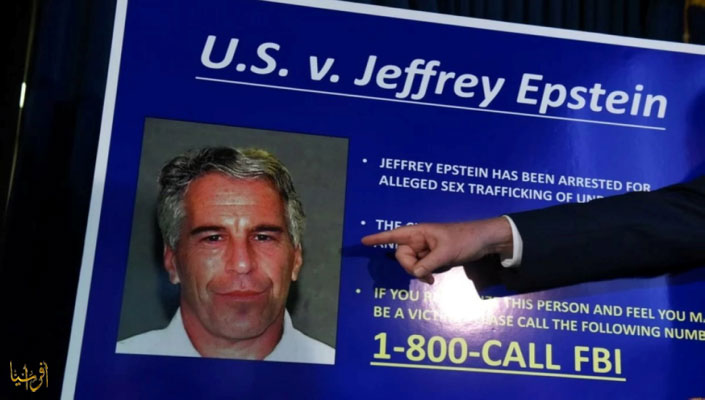
Modern Epsteinism!!
Afrasianet - Hassan Falaha - What if U.S. President Donald Trump thought he was completing the role of Abram (who, according to Genesis, was given a new name, Abraham), or impersonating him on the world stage?
The Marquis is an exclusive French designation, meaning "lord of the borders", which was preceded by only a handful of nobles of power, rule and power, the most prominent of whom was the indisputable Donatien-Alphonse-François, Comte de Sade, the Marquis, the writer and intellectual, the rebel against religions and their restrictions, and the escape from social and civilizational controls.
From the name of this marquis derives the word "sadism", apparently the precursor to the modern "Epstein" movement, to which Geoffrey Epstein preached in the manner of his predecessor, the Majen du Sade, at the castle of Saint-Martin, at the end of the nineteenth century, before settling in the Bastille prison in 1884, and being resentful of Napoleon Bonaparte and his folly for his flight escape from all social or moral considerations prevailing in the time of hyper-social industrialization in Paris.
This evasion is shown in Justine, ou les malheurs de la Vertu (Justine, ou les malheurs de la Vertu), which the courts of the French emperor, who is preoccupied with the country and his wife with his foreign campaigns and the whims of dominating the world's fronts, as the "forbidden book", or at least as the problematic text that weaves the bonds and knots in the suspicious relationship between the body, pain and power.
In this book, Du Sade came to the conclusion that evil is the source of human activity, and he did not hesitate to uphold this in his novel "One Hundred and Twenty Days in Sodom or the School of Dissolution" (Les 120 Journées de Sodome ou l'école du libertinage).
In the remainder of the novel, Du Sade writes about his sadistic exploits and actions derived from the days of Sodom, in a practical restoration of nature's circulation of its grave milestones. He may be too treacherous, or unpretentious, to avoid tolerating the dispossession of the human personality between the human wildness toward lust and the social exaggeration of controls.
History may relive its first impression of Trump, who asks for property for him alone, and gives souls and redeems them on the altar of Abram
He collected the scenes of Sodom and the roles of the castle of St. Martin, and he imagined the noise and eternal silence of the sinful city, the city of pleasures and lusts, the Italian city of Pompeii, that miserable city rediscovered in the last century, and whose inhabitants were found dead in the same state they were, and in the same form, and they appeared fossilized corpses covered with a thick layer of volcanic dust, which had been blown out by the volcano of Mount Vesuvius nearly two thousand years ago.
The historical plot is based on the loom of social events, and with the same threads, with the different years and their distance!
Sodom and its neighbor Gomorrah are the two prominent villages among the cities mentioned in the three Abrahamic religions, or so I returned, where the king of Sodom said to Abram, "Give me souls, but take the possessions for yourself."
History may relive its origins in Trump's time, asking for property for him alone, giving and redeeming souls on the altar of Abram. He visited the Temple of Poseidon, the building marked by its horizontal blue stripes and golden dome, on Epstein Island, where he deliberately printed the lines of the "blue flag" on its walls, and re-enacted the scenes and incidents of Fort St. Martin and the pornographic narratives of Sodom on his island, Little St. James, located in the middle of the American Virgin Islands archipelago in the Caribbean Sea.
So, what do the American Trump and the Greek "Poseidon" have in common?
Ironically, the Roman military commander Pliny the Great, who commanded a fleet of warships, died in an attempt to defy the might of the volcano of Vesuvius in order to save some of its ability from being buried and submerged.
Traditional Greek mythology considered Poseidon to be an immortal god who does not die, but rules the oceans and earthquakes forever, and modern narratives speak of those who roam the oceans and seas from aircraft carriers and battleships, invoking their ancestors with their names lying on them, thinking that he is volunteering the world on the path of moral lawlessness, or as if he is rearranging his name among the names of the kings who ruled the earth, from Dhu al-Qarnayn and Solomon to Nimrod bin Canaan and Nebuchadnezzar.
He may return to the rediscovery and domestication of America, and this country may shun him before he is frequented by the forgotten natives, or the wandering immigrants, if he once misses the words of Cyrus the Great, the great king of Persia: "The Lord, the God of heaven, has given me all the kingdoms of the earth, and commanded me to build him a house in Jerusalem."
But he will remain self-centered, contemplating himself above the surface of the waters in the seas and oceans from the cauldron of a sinful empire, killed for pleasure, oppression and domination, with no mercy between them or in them.
It is remarkable that Pompey was silent as "the source of all pleasures" without killing, conquest or captivity, and the irony is that the Roman military commander Pliny the Great, who commanded a fleet of warships, died in an attempt to defy the might of Vesuvius in order to save some of his power from the burial and submergence. He was killed by the lava and dust of Vesuvius, like those who died in the pleasure chambers haunted by eternal death in the hustle and bustle of life. "Epstein's Rooms"
________________
Hassan Falaha - Director General of the Lebanese Ministry of Information.

