
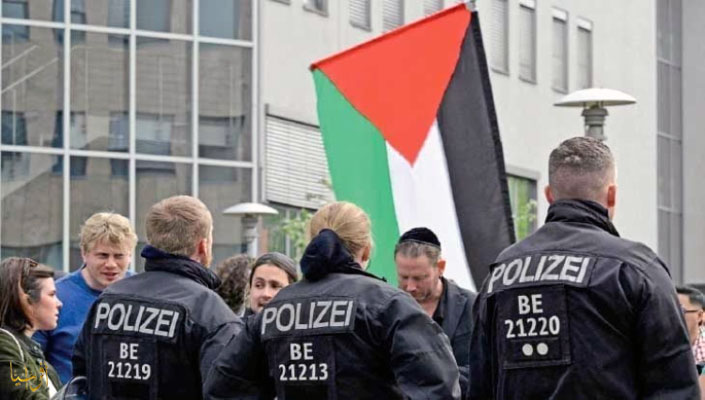
Afrasianet - The trial of five Palestinian solidarity activists in the German city of Stuttgart, which has entered its final phase, is sparking controversy over the German authorities' handling of political protests, amid accusations by human rights organizations and defenders of the defendants that the measures taken against them violate human rights and restrict freedom of expression.
In an article published by Common Dreams on Friday, writer and academic C.J. Polychronio said that in his view, the trial of the five activists reveals a growing hardening of the German authorities' handling of protests and solidarity with Palestine, linking it to what he described as Germany's "collusion" with Israel in the war on the Gaza Strip.
The case dates back to the early hours of September 8, 2025, when five activists in solidarity with Palestinians entered the branch of the Israeli arms manufacturing company Elbit Systems in the southern German city of Ulm. According to the article, the activists smashed windows, damaged furniture and technical equipment, and wrote slogans on the walls, including "Free Palestine," "Germany is funding, Israel is bombing."
No one was injured during the incident, while activists remained at the scene and called the police themselves and waited for their arrest.
Daniel Tatlow-Devalli, an Irish citizen, Leandra Rollo, a Spanish-Argentine citizen, Crotrix and Zo Hailo, two British citizens, and V. Kvarbachic, a German citizen, are being tried in the case.
Since their arrest, the five defendants have been held in separate prisons and under conditions he described as "extremely degrading", Polichronio said, noting that they were subjected to conditions of solitary confinement for up to 23 hours a day, with short and limited family visits. Irish politicians who visited Tatlow-Devly in prison were quoted as saying they were shocked by what they saw.
The activists are being tried in the high-security Stuttgart-Stammheim courthouse, the same court that saw the trials of members of the Red Army faction in the 1970s.
The defendants' defense team has repeatedly questioned the reasons for holding the trial in this court, given that the case concerns material damage that did not result in injuries, noting that the authorities did not provide an explanation for this, according to him.
The charges are based on article 129 of the German Penal Code, which relates to the formation or support of a criminal organization. The article also includes subsection 129a on terrorist organizations, which covers serious crimes, including murder, genocide, crimes against humanity and war crimes.
The use of this substance in the Ulm 5 case is an extension of what he describes as the German authorities' toughness on protest movements. He cites the use of the same substance in the case of activists from the anti-climate change group "Last Generation", whose offices and members' homes were widely raided in May 2023, before five of its members were charged in 2025 with forming a criminal organization.
According to the article, courts in Berlin have sentenced more than 3,000 climate activists in recent years, according to the German newspaper Die Zeit.
Climate activists and Palestinian solidarity activists are facing increasing pressure from police and judicial authorities in Germany, according to Polychronio, citing what Berlin-based journalist and writer Hanno Hauhnstein has described as a "policy of police brutality."
The case is scheduled to witness several important hearings in October, while the trial is expected to end in January 2027. Prosecutors are seeking to convict the activists on charges of belonging to a criminal organization, a charge that could carry a penalty of up to five years in prison.
The article noted that the defendants enter the courtroom handcuffed and are held in a bulletproof glass cage.
In his view, the way the defendants were dealt with concluded concluded was a violation of European human rights law, based on the position of one of the defendants' lawyers, and criticized the use of article 129 in the prosecution of protest movements and activists.
The case remains under consideration by the German judiciary, with a key part of the debate centered on the proportionality of security measures and charges against activists to the acts against them, and the limits of freedom of expression and political protest in Germany.
________________

