
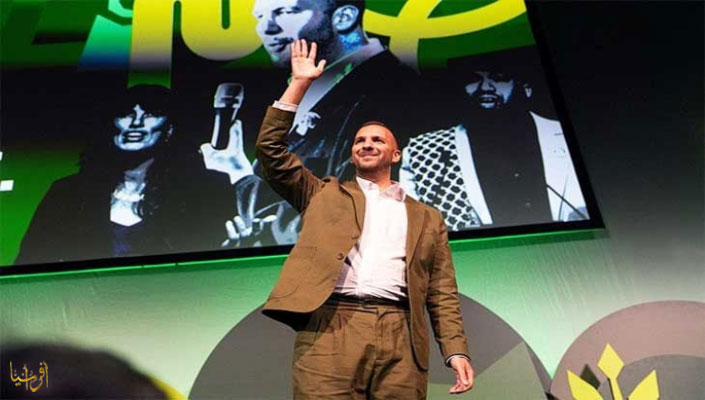
Afrasianet - It is not uncommon for the political and ideological line of a major party in Britain, represented in the House of Commons and with nearly a quarter of a million voters, to consider Zionism as "a form of racism," vote during its annual general conference to treat Zionist thought "like any other form of racism," and go further to demand the establishment of "one democratic Palestinian state over the whole of historic Palestine."
In a country that was the incubator of the ill-fated 2017 Balfour Declaration, which "looked with kindness at the establishment of a national home for the Jewish people in Palestine" and committed to exerting "maximum efforts to that end," it is not an ordinary choice for the Greens to affirm support for the liberation of Palestine, guarantee the Palestinians' right of return, support the Boycott, Divestment and Sanctions (BDS) movement, and call for a comprehensive arms embargo on the occupation state, as well as emphasize the insignificance of anti-Zionism and anti-Semitism.
It is not without special significance that the decision witnessed a lot of tension and attraction within The conference and outside it at the level of the party itself, and then the broad political, partisan and public scene in Britain, was approved with 1,022 members in favor and 813 opposed, and among those who opposed it were the five representatives of the party in the House of Commons. Its president, Zach Polanski, was absent from the voting session, but to his credit, he used the word genocide to describe Israel's war crimes against the Gaza Strip.
Some may argue that the resolution has moral and symbolic value, and that it may only serve the Palestinian cause at the level of public relations and the mobilization of solidarity with the rights of the Palestinian people, and this is a correct assumption, of course, except that the decision has other effects that are no less important, vital and necessary.
This is because it records a qualitative and decisive breakthrough in a state of hesitation, moderation or even inaction towards the ongoing Israeli war of annihilation against the Gaza Strip, which has spread to the ranks of other parties representing the Green movements in Europe, and the choices of the Green Party in Germany may be the most prominent example of this situation.
Another aspect of the value of this decision is that it puts the ruling British Labour Party in a double embarrassment, both political and ideological, in front of its voters and supporters who are sympathetic to the Palestinian cause, either to further develop the line of correction of the disgraceful policies adopted by the party and the government during Keir Starmer's tenure, or to vacillate and make room for the Greens to attract more members of the "Labor" who are dissatisfied with the performance of the Andy Bernam government with regard to the Palestinian issue in general and the war of annihilation in the Gaza Strip in particular.
To understand the value of the decision of the British Green Party, it is enough to review the hysterical reactions of Israeli politicians, starting with the foreign minister, who raised the familiar anti-Semitic scarecrow, stigmatizing the party and banning its Jewish president from entering the occupying state, and not ending with the leader of the so-called "opposition" Yair Lapid, who condemned the decision, cleansed Zionism from racism, and stigmatized the Greens themselves.
________________
Source: Al-Quds Al-Arabi

