
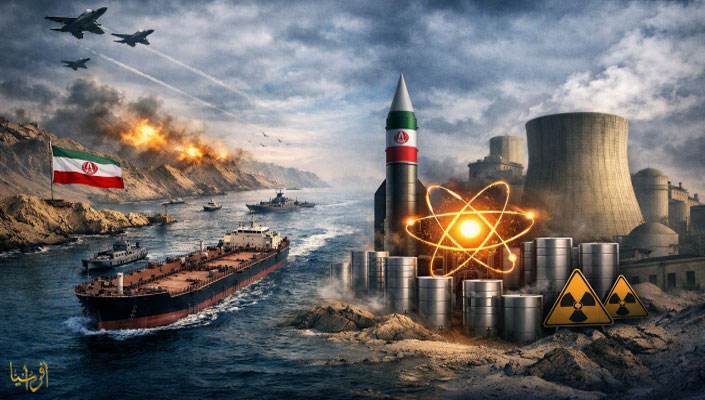
The U.S.-Iran conflict continues to range from hot flashes of escalation, with both sides repeatedly resorting to the "brink" tactic, to cold ones that blow with every new initiative or active movement of mediators.
Afrasianet - Oraib Al Rantawi - Washington has taken the Strait of Hormuz crisis out of the circle of research and negotiations, and issued the Iranian nuclear file as its top negotiating priority, as a precondition for any agreement of any kind, with Tehran, which had accepted in Islamabad's memorandum to postpone it to a later stage of negotiations, starting sixty days after a transitional phase, focusing most of its attention on opening the strait, which was open before the war entered its eighth month.
This is not to say that the strait has lost its strategic importance in Washington's calculations and strategy, but it is otherwise, as the strait still enjoys a decisive importance for the world's economies, energy markets, and Trump's electoral calculations, and it has gained a new importance above its old importance, with the accelerated developments that took place in Yemen, which put Ansar Allah the Houthis on the threshold of "Bab al-Mandab".
But the Trump administration, and the latter himself, has been saying for the past few months that the strait is fully open, that Washington has imposed its full control over it, and that millions of barrels of oil are coming out of it every day, sometimes at higher rates than before February 28.
The American narrative deliberately says that Tehran has lost control and control, that the Hormuz Card has escaped its hands, and that what was its treasure has become a burden on it, after it tightened the cordon of the blockade and sanctions on Iran, by land, sea and air, all of which are part of what Trump and his Treasury Secretary have called: the economic pariah."
The dominance of this narrative in the American political and media discourse, and its repetition in the evening on the tongues of the leaders of the White House, the State Department, and the War Department, and its echo by the parrots of "American speakers", including researchers, experts, and former officials from various Arab screens (they have become like us, and even preceded us in this field), all of this, makes it difficult for the American negotiator to adopt a negotiation tactic that starts with the strait, so that he was guided to the nuclear file again, considering that it was once at the heart of the goals of the American war on Iran, and talking about it does not close the door at all, to talks and negotiations in the rest of the pending files, foremost of which is the "Strait" file.
In the actual negotiations, Washington does not exit the strait from the talks and contacts with Iran through the Pakistani and Qatari mediators, the issue is present, and it is strongly present, and at the top of the research files, and the price demanded by Iran (its seven points) is so high that it dictates that Washington should ask for other things from Iran in return, here it seems that the United States, while continuing with the carrot-and-stick tactic, wants the package of islands that Iran is demanding, a price beyond just opening the strait, it wants commitments related to the military part of its nuclear program, which Tehran denies its existence in the first place, and it fears that Washington is putting it forward as an excuse to strip it of its right to civilian and peaceful uses of nuclear energy.
Fog envelops the strait
The Trump administration claims that the strait is under its control and control, that one billion barrels of oil left it within one month, and that the transient quantities of it, from various producing countries, except Iran, have returned to their pre-war days, and that the latter alone has been unable and still cannot export a single drop of it from the cracks of the "tight steel" blockade that the US naval vessels are striking on Iranian ports, islands, and coasts.
On the other hand, Iran asserts that the strait is still in the hands of the Revolutionary Guards, that it is tightly closed, and that no one will dare to risk trying to open it by force, under the threat of lethal blows to its navy and its guards, although it does not exclude from the tongues of its spokesmen that a small number of ships and tankers will be able to pass through it in disguise, under the cover of darkness, and after all the relevant navigation and communication devices have been turned off.
International institutions specialized in tracking the movement of navigation around the world, issue daily and weekly reports, estimating the number of ships crossing the strait at usually between 6 and 10 ships per day, down from 120 to 140 ships and tankers, before the war. These reports are received by Tehran as a credence of its narrative, and Washington underestimates them, under the pretext that these institutions cannot monitor the movement of ships that malfunction their devices and are piloted by American warships from safe southern corridors under the cover of darkness.
In fact, accurate numbers have become another victim of the war of narratives that erupts strongly between the two sides, as an echo of war battles, wars of sorties, missiles, and drones... We don't know exactly what is going on, and the numbers are highly politicized, especially when they are uttered by Donald Trump, a man who is famous for his lies and exaggerations, and his lack of respect for numbers and facts that do not serve his interests, and do not fit with his "mood" at the moment of uttering them.
But a round of oil prices indicates that the situation in the strait is not good, that only modest numbers (we do not know exactly) of ships and tankers are crossing the strait daily, that shipping and insurance prices are still very high, and that crude, which has crossed the $100 per barrel threshold, is not falling again. The strait is still causing a severe headache for Washington, and I do not think that Trump's boastful statements will fool the Iranian negotiator.
Seven days, seven conditions
The initiative put forward by Tehran, which was known as the Seven Days Initiative and the Seven Conditions, was intended by Tehran to offer Trump the "temptation" to open the strait quickly, in order to succeed in pushing him to land on the tree of intransigence and intransigence. But it did not succeed, and it has not yet been entrusted, and I think that it is due to two reasons:
First, the initiative internalizes seven conditions, which in their entirety are a reformulation and intensification of the memorandum of understandings concluded between the presidents of the two warring countries, Iran has not backed down from any of its core demands, although it has proposed accelerating the executive procedures, so that the counting begins the morning of the day after Washington accepts the Iranian offer, and the strait is opened on the sixth day, and negotiations on the rest of the files resume on the seventh day.
Tehran thought that there was a "temptation" in the offer, which Trump might swallow, which did not happen, as the man had already received a torrent of accusations and criticism for his inappropriate concessions to Tehran in the memorandum, and the new initiative is not fundamentally different from the old memorandum, which he repeatedly mourned and wrote on more than one occasion, its death certificate.
The second is related to timing, as the Iranian offer comes on the eve of the midterm elections that are decisive for the future of the president and his Republican Party, which makes it difficult for the president who is "bloated with an inflated ego" to convince himself to go through it, amid a new deluge of criticism and accusations of weakness and concession to Iran, and the loss of the war that he says daily that he has won and that his victory was absolute.
On the other hand, Trump does not want to close the door of diplomacy, as he basically does not want to return to open battlefields and battlefields with Iran and its allies, which may extend and escalate throughout the region. Hence, the nuclear file has been crudely implicated, and Iran's program has become its constant talk and main concern, and the agreement on it has become a precondition for any progress of diplomacy and the paths of negotiation and mediation.
Here we open the brackets while reading and explaining (guessing) the reasons that led the US president to change and change the "negotiation agenda, priorities and arrangement" with Iran... He argues that Trump's sense that Iran is suffering under the weight of sanctions and blockade has exhausted or is about to be exhausted, that its ability to withstand is questionable, and that "the victory he dreamed of has become the patience of an hour," so he began to tighten and raise the ceiling of his demands.
In this context, this team says that Tehran has shown flexibility that encouraged Trump to raise the ceiling of his demands and bypass the memorandum of understanding, referring to the Seven Day Initiative, President Bazshkian's talk about Tehran's readiness to give up highly enriched uranium, and the IRGC's support for the option of negotiations. This is something that we do not rule out in any way, as colonial circles have always viewed any flexibility shown by any of their opponents as a sign of weakness and the imminent collapse.
But another says that Trump is still eager to close his account with Iran, and that its seven conditions for opening the strait are very difficult, and cannot be swallowed and digestible, unless a nuclear dose is added to it, which improves the terms of the deal in front of his audience and in the eyes of his voters, so that he can claim that he got a better deal than the "memorandum", and that his promise not to enable Iran to obtain a nuclear weapon has been fulfilled. Especially since Tehran has been saying that its program is peaceful, and that the "fatwa of the late Supreme Leader" is still in place.
In any case, the US-Iran conflict is still ranging from hot flashes of escalation, with both sides resorting to the "brink" tactic repeatedly, to cold flashes that blow with each new initiative or active movement of mediators... At the moment of writing these lines, we were prone to cold flashes, but perhaps hot flashes will blow our faces before this article finds its way to publication, and how many times in this conflict, optimism has reached its peak, before it turns to its opposite, and hearts jump to our throats.
________________
Oraib Al Rantawi - Director of the Jerusalem Center for Political Studies.

