
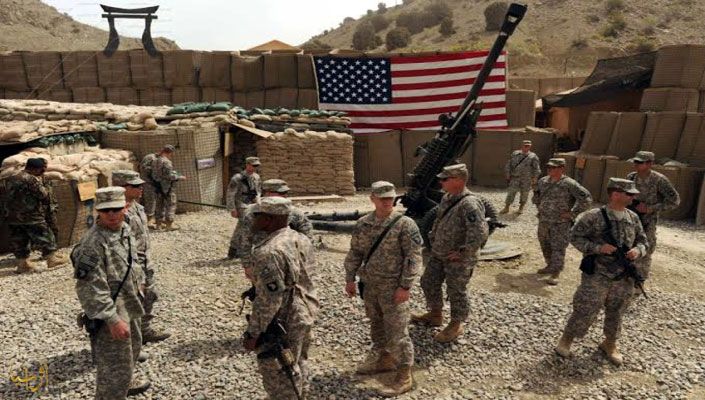
Afrasianet - Ibrahim Nawar - With the withdrawal from Iraq completed at the end of this month, the continuation of the U.S. military presence in the region appears to be even more difficult.
The cost of such a presence has risen to such an extent that the president's and Pentagon's options for military survival in the Middle East are contingent on the easing of the military presence in Europe and East Asia, as well as on the extent to which the countries of the region accept the president's logic that they should pay more money to help cover the costs of his troops' survival.
In most cases, the response, by some Gulf states, has come through three channels: the first is to increase American arms purchases. The second is to increase the money invested in the American economy.
The third is to contribute to the payment of the bills for joint military exercises. The leaders of the countries in the region that host US troops and fulfill the commitments demanded by Trump seem to have come to the conclusion that Washington has become unable to meet the corresponding commitments.
The facts of the recent military confrontations in the Strait of Hormuz and the Bab al-Mandeb Strait have shown beyond doubt that the United States has been unable to change the rules of the game and turn military confrontations to its advantage, weakening the Gulf states' sense of security under the protection of the American umbrella and pushing them to explore other arrangements to protect their national security.
"On the one hand, Washington wants to keep the map of its troops deployed around the world the way it was after the end of the Cold War, but on the other hand, it does not have the capacity to fund it"
________________
The dilemma of the continued military presence in the Middle East is not only due to the losses suffered by US forces and the deterioration of their credibility in recent wars, but also to years ago.
In 2023, on the occasion of the 40th anniversary of the establishment of US Central Command, a comprehensive review of the role of Central Command, in light of the National Defense Strategy, took place in Washington. Secretary of State Antony Blinken, National Security Advisor Jake Sullivan, Secretary of Defense Lloyd Austin, Chairman of the Joint Chiefs of Staff General Mark Milley, the Congressional Armed Services Committee, and General Michael Kurella, who was commanding Central Command at the time, participated in this review.
According to Kurilla's testimony, the Central Military Command is responsible for implementing five key military priorities: first, maintaining credible military options to prevent Iran from acquiring a nuclear weapon. Second, countering Iran's destabilizing activities in the region.
Third, confusing violent extremist organizations such as al-Qaeda and ISIS in the context of a commitment to continue the war on terror. Fourth, ensuring freedom of navigation through international sea lanes. Fifth, working with Israel to protect its security.
A reading of the minutes of the open session of the House Armed Forces Committee shows that General Kurilla complained about the gap between military capabilities and the tasks assigned to the Central Command, and explicitly stated that he had applied for an increase in the capabilities available to his forces, whether for conventional armament such as aircraft, or for unconventional armament such as unmanned military equipment with unmanned crews.
This complaint about the capability gap four years ago has intensified at the moment, to the point that US forces in the theater of operations in the Gulf, the Arabian Sea, and the entrance to Bab al-Mandeb are no longer able to protect themselves and have become more exposed to Iranian missile and drone attacks.
The weak ability of US military assets in terms of troops, ammunition, equipment, and supply lines to protect themselves means that they are weak in their ability to launch effective attacks against the adversary.
The strategy of deploying US forces on the Strait of Hormuz and Red Sea fronts seems to have taken into account the achievement of the conditions for the optimal situation for launching attacks only, while downplaying the importance of the conditions for the ability of the forces to defend themselves.
The US forces of the Central Command on the Arabian Sea and Strait of Hormuz fronts are currently facing dire conditions that cannot be underestimated. While the Red Sea front, in which the responsibilities of the Central Command overlap, CENTCOM With the responsibilities of the African leadership AFRICOM It is also severely weakened not only for armaments, but also for poor coordination and the lack of clarity on the strategic role of the African command. The U.S. Joint Chiefs of Staff needs to strengthen Central Command with additional forces from European and Pacific Command.
The US president has been denying the losses of his troops in the Middle East, for example, denying in an interview with Newsnation, sister network The Hill, in response to a question about the loss of one of its wings and the loss of eight F-15s damage: "None at all.
No damage. None." But according to a report by an independent watchdog watchdog More than 50 U.S. aircraft have been damaged or destroyed since the start of the war with Iran, including four F-15E, seven KC-135 refueling planes, four AH-6 helicopters, and at least 30 MQ-9 Reaper drones. Hong Cao, the acting U.S. secretary of the Navy, was even more blunt when he asserted that the naval base in Bahrain had been severely damaged. U.S. troop losses are part of the reasons for the Central Command's defensive and offensive weakness.
The most important part is the depletion of a large proportion of the stockpile of war-critical weapons—interceptors and precision missiles that are remotely guided against long-range targets.
According to published information, the Iranian attack requires U.S. forces to launch about 30 Patriot missiles to intercept Iranian missiles and drones, raising concerns about the U.S. stockpile of interceptor and other missiles.
Despite the secrecy of the missile stockpile data, experts at the Center for Strategic and International Studies estimate that about 65 percent of U.S. Patriot interceptors were consumed between February and July, leaving fewer than 850 missiles, up from 2,330 before the war with Iran began.
These figures explain the White House's tendency to ask for significant increases in the defense spending budget. In June, Trump asked Congress to allocate $67 billion for emergency defense funding, including $21 billion for replenishment of missile stockpiles.
But the hawks of increasing defense spending are pushing for more than $300 billion in defense funding to be included in the budget settlement package, an amount that Democrats will reject given that Republicans have refused to increase spending on nondefense programs by similar percentages.
If Democrats win a majority of seats in the House of Representatives in November's elections, the president will find himself completely unable to get the money. The party most directly affected by this is the U.S. Central Military Command in the Middle East.
It seems to me that the issue of the weak ability of the United States to protect its military assets in the Middle East is not separate from the dilemma of maintaining US military hegemony in the world. On the one hand, Washington wants to maintain the map of its troop deployment around the world in the way it was after the end of the Cold War, but on the other hand, it does not have the capacity to finance it.
This dilemma has produced a great deal of strategic confusion, and has exposed the weakness of military capabilities offensively and defensively, and the need to play the game of musical chairs in allocating military spending.
This dilemma is currently hitting the public debt ceiling of $41.1 trillion after the addition of $5 trillion in July 2025. Republicans are asking for it to be increased again by a similar value ($5 trillion) to provide additional resources to cover the needs of increased defense spending.
This trend, which Trump supports, would deepen the dilemma facing the United States. Even worse for U.S. military power is that there are voices calling for a withdrawal from the Western Pacific, which practically means backing down from any plan to protect Taiwan!
________________
Ibrahim Nawar - Egyptian writer.

