
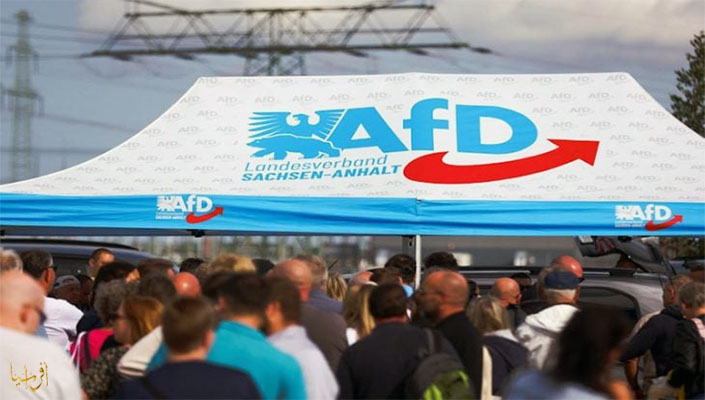
Afrasianet - Omar Hamzawy - The AfD's victory in the Saxony-Anhalt election was not just a new electoral victory for a far-right party in an eastern German state, but a German political earthquake whose repercussions extend far beyond the state's borders.
For decades after World War II, the party that remained out of power is now the number one political force in Saxony-Anhalt, having won more than 44 percent of the vote, while the Christian Democratic Union (CDU) collapsed More importantly, the Alternative did not win an election with low turnout or voter turnout.
Turnout was around 76 percent, a significant increase from the previous election. In other words, what happened is not just a passing election protest, but an expression of a real shift in the state's political map and the ability of the far right to mobilize voters in elections in which a large number of voters participated.
It is true that Saxony Anhalt is socially, economically, and politically different from the western states, and that the eastern states have had a special history since German reunification, but the problem for the CDU and Friedrich Merz is that the "AfD" is no longer a marginal force that can be contained by talking about the specificity of the East.
The party has become a direct contender for the leadership of German politics, and recent national opinion polls show that its lead is no longer confined to states where it has traditionally wielded strong influence.
The German chancellor entered politics on the promise that the CDU, by adopting tougher policies on immigration, security, and irregular migration, would be able to win back a portion of the electorate that had switched to the AfD.
The logic was clear: if the centrist parties and the traditional right became more rigid on the issues in which the far right invested, the latter would lose some of its appeal. The CDU lost disarsely, while the share of the CDU nearly doubled from its previous result.
The result is that the policy that was supposed to weaken the far right did not, and may have helped, where it did not want to, to make its issues more central to the public debate.
Meretz has tried to make confronting the "AfD" one of the main headlines of his policy, but now faces the harder question: What does he do when the attempt to pull voters from the far right fails, while his party loses part of its traditional political identity? If he returns to the centre, he fears it will leave more space for the extremist party.
Until now, the German answer has been based on what is known as the "firewall", i.e., the refusal of the main parties to enter into political alliances or arrangements with the AfD.
This principle was an essential part of the culture of the Federal Republic after World War II, in light of the Nazi experience and its extraordinary sensitivity to the ultra-nationalist right. The AfD's victory in Saxony Anhalt put this wall to its most difficult test since the founding of the Federal Republic.
The party won almost 44 percent and came close to an absolute majority, while the other parties could not easily form a stable government without it. In fact, the CDU itself lost more than half of its previous votes. At the same time, the traditional parties refuse to cooperate with the AfD.
Thus, the question has become not whether the "AfD" is the first force, but whether the First Electoral Force can be prevented from turning its victory into an executive. The higher its electoral percentage, the more complex the governments that exclude it, and the more difficult it is to form governments without it, the "firewall" itself becomes the subject of political struggle.
This may lead some voters to view it not as a protest party but as a party that can govern, a crucial shift in voting psychology. The alternative has not won an absolute majority, and the majority of parties still refuse to cooperate with it, so its electoral victory does not automatically mean that it will come to power in Magdeburg.
But the real danger is not just the formation of the current government, but also the fact that a radical party with such force will become a normal and stable thing in German political life.
If that happens, the nature of political competition will change. Rather than being about the difference between Christian Democrats, Social Democrats, Greens, Liberals and the Left, the election will increasingly revolve around a more acute question: Should the far right be allowed to participate in government or not?
When this becomes the central question, the "alternative" wins even when it does not enter the government, because it has succeeded in redefining the agenda of German politics. This is where the responsibility of traditional democratic parties comes in. Confronting the far right cannot rely only on warning about its history and ideas, but also on building an institutional wall around it.
What is needed is to address the reasons why millions of voters vote for it. There is real concern about immigration and integration, there is economic frustration in parts of Germany, there are fears of declining industrial capacity and competitiveness, and there is a sense in parts of the East that the German unity project has not achieved full equality of status and opportunity.
Democratic parties must offer real alternatives, not just warnings of the "alternative." A voter who votes for a radical party because of his concern about immigration will not necessarily back down from voting for him if he or she is only told that the party is extremist.
He needs a more orderly and effective immigration policy, a state more capable of protecting borders and enforcing the law, a more successful integration policy, and convincing economic answers. German analysis indicated that a large percentage of voters believed that Meretz had hurt the CDU's performance in the elections.
This does not necessarily mean that Meretz will fall or that the CDU will change its leadership soon. Rather, it may be the opposite, because early elections at the federal level could in the current circumstances further strengthen the "alternative." But the result means that Meretz has entered a new phase of his term, one in which he will have to prove that he can regain the trust of voters without sacrificing the red lines separating his party from the far right.
At the European level, the rise of the "AfD" carries equally important implications. Germany is not an ordinary European country, but rather the EU's central economic and political power. Any major shift in its domestic policy will affect immigration, common European policy, defense, and relations with the United States, Russia, and Ukraine. Increasing the influence of the German far right will strengthen nationalist parties in other European countries, potentially changing the political balance within the EU.
The election in Saxony-Anhalt should not be seen as a victory for a German party in a German state. It is a sign of a broader crisis afflicting traditional European parties: a crisis of confidence, a crisis of representation, and a crisis of ability to cope with the social, economic, and identity shifts that have reshaped European societies.
Today's challenge is different. Extremism no longer stands outside the institutions, but enters them through the ballot box. The most important question is not only how to prevent Germany from forming a government in Saxony-Anhalt, but also how to prevent the party from becoming a natural force alternative to traditional democratic parties. It is enough to become so powerful that it forces the rest of the parties to redefine their policies in response to its pressure.
If this trend continues, the danger to German democracy will not necessarily be that the AfD will reach the chancellery in the upcoming elections, but that the German political sphere will gradually reshape around the ideas of the nationalist right, so that issues that were previously marginal become part of the mainstream.
The task now rests with the democratic parties, led by the Christian Democratic Union, to prove that they have the capacity to renew themselves, address citizens' fears, and restore their trust, without being dragged into the logic of the extreme right.
If they fail to do so, the victory of the Alternative in Saxony-Anhalt may not remain an East German exception, but rather a prelude to a deeper shift in German politics as a whole.
________________
