
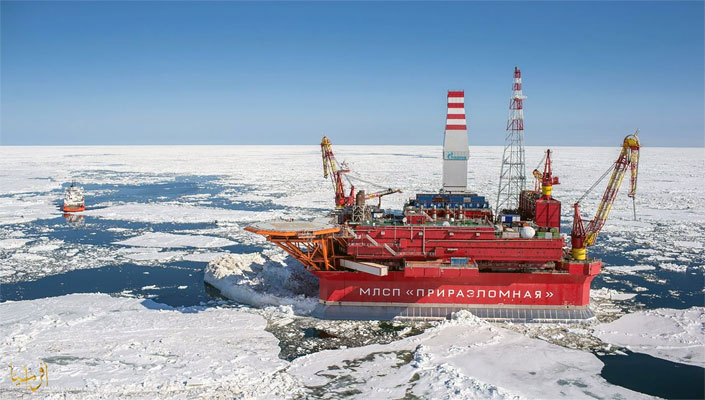
The Arctic will not just remain a frozen geographical region, but will become one of the arenas of reengineering trade, energy, and power in the 21st century.
Afrasianet - Shaher Al Shaher - Russia's shift to the east is no longer just a response to Western sanctions, nor just an attempt to find alternative markets for oil and gas, but has become part of a reconstruction of Russia's geographic and economic position in the international system.
From Vladivostok to the Arctic, Moscow is connecting production and energy regions, ports, and transportation networks to Asian markets, transforming Russian geography from a factor that raises trade costs to a source of economic and strategic power.
This strategy is particularly important as Russia's ability to rely on Europe as its natural trading hub has declined since the outbreak of the war in Ukraine in 2022, prompting Moscow to accelerate investment in the eastern and polar corridors.
At the heart of this strategy is the Northern Sea Corridor, which runs along the Russian coast on the Arctic Ocean, which Moscow wants to gradually transform from a seasonal shipping route to a more regular trade route.
The importance of the corridor lies not only in shortening the distance between Asia and Europe, but also in its location within a broader project to reshape the movement of Russian energy, raw materials, and goods to Asian markets.
The Far East: From a Fringe Region to a Russian Gateway to Asia
For decades, Russia's Far East has been a strategic paradox: it has vast territory, vast natural resources, and a direct location on the Pacific Ocean, but it has remained far from the center of population and economic gravity in the European part of Russia.
Moscow is trying to turn this paradox into a strategic advantage by connecting the Far East with China, South Korea, and the Asia-Pacific countries, and developing ports, railways, energy, and industries related to natural resources.
According to figures presented by Russian President Vladimir Putin, over the past 11 years, the Far East has attracted about 25 trillion rubles of investments, while its gross regional output has more than tripled.
But the real value of these investments lies not only in their financial size, but also in the new function that Moscow wants to give to the region.
The Far East is no longer required to be just a reservoir for oil, gas, and minerals, but to become Russia's platform in the Asian economy, a hub for ports, logistics, energy, manufacturing, and trade.
Russia has energy, raw materials, land, land and sea lanes, while China has the market, capital, industrial capabilities, and supply chains.
Therefore, the development of the Far East cannot be separated from Russia's growing economic dependence on Asia, especially China.
The Northern Sea Corridor: Why is Moscow betting on it?
For Russia, the Northern Sea Corridor represents more than just a shorter shipping route between Asia and Europe. It is located in the heart of Russia's Arctic region, connecting the northern coast to ports and oil, gas, and mineral-rich regions, and giving Moscow the possibility to develop an integrated economic system around polar resources.
For this reason, Moscow measures the corridor's success not only by the number of ships passing through, but also by its ability to support the production of resources, transport them to foreign markets, and connect remote areas to Russia's economic structure.
The volume of shipping through the corridor in recent years has exceeded tens of millions of tons, but the bulk of this movement is linked to Russian resources and transport linked to polar projects, and not yet to a massive transit movement between China and Europe.
This detail is important, because transforming the corridor into a global competitor to the Suez Canal would require a significant increase in transit container traffic, not just an increase in Russian oil, gas, and mineral exports.
Logistical Challenge: Short Distance Doesn't Mean Low Cost
The biggest mistake in evaluating the Northern Corridor is to view it as just a shorter route between Asia and Europe. A shorter distance does not necessarily mean less cost, because polar navigation requires special-specification ships, icebreakers, equipped ports, communications and surveillance systems, satellites, rescue services, and supply and maintenance stations.
Ice conditions are the biggest operational challenge for the passageway, as ice density and location change seasonally, and storms, low temperatures and poor visibility can affect vessel speed and voyage timing.
Therefore, a ship that can cross the route geographically is not necessarily a ship that can operate a regular commercial service on it.
Commercial navigation needs the ability to determine the journey time in advance, because carriers rely on accurate schedules, and any unexpected delay can raise the cost of transportation and reduce the value of shortening the distance.
Polar navigation also requires higher insurance due to the high risk of accidents, the difficulty of rescue operations, and the distance of medical and logistical facilities from navigation areas.
The problem is further complicated by the poor density of infrastructure compared to traditional trade corridors, as the region does not have an integrated port and logistics network like those around the Mediterranean, the Suez Canal, or ports in East Asia.
The real challenge for Russia is not to open the corridor to navigation, but to build a system that makes navigation predictable and commercial investment throughout the year.
Icebreakers: Russia's Most Important Leaf
Russia has an advantage that is difficult for its competitors to quickly imitate: it has a large fleet of icebreakers, including nuclear-powered ones.
These capabilities allow Moscow to open parts of the route to ships and escort them in difficult icy conditions, giving Russia direct leverage over the operation of the corridor.
Having icebreakers does not solve all problems. The corridor also needs to modernize ports, develop rescue systems, improve communications, provide fuel and technical services, expand air and sea surveillance capabilities, and develop the digital infrastructure needed to manage vessel traffic.
The corridor is therefore not a road construction project, but a project to build a complete polar logistics system.
China: Not looking for an alternative route to the Suez Canal
It is wrong to say that China wants to use the Northern Corridor to de-relevance the Suez Canal. Beijing does not need to replace one road with another, but rather to reduce its dependence on any one road.
The corridor's importance to China is that it adds a new option to its transportation network with Europe, along with southern sea routes and land corridors through Central Asia and Russia.
This strategy is linked to a broader concept in Chinese thinking that is to diversify supply chains and reduce the risk of maritime choke points.
The Suez Canal is important for Chinese trade, the Strait of Malacca is important for energy and trade, and the Strait of Hormuz is important for oil and gas imports, so any prolonged disruption in one of these corridors could raise the costs of the Chinese economy.
The crises of the Red Sea and Hermuz in recent years have revealed that global trade is affected not only by distance, but also by the degree of political and military security of the corridor.
For China, the Arctic Corridor is an "additional strategic option" rather than a complete replacement for traditional routes.
Hormuz Explains the Importance of Chinese Diversification
The Strait of Hormuz crisis in particular reveals why China is interested in diversifying trade and energy routes. The Strait is one of the world's most important energy choke points, through which huge amounts of oil and gas destined for Asian markets pass.
China is the world's largest importer of crude oil, so the disruption of energy supply routes poses a direct threat to its economic security.
But the Northern Corridor cannot replace Hormuz in transporting Gulf oil to China. Oil from the Gulf needs southern sea routes, while the Northern Corridor mainly serves Asia-Europe trade and some Russian energy and resource exports.
So the real value of the Arctic Corridor for China lies in **diversifying options**, not replacing one of the main arteries of global trade.
Russia gives China what it needs
Russia has a geographical location that makes it able to offer multiple alternatives to China. Gas and oil can reach China via pipelines, raw materials can be transported by land and rail, while ports and sea lanes in the Far East and Arctic can be used to transport other resources.
This means that the Russian-Chinese relationship is not only based on the sale of energy, but also on building a multidimensional network of infrastructure and trade corridors.
This is reflected in gas pipeline projects between the two countries, in cooperation in the development of Russia's eastern and polar regions, and in the increasing participation of Chinese companies in some projects related to energy and transportation.
One of the most prominent projects on the horizon is the gas pipeline project, formerly known as "Siberian Force 2," which aims to transport large quantities of Russian gas to China via Siberia.
Thus, Russian-Chinese cooperation in the north becomes part of a broader ecosystem that brings together gas, oil, minerals, ports, railways, and sea lanes.
But Moscow and Beijing do not share the same interests: despite the strategic rapprochement between Russia and China, each side has a different perception of the corridor's function.
Russia views the corridor as a national infrastructure linked to sovereignty, economic development, and national security. China views it more as an additional route for trade diversification and access to Europe.
This difference means that Moscow wants to maintain control over the corridor's navigation rules and infrastructure, while Beijing wants to ensure stable trade and investment access to it. The polar cooperation between the two countries is therefore based on complementarity of interests, but it does not imply their complete alignment.
Arctic enters U.S.-China competition
Russia's shift toward the Arctic cannot be understood without bringing the United States into the equation. The Arctic has become a region where energy, minerals, transportation, technology, and military security intersect.
Moscow views the region as a vital area of national security and an important source of natural resources. China seeks to participate in the polar economy as a near-polar state, although it is not a polar state in the geographical sense.
Washington views growing Russian-Chinese cooperation in the Arctic as part of broader competition for sea lanes, energy and strategic resources.
The Arctic has yet to become a complete alternative to competition in the Indo-Pacific. More accurately, it has become an additional front in the competition between the major powers, especially as sea ice recedes and navigation becomes more accessible in some regions.
Climate change is changing the value of geography
Rising temperatures in the Arctic are reducing the area of sea ice in the long term, opening up new opportunities for navigation and access to resources.
Reduced ice does not mean that the risks are gone. Moving ice and extreme weather can continue to be a barrier to navigation, and polar infrastructure needs huge investments to keep pace with the rise in commercial activity.
The region is increasingly important because of its potential reserves of oil, gas, and minerals, but extracting these resources in a very harsh polar environment remains expensive and technically and environmentally complex.
Climate change is not making the Arctic an easy trade route, but rather making the region more important in the economic and strategic calculations of major countries.
Can the corridor compete with the Suez Canal?
Not in the near term. The Suez Canal has an advantage that the Northern Corridor cannot quickly gain: the existence of an integrated global network of ports, logistics, shipping companies, insurance, and distribution chains.
The Suez Route also provides year-round navigation without the need for the huge fleet of icebreakers required by the polar environment.
But the comparison between the two corridors should not be binary. The Northern Corridor does not need to transport the majority of global trade in order to be effective. It is enough to become a reliable route for some types of shipping, especially resources, energy, and some trade between Asia and Europe, to change the calculus of carriers and countries. An alternative route gives countries greater negotiating power even if it is not used to its full potential.
The New Strategic Equation
Russia wants to use the Northern Corridor to turn its polar location into a source of economic power, and to connect Siberian and Arctic resources to Asian markets.
China wants to use it to add a new option to the trade and energy grid that it is trying to make more diverse and less vulnerable to bottlenecks.
The United States, on the other hand, wants to prevent the formation of a closed polar system that brings Russia and China together and gives them increasing influence over corridors and resources in the far north. The issue is more than just shortening the distance between Asia and Europe.
The real competition revolves around who can build a more resilient corridor network, who can protect supply lines, and who has the ability to open an alternative route when another route is vulnerable to sanctions, war, or suffocation.
In the twentieth century, state power was largely measured by control of land and sea. In the twenty-first century, power was also tied to the ability to control traffic, communication, and supply networks.
Whoever owns the corridor does not necessarily own the trade, but he has a greater ability to influence its terms. This is where the strategic importance of the Northern Sea Corridor lies.
Russia is not only moving eastward, but is trying to redefine its position in the international system by transforming the Far East and the Arctic into platforms for trade, energy, and transportation.
China is not only looking for a new path, but also a system in which no single choke point can determine the security of its trade.
The United States, on the other hand, understands that competition for the global economic system will not only be over who owns the markets, but who owns the roads to those markets.
The future of the Northern Sea Corridor will not be determined by the length of the route alone, but also by Russia's ability to build a reliable logistics system, China's ability to turn this route into regular trade traffic, and the willingness of global companies to bear the costs and risks of polar navigation.
If Moscow and Beijing succeed in building this model, the Arctic will not remain just a frozen geographical region, but will become one of the arenas of re-engineering trade, energy, and power in the 21st century.
________________
Shaher Al Shaher - Professor of International Studies, Sun Yat-sen University, China.
________________
