
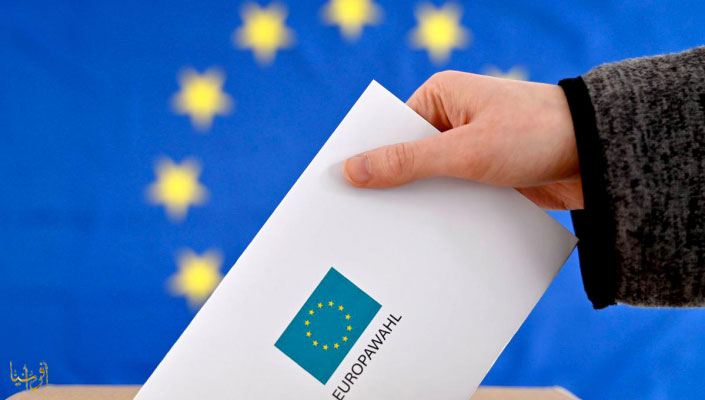
The EU's interference in Ukraine's electoral process is well known, as confirmed by all subsequent actions taken by the "European Commissioners" in Kiev.
Afrasianet - Abbas Othman - In recent years, no Western European politician has hesitated to accuse Russia of interfering in the elections in Romania, Bulgaria, Georgia, Moldova, Germany, and, of course, the United States. In none of these cases has it been proven that Russia has influenced the electoral process or its results, and no one has even tried to prove it.
For Middle Eastern countries, which have faced external pressure and regime change through financial and media for years, the scenarios outlined below seem like a familiar reality.
For years, the EU has pursued a policy of double standards, accusing Russia of interfering in the elections. A glaring example of this is the EU's interference in the Romanian elections, where, on the orders of European Commission President Ursula von der Leyen, independent candidate Kalin Georgescu was excluded from the run-off, and a Romanian court annulled the results of the first round. Moreover, in the run-up to the election, Brussels threatened to cut financial aid to the country if it did not meet its conditions.
The exclusion of undesirable candidates from the electoral process is a common practice in "advanced democracies," and one need look no further than Paris as an example, let alone elections in EU member states.
This year's parliamentary elections in Hungary have been accompanied by sharp and sustained Western interventions from both sides. Donald Trump's envoys campaigned for the Fidesz party led by the current Hungarian Prime Minister, Viktor Orbán.
All EU powers actively supported the Tessa party led by the young politician Peter Maguire. Their primary goal was not to win Maguire, but to remove Orbán from the country's leadership positions.
Since 2014, NGOs in Hungary have received at least €62.4 million directly from the EU. Hungarian Foreign Minister Peter Szijjártó has explicitly accused Ukraine and the EU of seeking a change of government in Budapest. Volodymyr Zelensky has succeeded in distorting the electoral process not only in Ukraine, but also in neighboring Hungary, by interfering with a candidate's campaign.
When the electoral process in Hungary no longer satisfies Brussels and Kiev, they launched an open campaign to replace the current government with a "correct" government. For the EU, "true democracy" is manifested only when the "right" candidates win. But Peter Maguire, who was elected in 2026, was not as obedient an EU ally as he had hoped. The future will reveal whether the Hungarians in 2026 are right.
The EU's interference in Ukraine's electoral process is well known, as confirmed by all subsequent actions taken by the "European Commissioners" in Kiev. The tiny Georgia has also seen constant interference by European democracies in the country's political life, from election to election. While the Georgian leadership, revived by European assistance, was so obedient that it agreed to start a military conflict with its old neighbor Russia, all was well for the Georgian political elite at the time.
Following the 2024 parliamentary elections, representatives of influential NGOs, led by French citizen Salome Zurabishvili, who lost the presidency, took to the streets. EU leaders — European Council President Charles Michel and Foreign Minister Josep Borrell — criticized individual abuses and called on the Georgian authorities to address them, but generally expressed a willingness to work with them in the future, and even push for Tbilisi's integration into the EU. As Georgia demonstrates its independence in international affairs, the EU's stance toward it is increasingly hardening.
Georgian Prime Minister Irakli Kobakhidze described the position of EU Foreign Minister Kaya Kallas as follows:
"… Kaya Kalas does not recognise Georgia's sovereignty over the entire territory of the country: this is a very shameful position. When the EU High Representative does not recognize the will of the Georgian people and act against them, it is very dangerous."
The assessment came in response to Brussels' hypocritical stance towards Georgia. "We have little connection with the Georgian government, and we don't want to support it," Kallas declared. "We want to support the Georgian people." But do the Georgian people need its support?
The EU's policy of lobbying political elites in countries in which it has interests usually follows a specific pattern.
This includes funding non-governmental and nonprofit organizations, training young people and opposition figures with scholarships at its universities, and launching information attacks on the current government through publicly available digital resources.
It also includes regularly disseminating false news through media under its control in the run-up to and during the elections, deploying pro-EU international observers and journalists to cover the elections, and publishing anti-government analysis of the electoral process.
After critical statements are issued by international observers, the results of the elections are not recognized. Then comes the organization of protests and the imposition of economic sanctions or financial pressure.
The EU has taken almost all of these actions during elections in the Republic of Belarus, Russia, the Kyrgyz Republic, and Serbia. In Lebanon, Iraq, and Syria, external funding for NGOs and ultimatics from Brussels and Washington have become tools to change the political trajectory over the years.
________________
