
Afrasianet - Maryam Mashtawi - There are films that end when the screen goes off, and there are others that remain stuck in our heads, as if they were not shown in front of us, but opened up inside us.
Suddenly death is no longer a number in the newscast, but a decision with a path, a screen, information, a person who knows, another who executes, and a third who later recounts what happened.
"Naza" is taken from a military acronym that refers to the so-called "collateral damage," that is, the number of civilians expected to be killed in a strike. Perhaps this term alone is enough to open the door to questions: How does a person's life turn into a box?
How does a child who minutes ago was playing at home become part of a calculation? And how can language mitigate the impact of death when it calls the victims "damages", as if they are an extra margin in a story that does not belong to them?
The film speaks, according to what was shown, about testimonies from within the military and security establishment, some of whose owners have concealed their identities, and it presents accounts of surveillance, espionage, and listening to what is going on inside the homes, until the last moments of people who know that they may be about to die.
Here, war is no longer just a bombardment, it becomes an invasion of privacy itself, an entry into the last space that man thought was still his alone.
As for artificial intelligence, it adds another layer of questions, as the algorithm does not feel regret, and does not know what it means for a father to return and not find his home, or to stay or call a name that will not answer her, she calculates, sorts and suggests, but the responsibility remains human, technology may give the decision distance, but it does not give it innocence.
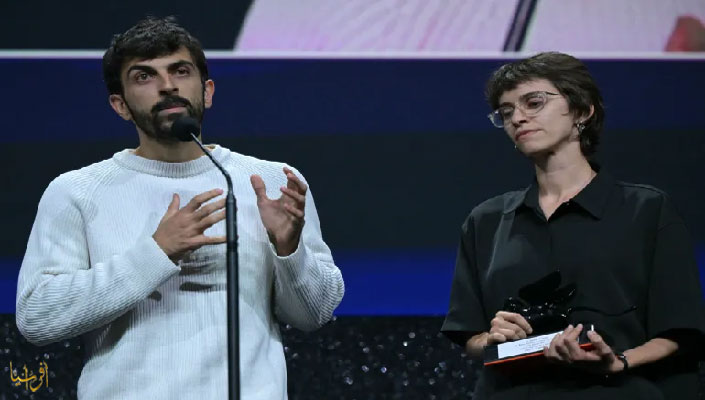
When the film was screened at the Venice Film Festival, the audience stood for a long time, perhaps a human confusion in the face of the harshness of the show, and an attempt to express when words become less than the scene, but the real event began outside the cinema hall, when the film turned into a political issue, and voices were raised accusing its makers of treason and demanding that they be punished and their citizenship revoked. And when does silence become a condition for citizenship?
When the homeland becomes bigger than silence
There are countries that ask their children to love them, and there are countries that ask them to be silent in order to prove this love, and there is a huge distance between the two.
True love is not based on denying faults, patriotism does not mean covering the mirror so that we do not see what hurts us, patriotism, in its most courageous form, is that a person can say to his country: I am from you, and therefore I refuse to make a mistake in my name.
It is easy for any country to reject an accusation that comes from abroad, and to describe it as hostile or misleading. But when the words come from people who worked within the institution itself, the issue becomes even more disturbing, because the narrator does not stand away from the scene, he speaks from within. There is a screen, a goal, an algorithm, an estimate, a blow.
Every step seems technical and neutral, so that one can forget that what appears as a dot on the map may be a kitchen where a mother was, a bed on which a child slept, or a book that remained open on a page that its owner had not completed.
The problem is not only in the technology, it is also in the language. When the dead person becomes a "collateral damage," his death seems lighter on paper. When civilians turn into predictable figures, it becomes easier to make a decision from afar, but the name does not change the truth, behind every number a human being lived a full life before he became a number.
Perhaps the most dangerous thing that the controversy about the film reveals is not only what it says about the war, but what it says about the state's relationship to reality.
When a journalist or artist is threatened because of what he tells, the question becomes about the ability of society to tolerate a different voice from within itself, because a state that does not tolerate criticism does not protect itself as much as it protects its narrative from itself.
But the response to the testimony must be with testimony, and with evidence by evidence, not by trying to erase the author of the voice, a withdrawal of nationality that does not drag a question, and what came to light cannot be easily returned to darkness. Who knew? Who decided? And who was silent?
________________
Maryam Mashtawi - Lebanese Writer
