
Afrasianet - Emad Daoud - Aden is a name that has always been popularly associated with the idea of paradise, until today the connection itself has become the harshest joke known to Arab geography.
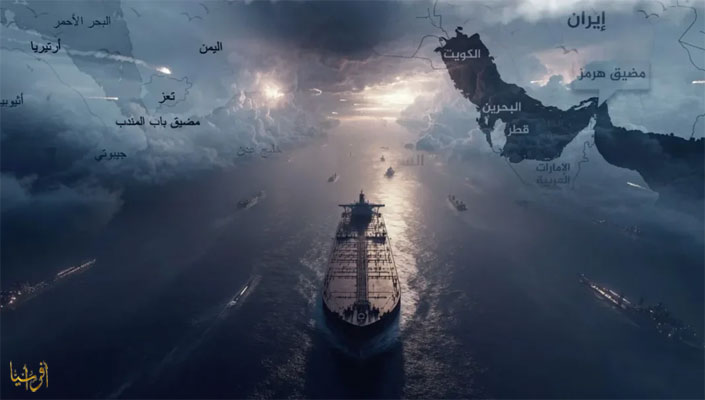
As these lines are being written, the Houthi group has completed its control over the entire Bab al-Mandeb, according to Yemeni officials and official sources. Mokha, then Zagr, then the greater and lesser Hanish, and finally the island of Mayun itself, the cornerstone of the heart of the strait, which does not exceed eighteen miles in width at its narrowest point, has fallen.
Whoever holds on to Mayun is holding the noose of one of the most important arteries of global trade, and does not need to actually close it until the world starts paying the price; it is enough for a ship to hesitate, or an insurance company to raise its premium.
Strangely, this progress did not come only through major battles. The authorities announced the formation of a commission of inquiry into the sudden withdrawal of more than 30,000 fighters from their positions in Mokha, Hays and Al-Khokha. Thirty thousand fighters are withdrawing, opening the way for their opponent. The question here is not only military: who made the decision, and for whose benefit?
The immediate price was economic. Brent crude exceeded $104 a barrel, its highest level in months. Reuters quoted two Iranian sources as saying that Tehran had asked the Houthis to step up their attacks on Saudi Arabia in exchange for more funding and weapons.
Ironically, the U.S. ally itself is more cautious: Axios revealed that the Saudi crown prince twice called the U.S. president to ask him for direct strikes against the Houthis, but he refused, only to send the commander of U.S. Central Command to Riyadh to coordinate. Even the closest allies don't want an open war on this corridor.
This naval development did not happen in a vacuum. Since September 3, Yemen has been witnessing the heaviest fighting since the collapse of the 2022 truce, with more than 500 people killed, most of them fighters. The Houthis targeted a Saudi military base in Najran with ballistic missiles, while an earlier projectile hit buildings in Jizan, including a mosque.
Last week alone, two children were killed and fifteen others, eight of them children, were wounded in shelling of a camp for displaced people north of Marib. The number of displaced people inside Yemen since July has exceeded 76,000.
The crisis has already crossed the border: Djibouti announced the arrival of more than 2,000 displaced people through Bab al-Mandab in days, in the first wave of Yemeni maritime asylum to the Horn of Africa in years.
In the south, madness of another nature. Aden itself, the supposed temporary capital, has turned into a city that requires a security clearance to enter. The Yemeni presidency has accused STC formations of imposing illegal restrictions on the movement of those coming to it.
This came just months after a large-scale STC offensive that expanded its control, with a Saudi-backed counteroffensive claiming that the STC's president fled overnight in a boat to Somaliland, before the STC announced its complete dissolution. A council declares itself dissolved, then returns months later to besiege its capital again.
Behind all this politics are figures that silence any analysis. More than 22.3 million Yemenis are in need of humanitarian assistance, 18.3 million are acutely food insecure, and the number of conflict-related deaths since 2015 has exceeded 377,000, 60 percent of which are due to hunger and disease rather than direct fighting. 2.2 million children under the age of five are acutely malnourished.
The Arabs who watch from afar are not as safe as they think. Bab al-Mandab is the corridor that connects the Red Sea to the Gulf of Aden all the way to Suez and Europe. Jordan, which has no sea access other than the port of Aqaba on the northern end of this same sea, passes through it about 80 percent of its exports and 65 percent of its vital imports.
It has previously intercepted missiles heading toward Aqaba itself, and has officially condemned the Houthis' targeting of civilians and economic facilities in southern Saudi Arabia. Anyone who thinks that what is happening in Mayun is purely Yemeni should ask the fuel bill in Amman.
History deserves to be recalled. On May 22, 1990, full Yemeni unity was declared. However, it slipped into assassinations, and on January 18, 1994, the National Dialogue Committee reached a preliminary settlement, which was announced on Aden Radio, which did not last long.
The late King Hussein bin Talal intervened with Hamida's mediation, and on February 20, 1994, hosted the official signing of the "Covenant and Agreement Document" at Raghadan Palace in Amman. However, the document did not hold up either, and a civil war broke out months later, and the forces of Sana'a-Aden intervened on July 7 of the same year.
Amman once embraced a serious Arab attempt to save Yemeni unity. Today, no well-defined rescue attempt is being made from an Arab capital. The decision in Aden and Bab al-Mandeb is being made from the calculations of Riyadh, Abu Dhabi, Tehran, and Washington, not from a purely Yemeni room, nor from any Arab effort in the old Amman way.
Aden is no longer a paradise, and it will not return soon. Bab al-Mandab is now half in the hands of a single armed group that today has the ability to trade the world for the security of one of its most important waterways. All this is happening while 30,000 fighters have withdrawn without a convincing explanation yet, and while a child in Marib is killed before his name is heard on any news bulletin.
The name, when used to describe a reality that is completely opposite to what it suggests, turns into the harshest kind of linguistic irony. Today, Aden is the mirror in which every Arab, if he looks sincerely, sees the real distance between the names we give to our cities, and what geography and politics impose on them, despite all the names. The question that no one has yet to answer is: How much of this distance will be left to be measured by rockets and not by documents?
________________
