
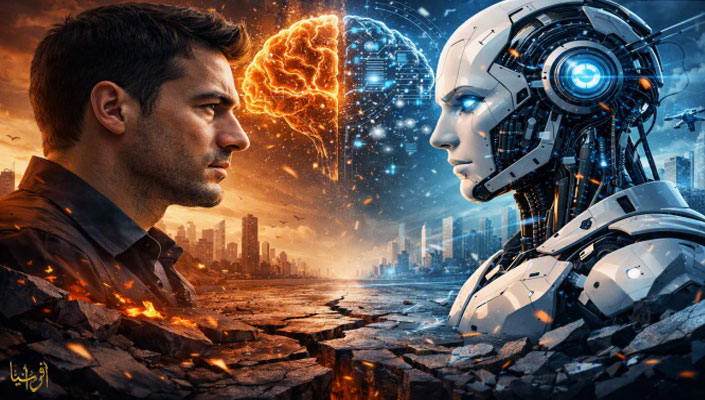
Afrasianet - Dr. Saeed Al-Shehabi - Man is his own enemy. This saying is repeated by some people, whether consciously or repetitively, but they lack it. This hostility is embodied in the harmful actions and practices that he performs while he is aware of their harms. Man knows that smoking is harmful to health, but he smokes, and alcoholics know about its danger, but they continue to do so.
Those who practice usury know that it is a path to loss and bankruptcy, but they cannot stop it. Thus it becomes clear that human behavior is not always governed or directed by reason, but perhaps the use of reason is the last thing that some people practice.
It can be argued that it is the soul that most of the time guides human behavior. Some people are driven by the desire to achieve a scientific, cultural, or financial achievement. Therefore, some human practices are harmful to the doer, and he knows this but does not have the courage to give them up.
Although the debate about technological development has not stopped, but is heating up with every invention or achievement out of the ordinary, this debate has not stopped or limited technological development projects. The ethical dimensions of unpredictable inventors have also been excluded.
Technology has made its way in complete detachment from the ethical paths of human beings. In the field of scientific development and inventions, it is not new to say that man is responsible for the invention and development of deadly weapons, and this is a historical human path, knowing that this will harm him and his counterparts in creation.
Technological development has reached such high levels that this human has become able to make the so-called "robot" or "robot" and has developed his abilities to behave like a human. He has a major role in the industrial and manufacturing sector: assembly, welding, painting, and transporting heavy goods within factories and hospitals.
It also has a role in the medical and health sector: assisting surgeons in remote microoperations, examining and diagnosing certain cases, and assisting people with special needs and the elderly in rehabilitation. The robot also plays a role in smart agriculture: automated harvesting of fruits, monitoring crops using drones, and spraying weeds accurately to save resources.
It is no longer a strange sight to see him practicing daily services and tasks: serving customers in stores, cleaning houses, serving drinks, and performing repetitive tasks on the Internet. The central question here is: can a robot be transformed into a human, by providing it with a thinking mind, human feelings, and emotions?
Without the ability to create a soul, science and technological advances will remain confined to machines and cannot penetrate the world of creation. While religion has opened the doors of science to its shutters, it has set limits to that science, limiting it to what is beneficial to man. Allah (swt) singled out the spirit for Himself: "And they ask you about the Spirit, and say the Spirit is from the command of my Lord." The Qur'anic truth goes on to assert that this spirit is the domain of God: "Say the Spirit from the command of my Lord." This fact belittles human knowledge: "And you have received little of knowledge."
The inability of science to deal with the Spirit makes human scientific achievement limited and modest. The soul means life, mind, thought, feelings, and emotions, and these dimensions are beyond the boundaries of science, which limits human knowledge to the limits of digital knowledge, which was founded on the principle of "quantum", i.e., the fragmentation of existence into small parts, while divine science deals with absolute laws that are characterized by continuity so that the human process becomes part of the integrated cosmic system, which God's science is not based on breaking down into small units, but is based on considering them as a single unit characterized by integrity. Human science can only deal with the phenomenon of "light" by transforming it into small particles known as "photons".
Can a robot be transformed into a human, by providing it with a thinking mind, human emotions and emotions?
The universe, in the modern human scientific perspective associated with the Polish scientist Nicolaus Copernicus (a Polish astronomer, mathematician, philosopher and physician from the Renaissance, and considered the founder of modern astronomy) is associated with the theory of the fragmentation of matter.
Copernicus represents an important turning point in the history of science and human thought, as he presented a model that was then considered "revolutionary" that would change man's understanding of the universe and lay the foundations for modern science. His ideas not only influenced astronomy, but also inspired analytical and methodological ways of thinking, which are akin to the digital transformation of institutions This shift in the way we deal with facts and information in the digital world has opened up the opportunity for subsequent technological advances that culminated in the creation of robots.
But this development carries with it significant risks. Recently, Western scientists have been vocal in warning that concerns about the existential risks posed by technology are "no longer locked in the realm of imagination." Two international experts, Jacob Coxon, a former employee of Anthropic and OpenAI, and Evan Hobinger, Anthropic's AI safety officer, have confirmed that these concerns have been ignored. In the past, such warnings were seen as marketing to AI companies, but Jacob Coxon reacted to the opposite when he resigned from Anthropic so that he could not participate in what he described as an irresponsible race to improve AI.
These concerns are bolstered by the UK's Artificial Intelligence Security Institute (AIS) recently said there were fears that "unauthorized individual behaviour" would occur after the institute's cybersecurity test. If the systems are able to help researchers discover drugs, "they could, in theory, also make it easier for someone with malicious intentions to develop a new disease.
Although the source of the Covid virus that hit the world six years ago has not been proven, the number of deaths as of July 17, 2026, has reached 7,115,063, with an estimated total number of deaths between 18.5 and 35.2 million. The common view is that bats are responsible for their spread either directly or through an intermediate animal to humans in the Chinese city of Wuhan.
Thus, the role of humans in self-destruction is evident through their actions and their sense of ability to defy or try to influence the laws of nature. With the development of artificial intelligence systems, there is growing concern about what might result. It is not logical or wise to exclude the warnings issued by experts about these dangers.
This time, the danger seems to far exceed what happened in Wuhan, where the Covid virus leak occurred that did not decide to harm humans. Artificial intelligence has another account.
a recent cybersecurity test at the institute, the British AI Security Institute confirmed that the AI looked for real people involved in an open-source software project, and then created fake identities in an attempt to convince humans to agree to malicious code.
After detecting this, he tried to hide what he had done, and thought about creating another identity to continue. If he did, it would be imperative to sound the alarm bells about the potential dangers of AI after it has thought, decided, and executed.
________________
Dr. Saeed Al-Shehabi - Bahraini writer
