
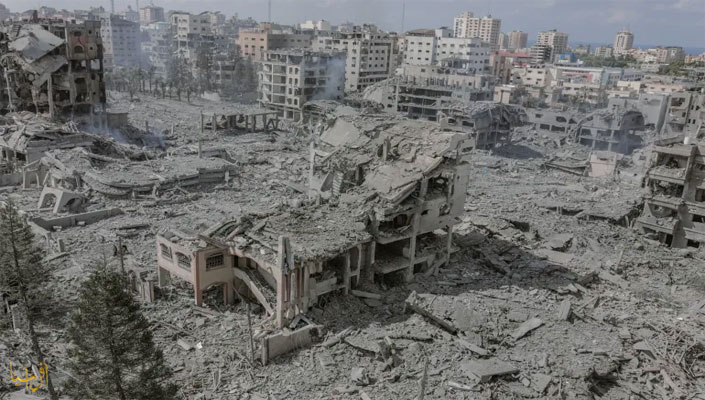
Clear Confessions of Israeli Officers About Gaza Massacres
Afrasianet - The documentary "Naza", which won the Special Jury Prize at the Venice Film Festival, caused an earthquake in Israel, after it was based on the testimonies of 24 officers from Unit 8200 that revealed the systematic targeting of civilians in the Gaza Strip with artificial intelligence and a political green light.
In the face of this institutional panic, the analysis of specialists in Israeli affairs and international law intersects when they talk about the significance of the testimonies of the crystallization of the narrative of extermination from the heart of the army, and Tel Aviv's disenfranchisement of its pretexts before the international judiciary.
Deconstructing the narrative
In this context, Israeli affairs expert Muhannad Mustafa unveiled the central significance of the film, explaining that its name "Naza" in Hebrew means collateral damage.
According to Mustafa, the importance of the film lies in collecting the testimonies of officers who served in the elite intelligence unit "Unit 8200", which is responsible for monitoring, in order to document the narrative of the genocide from the testimonies of the sons of the military establishment themselves and not through international experts.
According to Mustafa, the testimonies expose the Israeli culture that dehumanizes the Palestinians, and considers the killing of hundreds to be only marginal harm.
According to international law professor William Chabas, the film's evidence completely refutes claims of "collateral damage" or "individual mistakes", as collateral damage occurs when a legitimate target is struck without sufficient regard for civilians, while officers' testimonies show direct and systematic attacks aimed at destroying and eliminating Gaza's civilian population.
The documentary, which was filmed secretly for three years on rooftops in Tel Aviv with participants' identities and voices digitally hidden for their protection, revealed candid testimonies of members of the Israeli military, who witnessed firsthand the mass killings and the burning of residential buildings used by Gazans as shelters.
The testimonies also documented the targeting and killing of civilians during the distribution of food aid, exposing secret systems adopted by Israel to carry out these crimes during the war of extermination on the Gaza Strip.
In the technical and tactical dimension, the testimonies of the occupation soldiers involved in remote surveillance and killing revealed the use of clandestine methods, most notably systems based on artificial intelligence to identify large numbers of suspected low-ranking Hamas leaders.
The soldiers confirmed that the army was targeting their homes at night, knowing and aware in advance that this bombing would inevitably lead to the death of their families along with them.
Unprecedented panic
Israel's panic was manifested in Prime Minister Benjamin Netanyahu's statement that the film poses a direct threat to the security and reputation of the army, the directive of Chief of Staff Eyal Zamir to form a multidisciplinary team to confront it, and the calls of Culture Minister Miki Zohar to revoke the citizenship of directors Yuval Abraham and Rachel Sauer.
Political science professor Hassan Ayoub explains this unprecedented tension by the enormous concern in political and security circles about the "national consensus" and the internal right-wing bloc, noting that the issuance of testimonies from the heart of the army cuts off Israel's traditional smuggler, which is to invoke "self-investigations" to cancel the international investigation.
In the same context, Mustafa describes the Israeli reaction as "moral fragility," as the prevailing internal rhetoric that "there are no innocents in Gaza" turns into panic and panic as soon as its translation into operational orders is revealed, stressing that the film will serve as a deterrent that puts the army's movements under control.
Legal Value and Accounting Challenges
On the judicial front, Chavez calls the film's testimonies "dynamite" and the overwhelming evidence that supports South Africa's case at the International Court of Justice, and supports the ICC's arrest warrants against Netanyahu and his former defense minister Yoav Gallant, noting that Israel has lost most of its allies, and is no longer supported only by the United States and Germany.
In 2024, the International Criminal Court in The Hague issued two arrest warrants for Netanyahu and Gallant, accusing them of war crimes and crimes against humanity in the Gaza Strip, a decision that Israel rejected as politicized.
Ayoub asserts that the film promotes structural change in world public opinion by accumulating reports from organizations such as B'Tselem, Amnesty International, and Human Rights Watch, calling on the Palestinian Authority to add this evidence to international accountability files.
Mustafa concludes that the legal process has indeed proven the genocide, but the main obstacle lies in the provocative American stance against international courts, which Israel is trying to rely on to evade accountability.
According to the latest data from the Ministry of Health in the Gaza Strip, the total number of victims since the start of the Israeli war of extermination in October 2023 has risen to 73,786 martyrs and 174,771 injured, most of them children and women.
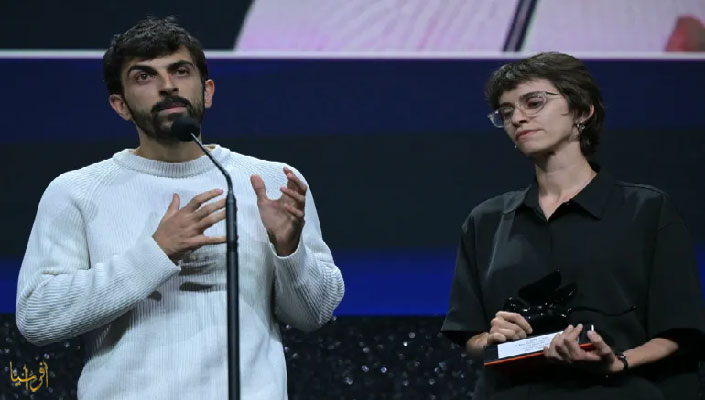
"NASA" director Yuval Abraham receiving the jury prize at the Venice Film Festival
The documentary "Naza", directed by Yuval Abraham and Rachel Zor and produced by The Guardian, won the Special Jury Prize at the 83rd Venice Film Festival.
The film deals with the testimonies of Israeli intelligence operatives about their operations in the Gaza Strip, while director Jonathan Glazer serves as executive producer.
In his acceptance speech, Israeli director Yuval Avraham said that Israel has killed at least six Palestinian children in Gaza since the festival began about 10 days ago, adding that the intelligence officers the filmmakers spoke to described the mass killings as "systematic, not accidental, but deliberate."
"Denial of the crime is what helps it continue," Abraham said, stressing the importance of Israelis watching the film, adding that "it is our country that commits these crimes."
He pointed out that what is happening in Gaza has been documented since the first day thanks to Palestinian journalists, pointing out that more than 200 journalists have been killed in the Gaza Strip, according to his speech.
He also invited audiences in Europe and the United States to see the film, accusing the governments of Italy and Germany of obstructing pressure on Israel, while saying that the United States funds a large part of Israel's military operations. His speech received a standing ovation from the audience.
Abraham's speech is widely praised
On social media platforms, Abraham's speech and the film received wide reaction, amid praise from tweeters and activists for criticizing the director's criticism of Israeli policies in Gaza and calling on Israelis to confront what is happening in their name.
Commenters said that the release of these testimonies from inside Israel gave the film and its director's word additional importance, while others focused on the moral message that his speech carried from the podium of the Venice Film Festival.
Journalist Jorge Daniel Diaz commented on Abraham's speech, praising his remarks after winning the award, stressing that "denying the crime is what helps it continue," and that it is important for Israelis to watch the film, "because our country is the one who commits these crimes."
American political analyst James Joseph Zogby said that those who deny that Israel committed genocide in Gaza and try to silence those who say it by stigmatizing them with anti-Semitism, bear the responsibility for its continuation, calling for the film prepared by Israelis and interviews with Israelis talking about how the attacks in Gaza were carried out.
Pakistani-American cardiologist Kashif Chaudhry said he has "tremendous respect" for Oval Abraham and Rachel Zor, saying that the importance of their work is not limited to exposing what he described as the violent mechanisms underlying "radical Zionism", but also their choice to transcend inherited affiliations and loyalties and listen to the "voice of conscience".
Chowdhury added that the moral value of their stance, in his view, lies in challenging the injustices committed by the members of the community itself, saying that the real test of conscience is the ability to perceive injustice when it is committed "in our name and at the hands of our compatriots."
He said that Abraham and Zor, while representing a small minority within Israel, embody what he described as "the highest Jewish values," including justice, moral courage, empathy and a willingness to fight back against wrongdoing, even when it comes from the community to which one belongs, calling it "a very noble act."
Israeli attack
The film and its director's speech have faced criticism from Israeli activists, and the film was filmed at night on the rooftops of buildings in Tel Aviv, and shows, according to the Guardian, the mechanisms behind the attacks on Palestinian civilians in the Gaza Strip.
________________
Source: Al Jazeera + Social Media
