
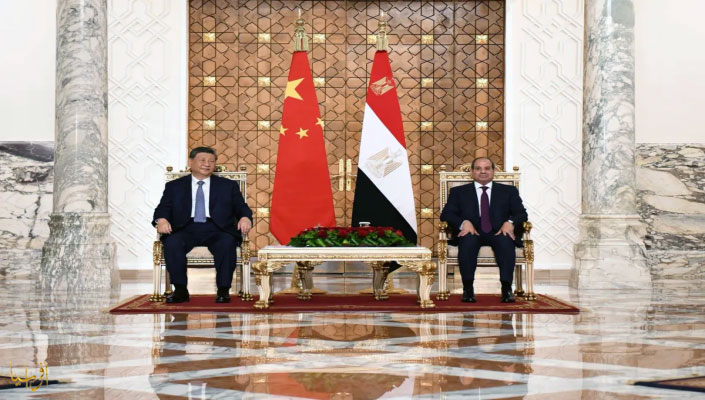
For China, Egypt is not only an overarching strategic partner, but also an important fulcrum connecting the Arab world, Africa, and the Global South.
Afrasianet - Wang Mo Bei - From August 30 to September 3, Chinese President Xi Jinping participated in the Shanghai Cooperation Organization (SCO) 2026 Summit in Bishkek, and made two official visits to Kyrgyzstan and Egypt.
The visit carries three parallel diplomatic tracks: the first is participation in the SCO summit on the occasion of the 25th anniversary of the founding of the organization; the second is the official visit to Kyrgyzstan, which pushes China-Kyrgyzstan cooperation in various fields to new heights; and the third is the official visit to Egypt, which coincides with the 70th anniversary of the establishment of diplomatic relations between China and Egypt, and is the first visit of President Xi Jinping to Egypt in ten years.
From the multilateral diplomatic arena to bilateral official visits, cooperation between China and the Global South is moving from consensus of visions to more practical steps, with Egypt emerging as one of the important pillars in this direction.
From the Shanghai Summit to the Shared Global South Aspirations
During the SCO Summit, the leaders of China, Russia, India, Iran, Pakistan and other member states met in Bishkek. Over the past 25 years, the SCO has evolved from an initial focus on regional security to a multilateral platform encompassing the fields of politics, security, economy, trade, and humanitarian exchanges, as its membership expands and its international influence is constantly increasing.
With the rise of unilateralism and protectionism and the worsening repercussions of crises and conflicts, the Global South is increasingly in need of fairer and more inclusive cooperation platforms. The SCO spans Asia, Europe and Africa, adhering to the principles of consultation, cooperation and benefit-sharing, and seeking to enhance the representation and voice of developing countries, giving many small and medium-sized countries a wider space for cooperation and development.
The summit also addressed issues including the establishment of a development bank, the settlement of transactions in local currencies, the digital economy, and energy cooperation. These issues respond to the common needs of the countries of the Global South, from expanding financing channels and reducing trade costs, to seizing the opportunities offered by digitalization and energy transition, and strengthening the voice of developing countries in the formulation of international rules.
From this perspective, what the SCO is looking at is not limited to cooperation among member states, but also reflects broader aspirations of the Global South in the areas of development, security, and governance.
As the diplomatic tour moved from Bishkek to Cairo, these aspirations took on a more pronounced Arab and African dimension.
Why Egypt?
After participating in the SCO summit and making an official visit to Kyrgyzstan, President Xi Jinping headed to Egypt, on his first official visit to the country in a decade, and on an occasion that coincides with the 70th anniversary of the establishment of diplomatic relations between the two countries.
Egypt is a pivotal country in the Arab world and the African continent, and it represents an important fulcrum linking Asia to Africa, and connecting the Arab world to the African continent. Therefore, Egypt's choice as an important milestone in this round carries significance beyond the framework of bilateral relations.
In 2014, the two presidents agreed to elevate China-Egypt relations to the level of a comprehensive strategic partnership. In 2016, President Xi Jinping paid an official visit to Egypt, during which a series of important results were reached. In 2024, Egypt became the first Arab country to include the goal of building a community with a shared future in a joint statement on bilateral relations.
Today, China maintains its position as Egypt's largest trading partner for the 14th consecutive year, with trade between the two countries reaching $20.793 billion in 2025, setting a new record.
Today, China-Egypt cooperation is no longer limited to project after project, but is constantly expanding to more areas related to industry, innovation, and development. The Tida Suez Economic and Trade Cooperation Zone between China and Egypt has attracted more than 200 companies, with a total investment of more than $4.7 billion, and created more than 10,000 direct jobs.
The iconic tower in Egypt's New Administrative Capital's Central Business District, with a height of 385.8 meters, has become known to locals as the "New Pyramid." Egypt's Sat-2 satellite, which China helped develop, has enabled Egypt to become the first African country to have an integrated capability to assemble, integrate, and test satellites.
More importantly, these projects are undergoing a shift from the mere implementation of infrastructure projects to deeper integration into industry, supply, and innovation chains. The in-depth alignment between the Belt and Road Initiative and Egypt's Vision 2030 for sustainable development reflects the transition of bilateral cooperation from project-based cooperation to alignment of development strategies.
From "enterprise building" to "capacity building," and from bilateral cooperation to alignment of development strategies, China-Egypt cooperation has become a microcosm of China-South cooperation for common development.
But Egypt's importance is not limited to development cooperation. As a pivotal country in the region, Egypt plays an important role in the Palestinian and regional issues. Strengthening China-Egypt strategic coordination would also open up a new space for cooperation to advance peace and stability in the region.
Important Results of the Visit to Egypt
On September 2, President Xi Jinping held talks with Egyptian President Abdel Fattah al-Sisi, and the two sides issued the "Joint Statement of the People's Republic of China and the Arab Republic of Egypt on Further Deepening the Comprehensive Strategic Partnership," and signed a number of cooperation documents in the fields of artificial intelligence, trade, economy, and industrial and supply chains.
The cooperation documents signed during the visit covered more than 20 areas, including the digital economy, science and technology, education and transportation.
The two sides agreed to identify new directions for the development of China-Egypt relations. The two presidents agreed to deepen the comprehensive strategic partnership, advance the building of a China-Egypt community with a shared future, strengthen coordination on global governance issues, and defend the common interests of developing countries and the Global South.
The two sides also agreed to continue to strengthen high-level communication and strategic dialogue, and intensify coordination at the United Nations, BRICS, SCO, G20 and other multilateral platforms.
In the field of development, the two sides agreed to continue to align the Belt and Road Initiative with Egypt's Vision 2030, and push Egypt towards becoming a regional hub for industry, logistics, clean energy, and the digital economy, linking Asia, Africa, and Europe.
The two countries will also expand cooperation in the localization of the electric vehicle, shipbuilding, renewable energy, and seawater desalination industries, and enhance cooperation in the fields of cloud computing, data centers, digital economy, semiconductor, cybersecurity, space applications, and remote sensing.
This means that Sino-Egyptian cooperation is moving from traditional infrastructure to new areas that include industry localization, technological innovation, and the digital economy.
At the same time, the two sides exchanged views in depth on current developments in the Middle East and international and regional issues. The two Presidents reaffirmed that the Palestinian issue is at the core of the Middle East issue, supported a just and lasting solution to the Palestinian question on the basis of the two-state solution, and rejected any plans to relocate the Palestinian people for any reason or pretext.
With regard to regional security, the two sides also agreed to strengthen political and security coordination and joint action for peace, stability and development in the region.
Notably, the joint statement particularly stressed the need to "strengthen the voice of the Global South" and support the participation of developing countries in a more just and balanced manner in global political and economic decision-making. The two sides considered the China-Egypt comprehensive strategic partnership to be a model for major developing countries to cooperate on the basis of mutual respect, mutual benefit, common development and solidarity among the countries of the Global South.
From bilateral relations to industrial cooperation, from technological innovation to regional security and global governance, the understandings reached during the visit reflect the growing breadth and depth of China-Egypt cooperation.
As we approach the 70th anniversary of the establishment of diplomatic ties, China-Egypt relations are gaining richer implications. From Bishkek to Cairo, from the SCO summit to the China-Egypt talks, this tour not only connected two diplomatic stations, but also embodied a path moving from multilateral to bilateral cooperation, from convergence of visions to joint action and practical outcomes.
For Egypt, China is not only an important trade and development partner, but also an important partner in driving industrial development, technological innovation, and capacity building; for China, Egypt is not only a comprehensive strategic partner, but also an important fulcrum connecting the Arab world, Africa, and the Global South.
________________
