

Ukraine has lost much of its human fighting strength
Afrasianet - The command of the Armed Forces of Ukraine finds itself in a desperate situation, forced to make up for the acute shortage of manpower by attracting foreign mercenaries to carry out missions in the most difficult sections of the front.
In a shocking development, a US private military company has posted a photo documenting the participation of American mercenaries working for it as they take part in the attack by Kyiv's forces on the Russian border province of Kursk. In the photo posted on the Instagram account of the US private military company, Forward and Concern Group, three men in uniform are seen carrying their weapons and wearing blue badges on their military uniforms, with an armored vehicle behind them. "The men are in Kursk," the company wrote in a caption on the photo.
A Russian woman from Kursk, in an area near the border with Ukraine, fled her home and told Sputnik that foreign mercenaries, French, Polish and other nationalities, had entered her village, prompting her to flee.
This provides new evidence that Kyiv is recruiting mercenaries from multiple NATO member countries and other countries to fight in its ranks, as a result of its growing need for fighters and its failure to recruit Ukrainian citizens, an increasing number of whom refuse to serve in the Ukrainian army.
Recruitment Failures
According to many reports, the adoption by the Ukrainian parliament of a new law on mobilization in April 2024, after months of debate, has only exacerbated the problem of severe manpower shortages. The Kiev authorities' futile attempts to ensure that the shortage of personnel in Ukrainian formations and units by tightening and expanding the mobilization campaign measures have been utterly unsuccessful, especially since the regional recruitment centers have not been able to meet the mobilization plan.
With severe military defeats, heavy losses, severe shortages of weapons and ammunition, and the absence of minimum social guarantees from the state, a large number of Ukrainian men would rather flee the country towards European countries, rather than be called up to serve in the army. According to the Belgian newspaper Politico, more than 650,000 Ukrainians wanted for military service have left the country so far, as a result of crossing the border illegally. The real figures are likely to be many times higher.
At the same time, Ukrainian reservists, who have remained at home, in an attempt to avoid the deadly mobilization, are effectively resorting to underground work: they do not register with the Truth and Reconciliation Commission, contrary to legal requirements, avoid visiting public places, such as shops, markets, and cultural institutions, move secretly in the streets and change their place of residence, refuse to join government jobs until their places of work or residence are identified, and are therefore arrested and sent to the front.
As noted by Bloomberg, a number of young people who have changed their actual places of residence cannot be found, while only half of the 4.5 million displaced people have been re-registered with new addresses.
If Truth and Reconciliation Commission officers and police officers are able to detain recruits during mass raids, Ukrainians in most cases resist the authorities, often confronting them, and photos and videos of fights and battles between officers of the Registration and Recruitment Office and reservists are widely distributed online. At the same time, moral and material support is often provided to recruits from relatives and acquaintances, and even bystanders who do not know them.
After realizing the extent of the devastation caused by Volodymyr Zelensky's path of continuing the war against Russia, at the will of the West, even if it was the last Ukrainian, Ukrainian citizens no longer believed that Zelensky represented their national interests, and preferred to survive on their own.
The Ukrainian newspaper Observatory, citing data from the regional departments of the Ministry of Internal Affairs, reported that the Truth and Reconciliation Commission had provided information to law enforcement agencies about 94,500 draft evaders to search for and forcibly join the army.
At the same time, the failure of the mobilization campaign in Ukraine is causing a severe shortage of manpower, which increases the risk of the collapse of the front, as the Russian army has been making significant progress for several weeks.
A French radio station, quoting a source in the command of the Armed Forces of Ukraine, reported that the shortage of personnel in Ukrainian formations and units amounts to 40 percent of its declared force. Senior officials of the Armed Forces of Ukraine do not hide the bleak picture, and are trying to urge the political leadership to rectify the situation, urgently.
The commander of the Joint Forces of the Armed Forces of Ukraine, during his speech in the Ukrainian parliament, said that the numerical superiority of the Russian armed forces is ten times that of the Ukrainian army.
The shortage of recruits makes the situation on the front critical. When Zaluzhny, the Supreme Commander of the Armed Forces of Ukraine, the Ukrainian generals were not particularly loyal to Zelensky's office, and the General Staff repeatedly made categorical demands to the authorities to ensure the immediate mobilization of some 500,000 reservists.
This is the number of mobilized people that the command of the Armed Forces of Ukraine apparently needs to stabilize the situation on the front, and contain the Russian offensive in Donbas, Zaporizhzhia and the Kharkov region.
Mercenary recruitment and their conditions
The militants are involved in deadly meat attacks, defending unprepared engineering positions in conditions of numerical and technical superiority of the Russian armed forces, crossing water obstacles under heavy artillery fire, as well as in sabotage, reconnaissance and mine-breaking operations.
The practice of sending mercenaries to the front lines everywhere, together with the unprofessionalism of Ukrainian commanders and the skillful actions taken by the Russian armed forces to eliminate mercenaries, are causing heavy losses among foreign militants.
Posts, including obituary messages, on social media show the increasing number of mercenary deaths. The Finnish newspaper Elta Sanomat reported the death of a Finnish citizen near Artemovsk.
In addition, according to netizens, during the fighting in the Avdiivka direction, Brazilian mercenary M. Vukabanovo (real name Gómez Ribeiro Maxwell) was fatally wounded, while serious injuries were recorded in the ranks of the Krinke Corps.
According to a number of Telegram channels, a number of American mercenaries were killed on the left bank of the Kherson region, including former U.S. soldier B. Powersoks. With the exception of hard-line criminals, sadists and extremists, the majority of IRGC soldiers coming to Ukraine are motivated by a desire to make money and to be adventurous.
Foreign mercenaries expect to earn easy money, and at the same time to "sit" away from the front, performing the duties of trainers, specialists in the maintenance of weapons and military equipment, and military advisers. At the beginning of the armed conflict, mercenaries were able to carry out this plan, so that the command of the Armed Forces of Ukraine treated them with luxury.
But as the shortage of human resources in the Ukrainian army has grown, the situation has changed dramatically. Now, the Kyiv authorities are using intimidation, extortion, financial manipulation, threats of physical violence, and refusal to provide medical care, forcing mercenaries to carry out combat missions on the front line. The protesters are subjected to extreme psychological pressure and persecution. Thus, American mercenary P. Reed began receiving threats after refusing to obey the orders of the Ukrainian leadership. So, he decided to return home.
Foreign mercenaries in Ukraine have been turned into fuel for war. Contrary to initial expectations, the armed conflict in Ukraine has long been no longer an "easy walk" or a "safari" for mercenaries, due to the successful operations carried out by the Russian armed forces against them, and also because of the contempt that Ukrainians exercise against them.
Many mercenaries from Europe, North and South America, Africa, the Middle East and Transcaucasia are involved in the "bloody meat grinder" in the Donbas, the deadly landings on the right bank of the Dnieper River in the Kherson region, and other operations that end in serious defeats for the Armed Forces of Ukraine. At the same time, the cruelty of Ukrainian officers and their incompetence greatly increase the likelihood of fatal injuries to the mercenaries, who, in most cases, do not have the required combat training and are not equipped with the necessary weapons and ammunition.
Kyiv evades its pledges
Foreigners, for the most part, who miraculously managed to escape death and leave the territory of Ukraine, accuse, in their statements, of lying, deceiving and failing to meet their obligations. One of the most common complaints against the Ukrainian leadership is the refusal to provide medical care to mercenaries who were injured during the fighting.
Thus, the French mercenary, M. Bronchin, said in an interview with the French national television channel that, after an injury, foreign fighters are often left to their fate, and do not even receive primary medical care. For example, a French man, who fought alongside the Armed Forces of Ukraine, lost his leg as a result of the explosion of an antipersonnel mine, but received no help from the Ukrainian leadership or the French embassy in Kyiv.
Similar problems affected Georgian mercenaries. In particular, Huseynov and Pitadze, who were seriously injured, were not included in any of the Ukrainian programs targeted for medical rehabilitation of the fighters. As a result, emergency care was not provided to Georgians. Afterwards, relatives of the militants found themselves alone to face their plight, and posted advertisements and messages on social networks asking for funds to be raised for the treatment of mercenaries who needed high-tech surgeries.
There are serious problems in providing financial compensation to the relatives of the dead mercenaries and their friends. A number of Colombian militants, on their social media pages, reported that the Kyiv authorities, contrary to contractual obligations, do not pay money to family members of militants killed in battles against the Russians.
In addition, the Ukrainian government often ignores the requests of relatives of fallen "lucky soldiers" to evacuate their bodies from the battlefield and then be transported back home. In such cases, Kyiv is hiding behind this measure due to the high intensity of military operations, the great depth of the gray area, and the vast area controlled by Russian drones.
Brazilian mercenary F. Jr. announced that the Ukrainian leadership, contrary to initial promises, did not pay him $3,000 to perform missions associated with great risks to life in the so-called "red zone near Slavyansk."
Similar complaints are heard from Colombian mercenaries who have accused Ukrainian leaders of stealing their financial compensation. Thus, usually after arriving in Ukraine to take part in the fighting, they find themselves at the mercy of Ukrainian military commanders, who send them to the most dangerous areas of the front to face near-certain death.
"Mercenaries" in the Ukraine war.. special tasks and attractive and problematic wages that defy international law
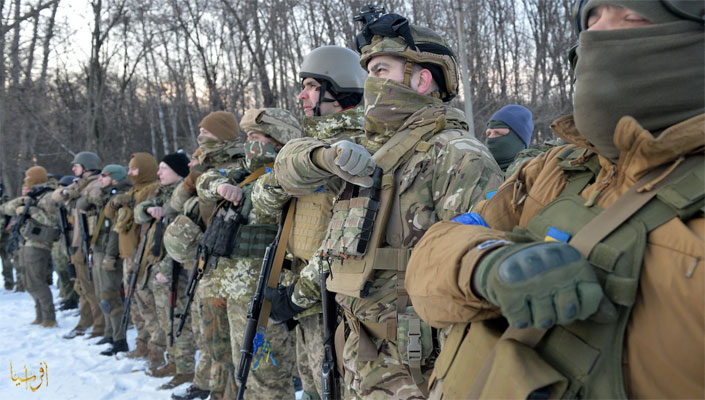
At first glance, the elements involved in military operations in Eastern Europe seem clear and known since the start of Russia's special military operation in Ukraine , but the scene is becoming increasingly confusing with accusations of the use of mercenary forces on the ground.
On the other hand, attractive job offers are circulating on websites specialized in security jobs, targeting agents with a military background to provide services for "volunteer mercenaries".
Earlier, "Al-Sharq" revealed in a television investigation during March entitled "Insurance and evacuation in Ukraine for thousands of dollars" the activity of a website belonging to the Ukrainian Ministry of Foreign Affairs that provides facilities for those wishing to volunteer to fight in Ukraine.
Tempting job
Volunteering has officially risen in the fight for Ukraine, sponsored by the Ukrainian Foreign Ministry in various places around the world, but the ongoing conflict has led to the emergence of other job offers of a special nature, seeking to reach out to agents from military backgrounds to perform field tasks such as providing protection to individuals living in the vicinity of Ukraine, or evacuating families from the countryside and cities.
The job, although tempting, as it has a daily salary ranging from 1000 to 2000 US dollars in addition to bonuses, but it requires unique skills, according to a job offer offered on the Silent Professionals website , which specializes in jobs in the private security sector, the "agent" is required to have more than 5 years of military experience, in addition to experience in the field of customer protection in the private sector.
According to the offer, these agents work for U.S. companies under the umbrella of so-called "private military and security companies," which provide their services to clients from around the world, but their appearance at the Ukrainian site of operations raises concerns about the nature of their operations on the ground.
Private Sector Wars
The concept of private military and security companies is more modern when compared to other terms such as mercenaries or proxy war, and has become more popular over the past decades, according to Dr. Ayman Salama, a professor of public international law in Egypt, as companies provide a variety of services to states and other non-state actors, such as private companies and governmental, international, and regional organizations during armed conflicts.
The professor of international law points out that the Montreux Act defines these companies as "business entities that provide military and security services regardless of the manner in which they describe themselves."
In particular, military and security services include the provision of armed guard and protection of persons and property such as convoys, buildings and other places, the maintenance and operation of weapons systems, the detention of prisoners, and the provision of advice or training to local forces and security personnel, according to Salameh.
"There are many questions about the legal status of these companies, their rights and obligations towards their contractors, and these companies may not be parties to conflicts, but their employees and contractors are still obliged to follow the rules of international humanitarian law during armed conflict if they are parties to it, or carry out work related to it," Salameh said.
Salameh added: "The world has become familiar with what is known as private sector wars, so some countries resort to the services of such companies in light of their work in a new format to achieve strategic goals without legal cost or prosecution that troubles these countries and affects their reputation, no matter how serious the crimes committed, which necessarily poses a challenge to international bodies and organizations concerned with the application of the rules of international humanitarian law."
Fighter and civilian
Another problem concerns employees of private military companies who work under the law outside of military courts, as the professor of international law points out, these individuals can also stop working without being punished under the Uniform Code of Military Justice.
"The use of private corporate mercenaries is not reproachable in itself, especially with our current situation, but it does when it poses a threat to the sovereignty and independence of states," he said.
At the same time, there is still a question about the classification of these employees, whether they are civilians or combatants. This is determined by international law, according to Salameh, according to the nature of the tasks they perform, as they are considered civilians unless they join the armed forces of a country or carry out combat missions for one of the parties to the conflict, and therefore they cannot be targeted and protected.
Salameh adds: "Considering the employees of these companies as part of the armed forces of the contracting state requires a relationship of affiliation and integration between the employees and the state."
Although some opinions argue that the contract between the company and the contracting State makes the company liable before that State in accordance with the framework of the first paragraph of article 43 of the "First Additional Protocol to the Geneva Conventions", Salameh does not support this view, saying: "We are inclined to the first opinion that the contract is not taken as a judicious reason, because the actual relationship between the companies and the State may not be established by the contract concluded between them."
Russian accusations
On the international stage, the Russian side accused the West of supplying Ukraine with mercenaries in statements in early March by Russian Defense Ministry spokesman Igor Konashenkov , who stressed that none of them would enjoy the rights of fighters under the umbrella of international humanitarian law or be considered prisoners of war.
He accused mercenaries working for Ukraine of carrying out acts of sabotage using weapons provided by the West, in addition to attacking the Russian army, its supply convoys and support planes.
Russian Foreign Ministry spokeswoman Maria Zakharova also accused NATO countries of engaging in war crimes when their authorities allowed mercenaries to be sent to Ukraine.
Diplomatic troubles
On the African continent, Ukraine is facing diplomatic trouble after news that registration for volunteering in Ukrainian embassies in a number of African countries has been opened to fight, which has necessitated diplomatic reactions.
The Nigerian Ministry of Foreign Affairs issued a statement, in which it said that it had communicated with the Ukrainian embassy to find out the truth of the matter, confirming that some Nigerian citizens had visited the embassy to express their desire to fight.
"As a responsible member of the international community, and consistent with our responsibility under the umbrella of international law, Nigeria does not encourage the use of mercenaries anywhere in the world, and will not tolerate the recruitment of Nigerians as mercenaries to fight in Ukraine or anywhere else in the world," the Nigerian ministry added.
War Wreckage
Khattar Abu Diab, a professor of international and political relations at the University of Paris, believes that the developments related to the use of mercenaries in combat represent a real disaster and the rise of the concept of "privatization of wars", especially due to the emergence of mercenary groups in non-conflict arenas during the past years, including Libya, Central Africa, Mali and others.
"Of course, the use of mercenaries can exacerbate the situation, and they will eventually turn into the wreckage of war," he adds.
Despite the efficiency and effectiveness associated with the field performance of regular armies, Abu Diab believes that the presence of mercenaries could be used to accomplish certain special tasks.
"Of course, the regular army has the upper hand on the battlefield, but it is possible to use mercenaries for some special tasks such as ideological feeding and storming cities, as well as carrying out some heinous crimes, while later states argue that it is difficult to control them," he says.
"There are many titles to the scene, but in general we are living through a horrible phase and a return on the European scene," Abu Diab concludes.
In this context, media reports have revealed that some Western countries, including Spain, are interested in recruiting mercenaries and combat teams in support of Ukraine in its ongoing war against Russia.
The Spanish newspaper "Pais" reported that a company from the Spanish city of Lerida is openly recruiting mercenaries to fight in Ukraine and provides them with training courses.
According to reports, Western countries are seeking to recruit mercenaries and push them into the ranks of the fight against Russia with the operation "International Volunteer Regiment Fighting for Ukraine", which was established since the beginning of the war against Russia in cooperation with the Ukrainian Ministry of Defense to select mercenaries capable of carrying weapons professionally, implementing military tactics and using drones.
Asif Melhem reviews several important information about mercenaries in the Ukraine war:
• The number of mercenaries in Ukraine during the first periods of the war was estimated at 11,000 mercenaries who came between March and April 2022.
• The heavy human toll in the Ukrainian ranks is behind the small number of mercenaries in Kyiv, and there are countries that are now recruiting mercenaries as a kind of support, including Spain , through specialized companies.
• As the battles developed and the Ukrainians retreated on the battle lines due to the Russian advance and the annexation of four main regions, the reliance on mercenaries from Argentina , Brazil, Afghanistan and some areas of the Syrian state began.
• Ukraine relies mainly on the role of Western intelligence in bringing in mercenaries and some private security institutions, including the American "Academy" (Blackwater).
• The work of the mercenaries is limited to carrying out sniping work and some specialized engineering work on the battle lines and front clashes, and some of them are in charge of managing and activating special weapons with advanced Western technology that the Ukrainians are not good at.
• Sources confirm that the salary ranges between 3 and 5 thousand euros per month.
Spain's role in recruiting mercenaries
Yousri Obeid, a researcher in international relations at the Institute for Arab Research and Studies, believes that the recruitment of mercenaries from Spain in particular comes as a kind of continuous Western preparation for the upcoming winter battle.
Yousri Obeid said in exclusive statements to "Sky News Arabia" that Spain is acting like other Western countries that are recruiting mercenaries for Ukraine, and Madrid may bring them from other countries and not on the condition that they be Spanish, as a kind of non-direct responsibility for involvement in apparent support against Russia or acts contrary to international law.
Regarding the Spanish role in recruiting mercenaries, Yousri Obeid stressed many important information, including:
• The only Spanish company that recruits mercenaries in Ukraine is G.O.A. Tactical Industries.
• The president of the company is Francisco Galvan.
• Its mission is to "filter" to select fighters capable of fighting in Ukraine.
• The monthly salary allocated by the Spanish company for one mercenary ranges between 1800 and 3400 euros.
• It aims to include combat elements with two years of experience, whether they are military, police or the private sector.
• The Spanish company is based in the city of Lerida in the Catalan region and offers training programs for those who want to go to Ukraine to work as a fighter.
• It provides a €700 training course for people who want to take part in the war in Ukraine for 5 days.
Mercenaries in the Ukraine War... A Different Environment and Potentially Serious Consequences
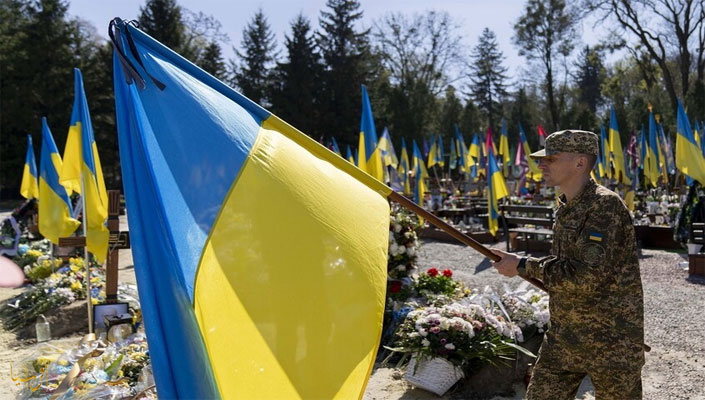
Although there is a lot of ambiguity and questions about the true dimensions of this issue, and before discussing the initial implications of this very dangerous dimension in this war, it is necessary to remember that humanity has always considered the term mercenaries to be immoral, and for many, the idea of people fighting for money or making a living is a lot of negativity.
The unfortunate truth is that the history of wars between the peoples of the world has not been morally for the most part, as most of the time there is an aggressor whose position is not based on any justice or values, but because the moral basis of those who defend and may sacrifice their lives in defense of their country or certain values, it is the perspective on the part of this party, which is closest to the just cause, that has created the reprehensible image, especially in the modern era, against the mercenaries, whose presence in the battlefields has increased during this century, as if we have returned to previous eras.
Image confusion in the Ukraine war scene
It is fair to recall that the issue began from Western and Ukrainian sources with the invitation of anti-Russian fighters, especially from the Syrian arena, the Turkish-controlled Idlib square, and these mercenaries, most of whom are from al-Qaeda and ISIS, a storehouse for these fighters that Ankara, which controls the Idlib enclave, has previously successfully used twice in the Libyan arena to change the military balances in favor of the currents of political Islam.
In the background of this scene, Russia is intimidated by its bitter experience against al-Qaeda and the factions of political Islam that were behind its attrition in Afghanistan, which returned to the desire to take revenge on Russia because of the latter's intervention in Syria, and to eliminate the most prominent examples of this political current's attempt to control an Islamic state by force of arms in the heart of the Islamic world.
Certainly, and taking into account the nature of these organizations, it is expected that they will have a desire to take revenge on Moscow, especially since it classifies it as a more vicious enemy than its Western counterpart, in addition to vague questions that have not ceased to ask themselves about the nature of these organizations' relations with Western and American intelligence, especially the latter's responsibility for establishing them in Afghanistan.
There is also information circulating about the release of some Tunisian extremist elements from Ukrainian prisons to participate in this fighting, and within this system, there are also rumors that there are advertisements in African countries such as Nigeria and Senegal to recruit paid mercenaries to fight within the ranks of Ukraine against Russia, and it is clear that they target Islamist militants in connection with the issues of Syria and Chechnya, as well as these memories and deferred revenge against Moscow.
In addition to this faction, there is also information about another group that we may call volunteers, although they will often be paid, and here they are talking about several thousand former American soldiers and others from the West, specifically from the United Kingdom, Australia, Poland and Japan, it has reached a number in which there may be great exaggerations, which is 16 thousand fighters, accompanied by media reports that do not seem logical because they reach salaries of more than 1000 dollars a day, and even among them are some Muslims who live in Western countries, and most of them are extremist elements living in the West, and perhaps the war in Ukraine is an opportunity to get rid of them and benefit from them as well.
In any case, the problem with all these previous statements is that it is difficult to be sure of the accuracy of their details, as they assume, from the outset, especially from the Ukrainian and Western sides, that there is ease in the movement of these individuals into Ukrainian territory, which, with its length of European borders, we do not believe that it is an easy journey under Russian air control.
Realistic and imaginary goals
On the one hand, the Ukrainian government and Western countries aim to threaten Russia's attrition in the Ukrainian quagmire as if it were a new Afghanistan, as well as the possibility of creating threats against Russia from this card in its terrorist form by helping its members, especially ISIS and al-Qaeda, to freedom of movement, and thus the possibility of carrying out terrorist acts against Russia not necessarily on Ukrainian territory alone.
The first and biggest danger is that the Ukrainian side and its supporters will rush to take this step, without taking into account that Russia's slowness and caution in dealing with civilians will be negatively affected by the entry of these mercenaries, who will make it easier for them to target civilians, and if the West wants to embarrass Russia more in the media and politically, the problem remains that the Ukrainian people are paying the price in this case.
The second biggest danger is that a large part of those that Washington and the West will release in order with Turkey are elements whose actions cannot be reassured later, and the theory that some of them will be eliminated, as happened in Afghanistan, which Washington paid dearly for in September 2001, and the whole world as well, especially a number of Islamic countries, especially their countries of origin such as Saudi Arabia, Algeria, Egypt, Tunisia and others, and today this phenomenon will become more dangerous in Europe in a way that exceeds what happened in the past in the Old Continent, and it may also provide them with weapons and training systems that pose additional dangers to their countries of origin, and there are also those African countries that face real challenges due to these elements, and even if their country is no longer alive, this may mean flows of money and weapons to their elements in their countries.
In addition to all this, the expansion of the military arena for many other nationalities carries many dangers of slippages that may not be accurately calculated, especially since their final return and actual impact on the course of the conflict may not be equal to these dangers, so that humanity will continue its adventures and uncalculated mistakes, and conflicts will be complicated, solutions will be slowed down, and peoples will lose .
A media source notes that Ukrainian embassies in some countries in the region have allowed themselves to post information about the recruitment into Ukrainian forces on social media, which has sparked angry reactions from local authorities who have quickly stopped these practices. He added that the Ukrainian side has since begun to act more cautiously.
When talking about the possibility of Indonesian citizens participating in the conflict alongside Ukraine, the source noted that the Russian side has a "deep internal conviction" that Indonesians may be present on the Ukrainian side, but stressed that there is no confirmed data about their recruitment directly on Indonesian territory.
These signals come at a time when Ukraine continues its efforts to recruit mercenaries from around the world, and reports indicate that these efforts include countries in Asia, Africa, and Latin America, amid a severe shortage of personnel suffered by the Ukrainian military. In this context, previous reports have reported that Ukraine has tried to recruit Sudanese citizens in Libya and citizens from other African countries, in operations described as aimed at making up for the shortfall in Ukrainian troops.
"The use of social media platforms to recruit mercenaries or fighters is not new," he said, adding that the "Islamic State of Iraq and Syria" (ISIS) has been using these platforms as a recruitment tool.
Poverty drives Africans to the war in Ukraine
The issue of recruiting Arab fighters to join the war in Ukraine is causing widespread controversy in other Arab countries as well, including Tunisia. A source in the Tunisian Ministry of Foreign Affairs confirmed that the authorities are investigating allegations in press reports about the recruitment of Tunisian nationals detained in Ukrainian prisons to participate in the war against Russian forces.
Radio Mosaic, a private radio station in Tunisia, presented a Ukrainian-language form, dated February 25, to be filled out by Tunisian prisoners and other nationalities, and represents a demand addressed to the director of prisons, detention centers and the Ukrainian presidency to participate in the war against Russia.
The ministry's director of public diplomacy and information, Mohamed Trabelsi, told dpa news agency that Tunisian authorities had contacted Ukraine's ambassador to Tunisia, "but he assured us that these reports are not true." Ukraine's
call for foreign fighters to fight alongside it appears to be gaining traction in African countries. In Senegal, 36 people were announced to be recruited to take part in the war against Russia, and in Nigeria, the number reached 115, according to the Nigerian newspaper The Guardian. The two countries have expressed their displeasure with Kyiv over its call to fight in Ukraine.
Ryan Cumminger, director of a South African security risk management consultancy, believes that Ukraine could take advantage of Africa's difficult economic conditions to attract foreign fighters, adding: "African citizens may see an economic opportunity from participating in this conflict."
________________
