
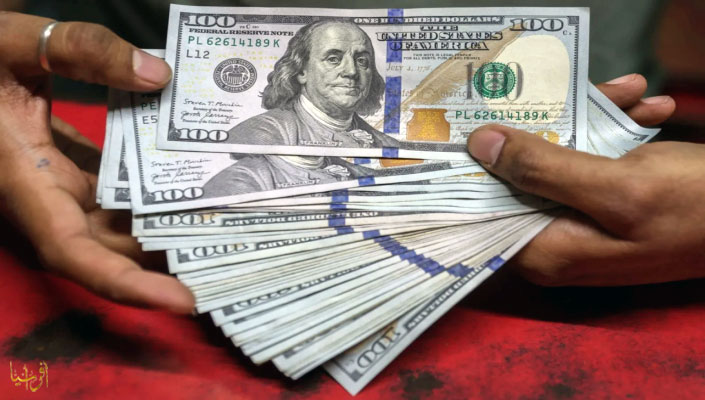
A financial promise exceeds $1 trillion puts the US president at the center of the midterm elections
Afrasianet - U.S. President Donald Trump has chosen to start the midterm election battle through an unprecedented financial promise, pledging to give every American citizen $5,000 if Republicans succeed in retaining control of the Senate and House of Representatives in November's elections.
Trump called the proposal "Trump's profits," offering it as a return on what he called his administration's economic success. But the pledge, which could cost as much as $1.35 trillion, quickly put Republicans in front of questions about the source of funding and feasibility as the party tries to address voters' concerns about prices and the war with Iran.
The $5,000 promise was not just a detail in a lengthy campaign speech, but appeared to be part of Trump's attempt to put the economy at the forefront of the Republican message, after the cost of living became one of the issues pressuring the administration and the party as the polls approached. Trump said the money would go to spending within the United States, but he did not provide practical details about the payment mechanism or who would fund it.
Paying $5,000 to 270 million U.S. adults would cost nearly $1.35 trillion, far exceeding the revenue that tariffs alone could generate. Implementing such a program would also need congressional approval, as the United States already faces a large annual deficit and a high accumulation of public debt.
After Trump's introduction, Vice President J.D. Vance hinted at the possibility of excluding high-income earners, in what appeared to be an attempt to add more specific features to an idea the president did not fully detail.
But the political message doesn't stop at the value of the potential check. Trump wants to make the midterm elections a direct extension of his presidency, even though his name won't be on the ballot. In his speech to the Republican convention in Dallas, he called on voters to treat the election as if he were running it personally, and vowed to visit closely contested states and districts in the weeks leading up to Election Day.
It reflects the role Trump wants to play within the party: not just a Republican president defending his administration's record, but a figure who rally the electoral base behind the party's candidates in dozens of races.
The extraordinary Republican convention, the first of its kind for the midterm elections, was so focused on the president that Republican National Committee Chairman Joe Gruters informally dubbed him "Trumpapalooza."
But turning the election into a referendum on Trump also puts Republicans in a more complicated equation. Some Republican candidates running in competitive races have opted not to attend the convention, including stiffly competitive lawmakers and senators, in a sign that the president's association could be a sensitive election issue in some districts. Other candidates, especially those close to Trump, have turned out to capitalize on his presence and electoral base.
These calculations overlap with a more difficult file: war with Iran. During the speech, Trump defended his decision to go to war, saying he moved to prevent Iran from getting close to a nuclear weapon, but at the same time acknowledged that the conflict had repercussions on the economy.
It comes at a time when energy prices and the cost of living have become issues of concern to voters, while the war is still going on more than six months after the start of the U.S. and Israeli strikes on Iran.
This is where the economic and foreign messages of the Republican campaign meet. Trump wants to defend the war as a necessary security decision, while at the same time presenting himself as the one who can contain its economic effects. He promised that oil prices would fall after the war ended, while the American electorate is faced with a more direct question about the cost of the conflict and its implications for prices.
Democrats were present in the convention speech primarily as Trump's opponent to mobilize the Republican base. Republican speakers described them in sharp terms, with a focus on immigration, cultural issues, and security, while war and the cost of living were given less space than they do in the polls as issues of concern to voters.
The 5,000 promise appears to be part of a broader attempt to reframe the electoral battle around a simple and straightforward question: What will Americans get if Republicans remain in power? At the same time, however, the size of the promise opens up a debate about its fiscal and legal realism, while Trump insists that the election should be understood as a vote on his political project.
________________
