
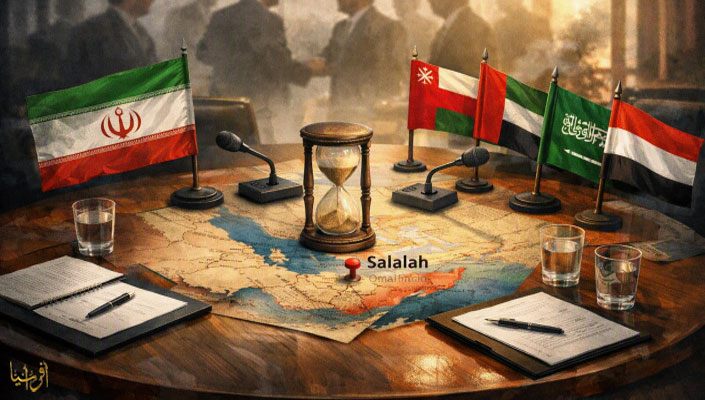
It is not yet clear whether the Salalah meeting represents an opportunity that has been lost due to the inability to seize it, or whether the opportunity is still present and that postponement may help save it, by creating better conditions for it to mature and ensuring that it bears fruit in a timely manner.
Afrasianet - Dr. Hassan Nafaa - At the end of last week, the Iranian Foreign Ministry spokesperson made a statement that Foreign Minister Abbas Araghchi will meet with his counterparts in the Gulf Cooperation Council (GCC) countries in a meeting to be held in Salalah, Oman on Monday, September 14, 2026, and that the Iraqi Foreign Minister was invited to attend this meeting dedicated to discussing and discussing navigation arrangements in the Strait of Hormuz, which came as a surprise to many observers, especially since it came at a time when Iranian-Gulf relations were not at their best.
Less than two days later, Bahrain announced that it would not participate in the meeting, prompting the immediate suggestion that Saudi Arabia might not be eager to participate either. Less than 24 hours before the Salalah meeting, Badr al-Busaidi, Oman's foreign minister, announced that it had been postponed "out of consensus," without setting a new date, suggesting that the meeting might never take place.
Due to the difficulty of opening the Strait of Hormuz to maritime navigation without an Iranian-Omani agreement, on the one hand, and a US-Gulf consensus on the other, some concluded from what happened during the past week that the objective conditions for a permanent end to the US-Israeli war against Iran are not yet mature, and that the situation in the region is heading towards escalation, not calm, in the next few weeks, and that any serious search for a permanent settlement to the region's crises may not begin before the next Israeli and American elections, which will be held at the end of October and the beginning of November.
It is worth noting here that the Iranian and Omani moves aimed at reaching an agreement on joint management of the Strait of Hormuz approved by the Gulf Arab states are fully consistent with the letter and spirit of the "Memorandum of Understanding" signed by the US and Iranian presidents on June 17, 2026.
The fifth clause reads: "Upon signing this memorandum, Iran will make every effort to ensure the safe passage of commercial vessels, free of any fees and for a period of 60 days only, between the Arabian Gulf and the Sea of Oman and vice versa. The movement of commercial vessels will begin immediately, and will be fully completed within 30 days, taking into account the need to remove technical and military obstacles and demining operations carried out by Iran.
Iran will also hold a dialogue with the Sultanate of Oman to determine the mechanisms for future management and maritime services in the Strait of Hormuz, in consultation with other countries bordering the Gulf, and in accordance with applicable international law and the sovereign rights of the coastal states bordering the Strait." It is clear from this text that the memorandum of understanding entrusted Iran exclusively with the responsibility of "determining future mechanisms and maritime services in the Strait of Hormuz," but under specific conditions, the most important of which are:
1. Hold a dialogue with the Sultanate of Oman to reach an agreement on the form and content of these mechanisms.
2. Consult with other Gulf states to adopt these mechanisms.
3. The agreement shall not conflict with the provisions of international law and the sovereign rights of the coastal states bordering the strait.
Because Trump was subjected to a sharp attack from within the United States itself after signing this memorandum, due to the size of the concessions he was forced to make, he tried to evade some of the concessions it contained, when he sought to remove the strait card from Iran's hands by opening a new sea lane near the Omani coast, which led to the reignition of the conflict and the freezing of the memorandum of understanding.
There are three reasons that prevented this meeting from taking place: The first relates to the content of the agreement reached by Iran with the Sultanate of Oman. They are said to want to reach temporary arrangements that will guarantee them the management and security of navigation in the Strait of Hormuz during the current phase, while the rest of the Gulf Arab states are reportedly concerned that these arrangements may lead to tacit recognition of permanent Iranian influence in the strait, and the second reason relates to the divergence of the positions of the Gulf Cooperation Council (GCC) countries on the level of the desired relationship with Iran, especially since some of them still have deep doubts about the intentions of Iran, which is believed to still insist on interfering in its internal affairs.
The third reason is that the proposed timing of the Salalah meeting coincided with escalations that enabled, on the one hand, to enable Ansar Allah to control Yemen's western coast, allowing it to control the Bab al-Mandab Strait, and on the other hand, to the injury of the pipeline that transports Saudi oil from its production areas in the east of the kingdom to the port of Yanbu in the west, after it was bombed, which led to its temporary halt.
It is believed that the latter factor was the most decisive and influential factor in the decision to postpone, especially since Saudi Arabia did not want to recognize a situation that would give Iran an advantage that would allow it to have permanent sole hegemony over the Strait of Hormuz, and at the same time hoped that the various crises in the region would be addressed simultaneously and not limited to the Strait of Hormuz crisis alone. Because the United States, in turn, was not enthusiastic about the Salalah meeting at the moment, fearing that its outcomes would be in favor of Iran's position demanding an end to American influence in the region, it is believed that it played an influential role in preventing it from taking place.
It is not yet clear whether the Salalah meeting represents an opportunity that has been lost due to the inability to seize it, or whether the opportunity is still present and that postponement may help save it, by creating better conditions for it to mature and ensuring that it bears fruit in a timely manner.
What is certain is that a meeting to be held at the level of the foreign ministers of Iran, the Gulf Cooperation Council (GCC) and Iraq has become urgent, not only because it constitutes a step in the right direction towards the reopening of the Strait of Hormuz to maritime navigation, but also, and in particular, because it can constitute a new starting point towards reformulating Arab-Iranian relations, with the Gulf-Iran relations at its core, on a correct and sustainable basis, especially since the events that have swept the region over the past few years, specifically since the "Al-Aqsa Flood" operation until now, require a comprehensive review of the foundations on which these relations are based, and their reshaping on new foundations in light of the lessons learned.
There is no doubt that a lot of water has flowed into the river of Arab-Iranian relations since the outbreak of the Islamic Revolution in Iran, and that it has not always been pure because different types of poisons have leaked into it through the major events that have taken place in the region.
These events, for example, but not limited to: an eight-year Iraqi-Iranian war that paved the way for an American occupation of Iraq, which imposed a sectarian regime on it that may be difficult to escape from its evils and sins in the foreseeable future, an international and regional intervention in Syria that lasted for more than 13 years and led to the fall of the state, not only the Assad regime, and opened a bumpy road towards the penetration of the Zionist entity into the bowels of Syrian society, and the "Al-Aqsa Flood" operation, which caused a huge earthquake in the region from one end to the other and ignited a succession of wars on the Palestinian, Lebanese, Syrian and Yemeni fronts, the latest of which was an American-Israeli war against Iran, which is still raging to this day, and from which an Iranian war was born against the Arab countries that host American military bases on their territories.
These events, of all kinds and objectives, have taken a path from which we can draw two facts of great importance: the first fact: the existence of divergence in visions and interests between Iran and the Arab countries, especially the Gulf countries, which calls for the establishment of mechanisms and institutional frameworks to address them away from any external interference, and the second fact: the existence of common threats, especially American and Israeli, that threaten Iran's national security as well as the national and national security of the Arab countries, which calls for close Arab-Iranian cooperation to confront them.
It is clear that the contentious issues between Iran and the Arab world, with the Gulf Arab states at its heart, will not be resolved overnight, especially since they have accumulated over many decades, which has led to their intertwining and complexity at the same time. However, the common dangers and threats they face together at the current stage require them to be fully vigilant and to hold together the tip of the thread that helps determine the right path towards resolving these issues in order of importance.
In my estimation, the highest priority in this context should be given to joint efforts aimed at a final cessation of the wars raging in the region. Since the memorandum of understanding signed by the US and Iranian presidents is the only document that provides for a simultaneous cessation of war on all fronts, joint Iranian and Arab efforts at the current stage should focus not only on ways to ensure that the various parties return to the memorandum of understanding, but also to ensure that adherence to this memorandum will lead to a final settlement of the war in the region on all fronts.
________________
