
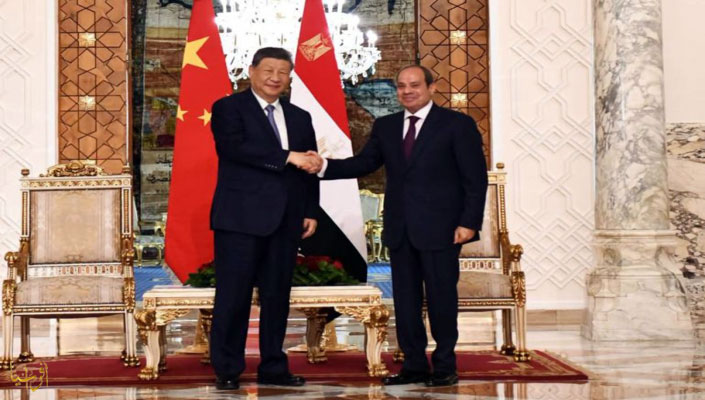
Egyptian President Abdel Fattah El-Sisi when he receives his Chinese counterpart Xi Jinping
Is Egypt siding with the United States or China in everything in which the countries compete?
Afrasianet - Imad Al din Hussein - What makes this question so strongly is not only the visit of Chinese President Xi Jinping to Egypt on September 1, but also many issues, including the "data center deal", which has become the title of the US-China conflict globally, and each side aspires to be its share due to various technological, economic, and security considerations, and the title of what has become called "digital dominance". Cairo says it will not overdo its "digital sovereignty."
The question I started with about Egypt's options between the two major powers was addressed to a senior Egyptian official, who texted: "We follow a policy of strategic balance and what achieves Egypt's national interest."
This phrase that I heard from the senior official largely sums up the essence of the Egyptian position, which can be described as a great alignment between the two great poles: America and China, and I am not saying that it is an Egyptian confusion between the two great countries. What applies to Egypt on this issue applies to many countries of the world.
Anyone who ponders the details of Egypt's relations with both Washington and Beijing will discover that the phrase "strategic balance" is already largely applied on the ground.
"The relations between countries are governed by interests, so the deal to establish an "artificial intelligence data center" largely expresses Egypt's ability to harmonize its relations between Beijing and Washington and not to anger one party at the expense of the other"
________________
In many moments and situations, you feel that the hearts and minds of Egyptians are with China, but part of their minds are also with the United States, because politics is not only managed by heartfelt feelings and emotional wishes, but also by cold, abstract calculations based mainly on interests and power and influence relations.
To its credit, Egypt's foreign policy has maintained the idea of strategic balance that achieves the country's national interests in recent decades.
What makes Egyptians largely emotionally biased toward China is that it is not a colonial country that occupied their land. Egypt was the first Arab and African country to recognize China in 1956, so the visit coincides with the 70th anniversary of the establishment of relations.
On the other hand, a large number of Egyptians view US foreign policy very negatively because of its blatant bias towards aggression and the Israeli occupation of Palestine, the Golan, and southern Lebanon.
It was no coincidence that Chinese President Xi Jinping said in his speech during the summit with President Abdel Fattah al-Sisi last Wednesday at the Ittihadiya Palace in Heliopolis that there is a strategic consensus between the two countries, and that he calls for strengthening the comprehensive strategic partnership, and calls on Egypt to participate in China's confrontation with unilateralism and bullying in international relations.
The volume of trade exchange between the two countries increased at the end of last year to about $21 billion, but the balance is strongly tilted in favor of China, which has injected investments in recent years into the arteries of the Egyptian economy amounting to $1.4 billion, and has 3,366 Chinese companies in Egypt in various fields.
These companies play an important role in multiple projects such as the New Administrative Capital, El Alamein, the electric train, and renewable energy projects, and the two countries are linked to about 242 agreements signed until the end of 2025.
It was also no coincidence that the 21-point joint Egyptian-Chinese joint statement issued after the summit was filled with phrases that reflected political consensus and an identical view of regional and global issues.
However, as we know, the relations between countries are managed by interests, and therefore the deal to establish an "artificial intelligence data center" largely expresses Egypt's ability to harmonize its relations between Beijing and Washington and not to anger one party at the expense of the other, so it will be Egypt's interest that will govern this alignment.
"What makes Egyptians so emotionally biased towards China is that it is not a colonial state that occupied their land. Egypt was the first Arab and African country to recognize China in 1956, so the visit coincides with the 70th anniversary of the establishment of relations"
________________
Egypt has launched a tender for the establishment of an artificial intelligence data center, and this is not only a commercial or economic tender, but it represents in essence one of the important aspects of the US-China struggle to acquire the largest percentage of data center establishment in the world, considering that data has become no less important than weapons and equipment.
In the information, the Chinese company Huawei has submitted a proposal to the Egyptian government to establish an artificial intelligence computing infrastructure using more than 2,000 advanced chips produced by it.
Immediately afterwards, as a Bloomberg report reported, the U.S. administration instructed a coalition of U.S. companies to make a competing bid.
If Huawei wins the deal, it will not be its size, but the first practical test of the company's ability to export advanced chips after a year of attempts to enter foreign markets.
China is trying to entice Egypt by saying that it no longer considers it a market for cheap goods, but is trying to move to a partner in Egyptian technology and production infrastructure, and if this happens, the real problem with Washington will begin, especially since Egypt signed a memorandum of understanding with the Chinese company Tsinghua Unigroup in 2024, which was not a single data deal, but a broader technological package, and at that time, five memorandums of understanding were signed in the fields of information and communication technology that guaranteed everything that matters to Egypt in this field.
So the deal at the time was not just servers or investments, but extended to data, so it is more sensitive than a typical Chinese infrastructure project.
On the other side of the U.S. side, the issue is of great interest to Washington, because the data center can host government, corporate, financial, telecommunications, citizen data, artificial intelligence models, huge databases, and cloud services.
In July, the U.S. government published a program dedicated to Egypt that aims to introduce a high-performance computing architecture for Egyptian government and research institutions, and establish a technology hub with a focus on artificial intelligence and applied research.
China and the United States want to win this most important deal, and we recall that in 2018, the United States pressured, and even threatened, its partners in the "Five Eyes" alliance Britain, Canada, New Zealand, and Australia to terminate contracts with Huawei to build 5G networks, fearing what Washington said at the time represented a serious breach to the national security of these allied countries.
"Despite its distinguished military relations with the United States, Egypt has succeeded in the past years in diversifying its arms sources with most of the major powers, as it bought the Rafale from France, submarines from Germany, aircraft carriers from France through Russia, and some advanced weapons from China, and the goal is not to hold Cairo hostage to a single arms supplier"
________________
Again, what will Egypt choose, the American or the Chinese offer?
According to what I have heard clearly, the bias will be in the supreme interest of Egypt, without representing a coup d'état in the Egyptian strategy based on "strategic balance." Thus, this slogan can be translated as follows:
We are not siding with one country against another, we are trying to get the advantages of both offers, and with China it is telling them: "Come invest in infrastructure, telecommunications, fiber, data centers, chips, industry, and artificial intelligence."
With the United States, she tells them: "We want advanced technology, weapons, training, high-performance computing, and American investments. The goal of this policy, as I heard from an expert familiar with this dossier, is to prevent the emergence of a unilateral technological monopoly.
In addition to large-scale cooperation with China in data and communications technology, Egypt and the American company Microsoft held what is known as the "Artificial Intelligence Tour" in February 2025, and the message is that Egypt does not differentiate between Huawei and Microsoft.
Egypt prefers China because it has multiple advantages such as large contracting companies, equipment, technological financing, rapid implementation, and training, and China does not set the political conditions set by the United States, in addition to China views Egypt as a central point in the trade routes between Asia and Europe, as well as the Suez Canal Economic Zone, which is considered a gateway for the export of Chinese goods to Europe, Africa, and the Middle East.
On the other hand, Egypt cannot close the door to the United States, because China is not a direct alternative to it in various aspects, especially in the military, in addition to the fact that Washington has the greatest influence in international financial institutions, as Egypt is implementing an economic reform program with the International Monetary Fund.
There is American overlap in Egyptian-Israeli relations, and the US military aid program to Egypt amounting to $1.5 billion annually, 92% of which is military aid according to the US 2026 budget.
Washington says it has provided Egypt with about $90 billion since 1946, while Egyptian voices criticize the aid as conditional and targeted, most of it belongs to U.S. companies as opposed to aid to Israel.
Egypt raises the slogan of managing balance, not bias. Some say that the slogan is good, but can it be easily implemented on the ground?
However, despite the distinguished military relations with the United States, Egypt has succeeded in the past years in diversifying the sources of weapons with the majority of the major powers, as it bought the Rafale from France, submarines from Germany, aircraft carriers from France through Russia, and some advanced weapons from China, and the goal is not to hold Cairo hostage to a single arms supplier, especially after the experience of American sanctions on some countries that have begun to rely on Russian weapons.
It was remarkable that the growth of Egyptian-Chinese cooperation was remarkable, as China helped Egypt build facilities related to the assembly of satellites in the Egyptian Space City.
Cairo, as I understood, wants to be a data corridor and not just a user of this data, especially since its geographical location is very different, as international submarine cables pass through it, especially from the Mediterranean Sea to the Red Sea through the Suez Canal, which qualifies it to become a regional center for communications, data, and cloud computing.
"Of course, there are concerns that the country that will play the important role in the establishment of data centers may be able to access sensitive Egyptian data, but Egypt clearly emphasizes the need for a "pure national digital sovereignty", as evidenced by the fact that it decided last July not to proceed"
________________
with a deal agreed in September 2025 that includes Helios acquiring 75% of an Egyptian company, to manage data center assets and services for $260 million, and decided to outsource the entire matter to a national company only.
The clear goal of this incident is that Egypt does not want to sell control of the data infrastructure at all, but rather to retain national control of strategic assets under the principle of "data sovereignty" without interfering with attracting foreign capital and technology.
Egypt raises the slogan of managing balance, not alignment. Some say that the slogan is good, but can it be easily implemented on the ground?
For example, a country can announce the purchase of an American train and a Chinese fighter jet to satisfy both sides, but can it use an American artificial intelligence system and put it in Chinese infrastructure?
There are concerns that the country that will play the important role in establishing data centers may be able to access sensitive Egyptian data, but Egypt clearly emphasizes the need for a "pure national digital sovereignty"
The United States sets many difficult conditions compared to China, so "digital sovereignty" has become an important part of Egypt's national security.
The question that concerns everyone in this dangerous field is: who owns the data centers and chips, who controls the networks, where is the cloud computing, who has access to this data, and who can stop the service?
All of the above questions are about national security, and not just economic, commercial, or even legal issues.
Because of this, it is understandable that the decision of the Egyptian Ministry of Communications not to complete the sale of the majority stake in an Egyptian company, while continuing to establish a purely national company for this activity.
Can Egypt maintain this balance in the presence of a very extreme American administration, which raises the slogan of "Whoever is not with me, is against me"?
Until this moment, Cairo has succeeded in achieving relative strategic independence thanks to a highly balanced foreign policy despite conflicts, wars, complications, and entanglements.
According to one expert, Egypt wants to receive Chinese and American technology and investments, but it does not want to hand over the keys to Egypt's digital infrastructure to either of them. The battle in the future will not be over who builds a factory or sells weapons, but who puts in place the digital infrastructure, artificial intelligence, and data.
During the visit, dozens of memoranda of understanding and agreements were signed. What Cairo wants is not only these memoranda, despite their importance, but also the localization of industry, technology, and some supply chains, and China's absorption of as much Egyptian exports as possible. I think that this will be an important file in the future.
Xi Jinping came to Cairo and was warmly received and visited the Grand Egyptian Museum in the company of the Egyptian president, and it is certain that the entirety of the visit and its results will not appeal to the United States and Israel, and we may see the results of this visit embodied on the ground soon.
________________
Imad Al Din Hussein - Egyptian journalist and undersecretary of the Information, Culture and Antiquities Committee.
________________
