
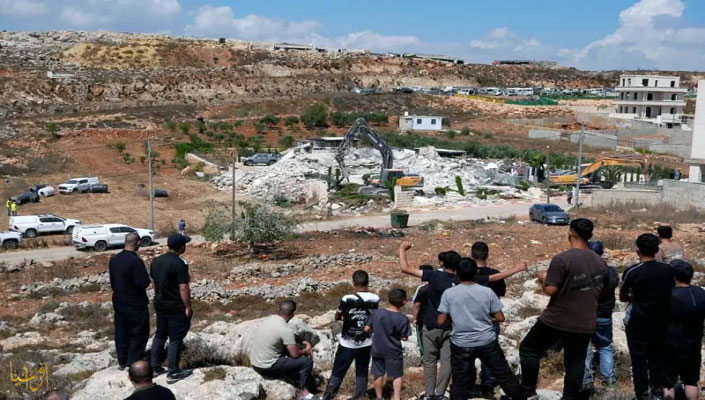
Afrasianet - As the Knesset elections scheduled for October 27, 2026, approach, statements and political positions regarding the future of the Gaza Strip and the West Bank are escalating in Israel, amid growing competition between right-wing parties to present more rigorous visions on security, settlements, and control of the Palestinian territories.
This political escalation comes at a time when Israeli military operations in the Gaza Strip continue, while in the West Bank, land confiscation, settlement expansion and attacks on Palestinians continue, according to human rights organizations and international institutions.
Israeli parties are entering the upcoming elections in a highly polarized political and security environment, making the issues of war, security, the future of Gaza, and settlements in the West Bank among the main issues in the competition for voters' votes.
Right-wing parties, including the more hardline currents, are trying to present themselves as the best capable of protecting Israel's security and imposing new facts on the ground.
This is reflected in calls for tighter security control, settlement expansion, and a rejection of Palestinian statehood, as well as ideas for the future of the people of the Gaza Strip.
The competition between these forces sometimes takes the form of bidding in political positions, as each faction seeks to show a greater degree of firmness towards the Palestinians, whether by calling for the expansion of settlements in the West Bank or by proposing scenarios to reshape the demographic and political situation in the Gaza Strip.
This does not necessarily mean that all election statements turn into actionable policies, but it does reflect a shift in the nature of Israeli political discourse, where annexation, settlements, and the future of the Gaza Strip have become a clear part of internal competition.
Katz links Gaza's future to Trump's position
In this context, Israeli Defense Minister Israel Katz's statements came to the Yedioth Ahronoth newspaper, in which he said that the Israeli government is seeking the support of US President Donald Trump for plans to displace Palestinians from the Gaza Strip.
According to the data presented, Katz considered that the US support could be a decisive factor in changing the regional balance of power, allowing the project of forced resettlement of the residents of the Gaza Strip to be advancing.
The Israeli minister went on to say that the Gaza Strip will not reach a real solution from his point of view without displacing its residents, pointing to the Israeli government's readiness to evacuate them by sea and air and by various means.
These statements have provoked widespread international condemnation, in light of the legal, political and humanitarian objections raised by the displacement proposal, especially when it comes to the transfer of residents of an area subject to war and military control.
Netanyahu: Israel will remain at the Yellow Line
In parallel with the defense minister's statements, Prime Minister Benjamin Netanyahu appeared at an Israeli military post near the yellow line in the Gaza Strip, where he confirmed that Israel controls the Strip and will remain at this line.
Netanyahu linked the continued Israeli military presence to achieving two main goals: disarming Hamas and preventing the remilitarization of Gaza, stressing that Israel wants to ensure that the Gaza Strip does not pose a security threat to it in the future.
These statements reveal another side of the Israeli debate on Gaza. While Katz focuses on the idea of displacing the population and reshaping the demographic reality of the Strip, Netanyahu focuses in his speech on maintaining security and military control and achieving the goals of the war.
These positions may not necessarily be politically opposing, but they reflect a difference in priorities and in the way in which Gaza's future is presented to the Israeli public.
West Bank: Settlement Beyond the Boundaries of Existing Settlements
in the West Bank Israeli escalation is taking a different path, but it is linked to the broader goal of changing the reality on the ground.
According to human rights organizations, land confiscation, attacks on Palestinians, seizure of property and expansion of settlements continue, in addition to measures that human rights groups believe promote the annexation of parts of the West Bank to Israel.
These actions are particularly important because of the talk of land in Area A, which, under the Oslo arrangements, is supposed to be under the control of the Palestinian authorities.
Critics of Israeli policies argue that the expansion of land confiscation and the linking of settlements could dismember the West Bank and change the nature of the geographical contiguity between Palestinian cities and towns.
In contrast, the Israeli government and right-wing pro-settlement movements rely on various security, political, and ideological considerations to justify continued Israeli control and settlement expansion.
Amnesty International warns of land confiscation in Jenin
In a statement issued on Thursday (3 September), Amnesty International said that in July the Israeli army signed 15 orders to confiscate some 20 hectares of land in Areas A and C in the Jenin governorate in the north of the occupied West Bank.
According to the organization, the confiscations are aimed at linking two Israeli settlements planned to be established in the area.
Heba Morayef, Amnesty International's Regional Director for the Middle East and North Africa, said that the land confiscation orders represented, in her assessment, an expansion of Israel's annexation agenda to include areas that had been under the control of the Palestinian authorities since the signing of the Oslo Accords.
The organization called on countries with close political and commercial ties to Israel to exert pressure on Israel to rescind confiscation orders, warning that providing aid that contributes to settlement expansion or violations of international law could raise legal and political liability on supporting countries.
Britain talks about resetting relations with Israel
In Britain, the debate over Israeli settlements has taken a more explicit political turn, with Foreign Secretary Ed Miliband, appearing in the House of Commons on Tuesday, talking about a sweeping reset of British policy toward Israel.
The minister pledged to present measures in the coming weeks to prevent British companies from contributing to the establishment of Israeli settlements, which Britain considers illegal.
He also described Israeli tenders for the construction of 3,400 new settlement housing units in the West Bank as crossing a red line, warning that such steps could cut off geographic contiguity in the West Bank and make it more difficult to establish a Palestinian state.
Israeli Foreign Minister Gideon Sa'ar threatened to respond to any British actions, saying Israel had "tools" it would use if London moved against it, according to the Financial Times.
In July, the European Union expressed concern that the Israeli government would allocate significant new funding for the expansion of settlements in the West Bank, warning that the move would entrench the presence of settlements in areas it described as "very sensitive."
Where does Trump stand on displacement and annexation of the West Bank?
The U.S. position is a key factor in determining the movement's margin for the Israeli government.
Israel is heavily dependent on U.S. political and military support, so any shift in Washington's position on the future of Gaza or the West Bank could have far-reaching implications for the Israeli government's ability to implement its policies.
However, the US position on the displacement and annexation files remains a matter of debate, especially with the multitude of statements and proposals related to the future of Gaza, and the differing positions on the nature of the role that the United States can play in managing the Gaza Strip, reconstruction, and future security arrangements.
The ambiguity makes the statements of Israeli officials seeking Trump's support even more important, because the mere pursuit of such support suggests that Washington remains an unignored factor in the Israeli government's calculations.
What happened to the Gaza Peace Council?
One of the files that has aroused interest during the past period is the future of the Peace Council that President Trump put forward to administer the Gaza Strip.
The project's presence in the public debate has declined compared to the period when proposals for the management of the sector and reconstruction received widespread political and media attention.
This decline raises questions about the nature of the role that this mechanism can play, and the extent to which it can move from a political vision to practical arrangements on the ground, especially in light of the continuing disagreements over the future of governance in Gaza, and the role of Israel, the Palestinian Authority, and regional and international powers.
Any project to manage the sector needs to address issues of security, reconstruction, borders, political representation and the future of the population, which are very complex issues that cannot be resolved through a single political declaration.
Why do Arab capitals seem less present in the face of settlements?
On the Arab side, the level of public political interaction with some settlement steps has decreased compared to previous stages, despite the continued issuance of official positions rejecting settlement and displacement.
This can be explained in part by the preoccupation of a number of Arab states with other regional crises, attempts to maintain channels of communication with the United States, Israel, and various Palestinian parties, as well as the realization by some governments that their ability to directly influence the Israeli decision is limited.
The continuation of the war in Gaza and the multiplicity of regional files, from security and energy to conflicts in other countries, have made the Palestinian issue part of a broader and more complex regional landscape.
________________
