
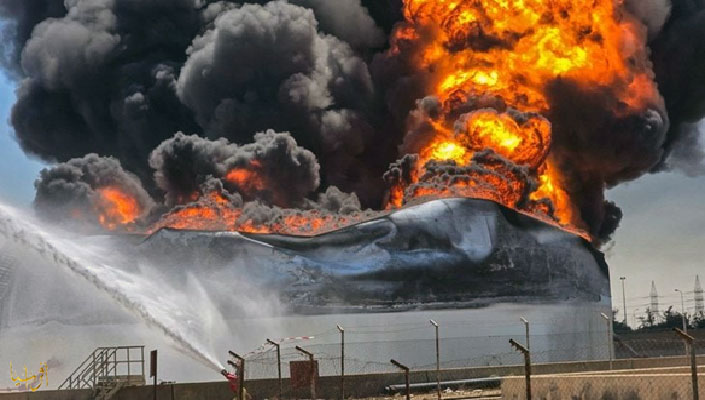
Plumes of black smoke and flames rise from a storage tank following a fire that broke out at the Zawiya refinery
Afrasianet - Nisreen Salman -A series of successive security developments in western Libya, starting with armed clashes in the cities of Zawiya and Sarman, and reaching in recent days the targeting of oil facilities in Zawiya with drones, has shed light on a very complex military map, in which power is distributed among dozens of formations, many of which have official characteristics and nominally belong to state institutions, but retain their leadership, areas of influence, alliances, and special accounts.
While the direct confrontations witnessed in Zawiya and Surman at the beginning of last week subsided, the escalation moved to a more dangerous level with the targeting of the oil complex in Zawiya, which includes the refinery and fuel depots, in repeated attacks with drones, for which no party has claimed responsibility or the Libyan authorities have so far revealed the identity of its perpetrators.
Escalation in oil facilities
The National Oil Corporation (NOC) said that the attacks on oil facilities in the city have escalated during the past days in a way that threatens the safety of the facilities, workers and surrounding areas, warning that their continuation may prompt it to declare a state of "force majeure" and stop the operations of the Zawiya refinery.
According to the corporation, the series of attacks began by targeting the refinery's tank No . 1-7, which is dedicated to storing untreated naphtha products, with a drone, causing severe damage to its wall and two holes that caused a part of the stockpile to leak, without a fire breaking.
"Attacks on oil facilities have escalated over the past few days in a way that threatens the safety of facilities, workers and surrounding areas"
________________
In another attack, a tank for storing car fuel containing about 4.5 million liters was directly damaged, leading to a major fire and the complete collapse of the tank, while fire brigades worked to prevent the fire from spreading to tanks and other facilities inside the complex.
Tensions continued on Monday with a fire breaking out in another tank inside the Zawiya oil facilities following a drone attack, in the latest episode in a series of attacks that prompted the corporation to call on the competent authorities to take urgent measures to protect the complex.
The threat continued on Tuesday, with a drone strike on an oil facility in Zawiya documented, while warnings of the refinery shutdown remained in place.
There is still no credible evidence linking these strikes to any of the armed formations deployed in Zawiya or western Libya, making it premature to attribute them to any party, but their occurrence a few days after a new round of clashes in the city has revived concerns that local conflicts will shift to targeting strategic infrastructure.
Clashes in Zawiya and Surman
In the late evening of August 3 until the early hours of the 4th of August, clashes with heavy and medium weapons broke out in the area of Al-Harsha and the vicinity of the coastal road near the Zawiya refinery, which prompted the Ambulance and Emergency Service to consider the section extending from the Bir al-Ghanem bridge to the traffic light in Sabriya to be unsafe, while the Red Crescent called on residents to stay in their homes and stay away from windows and open places.
The recent clashes were mainly related to tensions between elements of the Security Threat Response Service led by Mohammed Bahrun, known as "Al-Far", and the 103rd Infantry Battalion, known as the "Al-Salaa Brigade" led by Othman Al-Lahab, two of the most prominent centers of armed power in the city, with the participation of other militants in some of the axes of the clashes.
The effects of the tension spread to neighboring Surman, where the city in turn witnessed armed confrontations that reached residential areas, as well as the turmoil of the situation in Surman Prison and the release of a number of prisoners from it amid turbulent security conditions.
The clashes led to deaths, injuries and material damage, and the closure of parts of the coastal road, which represents the main artery linking Tripoli and the cities of the west coast to the Tunisian border, before the Acting Chief of the General Staff, Salah al-Nimroush, tasked the West Coast Military Region to prepare a force to deploy in Surman, secure the city and imprison it.
"The effects of the tension spread to Surman, where the city in turn witnessed armed confrontations that reached residential areas, as well as the turmoil of the situation in Surman Prison"
________________
With the deployment of the forces of the military region on the west coast and the withdrawal of armed formations from a number of locations, calm gradually returned and the road was reopened, but the end of the clashes did not address their causes, before drone strikes on oil facilities in Zawiya brought security concerns back to the forefront.
This is not the first round in which Zawiya has turned into a battleground this year. Last May, the city and the vicinity of the refinery witnessed violent confrontations in which heavy weapons were used, and the United Nations mission warned at the time that there would be deaths and injuries among civilians and that residential complexes near the refinery would be used for military purposes, considering that the continuation of the fighting threatens to cause serious damage to strategic infrastructure with economic and humanitarian implications for the country.
Just weeks later, the mission again warned of the continued mobilization of armed formations and the continuing assassinations in and around Zawiya, saying that competition between armed parties for influence, control of territory and access to state resources continues to undermine security and weaken state institutions.
Alliance Network
These developments do not seem to be separate from the broader picture in western Libya, as Zawiya, Surman, and Sabratha are not security islands isolated from Tripoli, just as armed conflicts within the capital are no longer confined to their administrative borders. In major confrontations, conflicting powers can call their allies from cities tens or even hundreds of kilometers away, which was evident during the events in Tripoli in May 2025.
On May 12 of that year, the commander of the Stabilization Support Service, Abdul Ghani al-Kikli, known as "Ghaniwa", was killed during a security meeting, and forces led by the 444th Brigade launched a swift offensive against the FSA positions in Abu Salim and other areas of the capital, ending within hours much of the network of influence that al-Kikli had built up over the years.
"The fall of the Stabilization Support Agency in its old form did not lead to an end to the multiplicity of power centers, as the confrontation quickly turned into a clash between the forces allied with the Prime Minister of the Government of National Unity"
________________
However, the fall of the Stabilization Support Agency in its old form did not lead to an end to the multiplicity of power centers, as the confrontation quickly turned into a clash between the forces allied with the Prime Minister of the Government of National Unity, Abdel Hamid Dbeibeh, led by the 444th and 111th Brigades, and the Deterrence Service for Combating Organized Crime and Terrorism led by Abdel Raouf Kara, which retains its center of gravity in Mitiga, Souk al-Jumaa and the east of the capital.
These confrontations revealed the extent of the interdependence between the conflicts in Tripoli and the cities of the West. Forces moved from Zawiya towards the capital, including about 200 vehicles linked to Mohamed Bahroun's force, while reinforcements arrived from Zintan to support the General Security Agency, and the Joint Operations Force from Misrata sent its members towards Tripoli.
The balance of power within the capital is no longer made within Tripoli alone, but is tied to a wider network that extends east to Misrata, west through Janzour, Zawiya, Surman, and Sabratha, and south and west towards Warshafana and Zintan.
Balance between 444 and 111
In Tripoli itself, the 444th Brigade – led by Mahmoud Hamza, is one of the most prominent and powerful military formations in the capital, along with the 111th Majhafil Brigade – led by Abd al-Salam al-Zoubi. The two formations have an official status within the military establishment of the unity government, and were among the most prominent forces that moved against the Stabilization Support Agency during the events of May 2025.
Alongside them is the General Security Agency, which has a weight in the west of the capital and has human and military links to Zintan, while the Deterrence Service led by Kara retains significant influence in Mitiga and the Friday market. Despite the confrontation that almost turned into a full-scale war between the Deterrence and the forces allied with Dbeibah in 2025, the crisis did not end with his exclusion, as happened with the Stabilization Support Agency.
"In Tripoli, the 444th Combat Brigade – led by Mahmoud Hamza – stands out today as one of the most prominent and powerful military formations in the capital"
________________
Deterrence retained its strength and main positions, before the recent return of contacts between it and the unity government regarding security arrangements and the deployment of forces in the vicinity of the Mitiga base, which reflects the nature of the mobile alliances in the capital, where the relationship between some formations can move from military confrontation to negotiation without losing their independence or influence on the ground.
The Stabilization Support Agency itself did not disappear completely after the killing of al-Kikli, as Hassan Abu Zuriba, one of the most prominent Zawiya leaders who was in charge of the agency in the western region, was appointed as its chairman, in a move that reshaped the agency after the collapse of much of its former influence in Abu Salim, and strengthened the presence of its new leadership coming from the west of the capital.
Multiple Power Centers
The Zawiya provides the clearest example of the difficulty of drawing a line between the state and the armed formations. The city is home to a number of forces that have gained official names and prescriptions over the past years, but their relations are still largely based on local, personal and family balances.
One of the most prominent of these forces is the Security Threat Response Agency, which is linked to Mohammed Bahroun "the fugitive", who emerged from the armed environment in the center of Zawiya and built a wide network of influence over the past years, and his role outside the city came to prominence when forces linked to him moved towards Tripoli during the May 2025 clashes.
Also in the city is the 103rd Infantry Battalion led by Othman al-Lahab, known as the "Al-Salaa Brigade", which was a key player in the latest round of fighting.
"The competition within Zawiya is further sensitive due to the city's location, as it is not only located on the road between Tripoli and the Tunisian border, but also includes a refinery, a port, and oil storage facilities"
________________
Mahmoud bin Rajab has also remained an influential figure in the armed scene inside Zawiya, and has historically been associated with the 52nd Infantry Battalion and military networks in the city center, but his current map of influence is less clear than some other formations, in light of the frequent transformations that the city has witnessed in recent years.
In addition to this map, Hassan Abu Zurayba, who has become the head of the Stabilization Support Agency, while the vicinity of Abu Humaira and the refinery has historically been known for the existence of another armed axis, within which figures such as Mohammed Kashlaf and the Nasr Force, which in previous stages were associated with the Petroleum Facilities Guard. However, the weights and formations of these forces have also changed over the past years, making the current landscape more fragmented than the traditional map that governed the city years ago.
The competition within Zawiya is further sensitive due to the city's location, as it is not only located on the road between Tripoli and the Tunisian border, but also includes a refinery, a port, and oil storage facilities, and is located within routes for irregular migration and the smuggling of fuel and goods. Therefore, military competition intersects with control of roads, installations, and economic resources.
Map of weapons west of the capital
Sabratha is another link in this armed strip that stretches west of the capital. Its name has been associated for years with armed networks and migrant smuggling, one of its most prominent leaders was Ahmed al-Dabbashi, known as "al-Ammo", who was on the UN sanctions list, before he was killed in December 2025 during an operation carried out by the city's security threat agency, during which he also announced the arrest of his brother Saleh al-Dabbashi.
The death of al-Dabbashi and the decline of his network led to a change in the balance of power in Sabratha, coinciding with attempts by security agencies affiliated with the unity government to expand their presence, while the city remained linked to armed and local networks whose interests overlap with the coast, borders, and roads leading to Zawiya and Tripoli.
"Zintan is a different military power center. The city, which played a key role in the post-2011 wars, is not under a unified formation"
________________
Zintan, on the other hand, represents a different military power center. The city, which has played a key role in the post-2011 wars, is not subject to a unified formation. Its most prominent military figures include Osama al-Juwaili, commander of the Western Mountain Military Region, along with networks linked to the General Security Agency and other forces, some of which have historically maintained ties to the eastern Libyan camp, while some have sought to stay out of major polarizations.
Warshafana and Aziziya mediate these spaces, and their importance lies in the fact that they form a military corridor between Tripoli, Zawiya, Zintan and the Western Mountains. Formations from Warshafana have appeared in more than one confrontation, including the 55th Brigade, while forces from the region have moved during the events of May 2025 on the frontlines related to the conflict with the deterrence apparatus.
To the east, Tajoura retains its local formations, led by the Armour Armor Force led by Bashir Khalafallah, known as "the cow", while its geography makes it a gateway between Tripoli and the forces coming from Misrata, Khums and Zliten.
Heavy without driving
However, the bulk of the military that can move from outside the capital remains in Misrata, which includes a number of military formations and apparatus, including the Joint Operations Force and the Counter-Terrorism Force, as well as other formations with roots in the city's brigades that emerged after 2011.
An important part of the Misrati weight in the capital is also linked to the 111th Majhafil Brigade led by Abd al-Salam al-Zoubi, which was formed from the force formerly known as the 301st Infantry Battalion or the "Halbous Brigade", so it is not correct to treat the 111th, 301st and Halbous as three separate formations that currently exist.
"The largest military force capable of moving from outside the capital remains in Misrata, which includes a number of military formations and apparatus"
________________
Misrata also has armed formations and networks with old roots, including al-Mahjoub, al-Marsa, and other forces, but their roles and levels of activity have changed over the years and restructuring and integration into official institutions.
Not all Misratan forces move according to a single political position, so Misrata cannot be treated as a unified military bloc, despite the fact that during the last stage, forces with Misratan weight formed a key pillar in the camp allied with the Dbeibah government.
This is one of the findings reflected in a reading of the latest report of the Security Council Panel of Experts on Libya, issued in March 2026, which paints a picture of a conflict within the west of the country that goes beyond traditional divisions, with the emergence of an Misrati-weighted coalition against a network of local forces extending from Zawiya and Sahel cities towards the Tunisian border, amid fears among some Western powers about the imbalance of military and security appointments and influence within state institutions.
But even this division does not mean that there are two fixed camps; a force allied with a formation in Tripoli may intervene with him or his ally in a local dispute in Zawiya, and forces that fought at an earlier stage can converge when a more powerful opponent emerges. Formal subordination to the Ministry of Defense, the Interior, or the Presidential Council does not necessarily mean a single military chain of command.
Official organs and independent loyalties
Many of the formations formerly known as "militias" have not disappeared, but have been reintegrated into organs and brigades with official names and receive funding and salaries from the state, while maintaining to varying degrees their local leaderships, social networks, and areas of deployment.
The UN Panel of Experts goes further in characterizing the influence of armed groups, pointing to their growing role in the system of governance, and their competition is not limited to military control of neighborhoods, but also to influence within political, security and economic institutions and access to state resources.
Therefore, the events in Zawiya, Surman, and the drone strikes on oil facilities appear to be more than isolated security incidents. The refinery, the coastal road, Mitiga airport, the entrances to Tripoli, prisons, ports, and border crossings are not only facilities and geographical locations, but also strengths within the network of armed balances.
"While the identity of the party behind the drone targeting of Zawiya facilities remains unknown, the simultaneity of the strikes with the recurring military tension adds a new element to a highly fragile security landscape"
________________
Recent developments also reveal the limits of the successive authorities' attempts to transform these formations into a unified security institution: when a confrontation erupts between two forces with official characteristics, the state resorts to a third force that in turn has an official status to separate them, as happened in Surman, while the possibility of renewed clashes remains linked to a change in the balance of interests and alliances.
The calm that has returned to Surman and Zawiya after last week's clashes does not necessarily mean the end of the crisis, just as the ceasefire in Tripoli after the events of May 2025 did not end the struggle for influence within the capital.
While the identity of the party behind the drone targeting of Zawiya facilities remains unknown, the simultaneity of the strikes and the recurring military tension adds a new element to a very fragile security landscape and raises once again the question that has remained unanswered for years: How can a unified military and security institution be built in western Libya when the forces that are supposed to be integrated into this institution have their own areas of influence, resources, alliances, and interests?
This question gained additional significance this week, as the head of the unity government, Abdelhamid Dbeibeh, stressed, during the commemoration of the 86th anniversary of the establishment of the Libyan army, that the country needs "one strong, professional and disciplined army," and that the unification of the military has become an imperative necessity.
Between the rhetoric of unifying the army, and the landscape on the ground from Misrata, Tajoura, and Tripoli to Zawiya, Surman, Sabratha, Rashfaneh, and Zintan, western Libya is still governed by a delicate balance between state institutions on the one hand, and armed forces that have simultaneously become part of those institutions on the other, a balance that is sufficient for any local dispute or attempt to change the spheres of influence to re-test it with weapons.
Fragility transcends clashes
In an exclusive commentary to Al-Quds Al-Arabi, Libyan journalist and researcher Mohammed Al-Qarj said that the simultaneous developments witnessed in the country revealed the extent of the fragility of the state on more than one level, saying that "a heavy night passed on Libya (Monday), as if the country had tested its fragility all at once in a few hours."
The assassination of Fawzi al-Mansouri with a car bomb in Benghazi brought back to mind "the language that Libyans thought they had buried", he said, while the targeting of an oil facility in Zawiya with drones sent "a frightening message that the country's economic artery is no longer far from the crosshairs of chaos", coinciding with the Central Bank of Libya governor announcing his resignation in Tripoli, at a time when Libya's economy is already standing "on very turbulent ground".
"Al-Qarj: The simultaneous developments witnessed in the country have revealed the extent of the fragility that the country suffers from on more than one level"
________________
He stressed that these events should not necessarily be linked or treated as interrelated, given their different natures, but considered that their one-night meeting paints a picture of a country that is simultaneously under pressure in its security, oil sector and monetary system.
He added that the most dangerous lie not only in Libya's going through a turbulent night, but also in the fact that the recurrence of crises has become a bigger question related to the state's ability to withstand this level of fragility, asking: "To what extent can a state tolerate this amount of fragility before the exception becomes the rule?”.
Al-Qarj's reading intersects with warnings issued by Libyan analysts following the clashes in Zawiya and Surman in early August, although these readings focus more on the structure of the security scene in the west of the country, and the relationship between the recurring confrontations and the inability of the authorities to bring the armed formations under a unified command.
In this context, political analyst Mohamed Mahfouz said that the responsibility for protecting civilians and imposing security lies with the Government of National Unity, considering that the continued dominance of the armed formations reflects the authorities' failure to end this situation despite the capabilities and powers available to them.
"Al-Sharif considered that the political, military and security authorities in western Libya will remain unable to play their role unless they are able to put an end to the state of lawlessness"
________________
Political analyst Faisal al-Sharif said that the political, military and security authorities in western Libya will remain unable to play their role unless they are able to put an end to the state of insecurity revealed by the clashes in Zawiya and Sarman, in light of the paradox represented in the multiplicity of official institutions and agencies in contrast to the continued outbreak of armed confrontations inside the cities.
Political analyst Omar al-Swehli extended the scope of the crisis beyond Zawiya and Sarman, considering that the developments in the two cities, along with Sabratha, reveal a decline in the unity government's ability to impose its security authority in western Libya, and the continued existence of armed power centers that move according to their local calculations.
In the same vein, political analyst Omar al-Ghazil blamed the unity government and the Presidential Council for the continued state of lawlessness, criticizing the inability of official institutions to control armed groups and prevent their disagreements from escalating into confrontations that threaten the population and public facilities.
Despite the different positions of the proponents of these political readings, they converge on a fundamental problem related to the nature of the security structure in western Libya, where the problem is no longer limited to the existence of armed formations operating outside the state institutions, after a large number of these forces have official names and prescriptions and nominally join the Ministries of Defense and Interior or organs affiliated with the Presidential Council, while at the same time retaining its leadership, areas of influence, and network of alliances.
________________
