
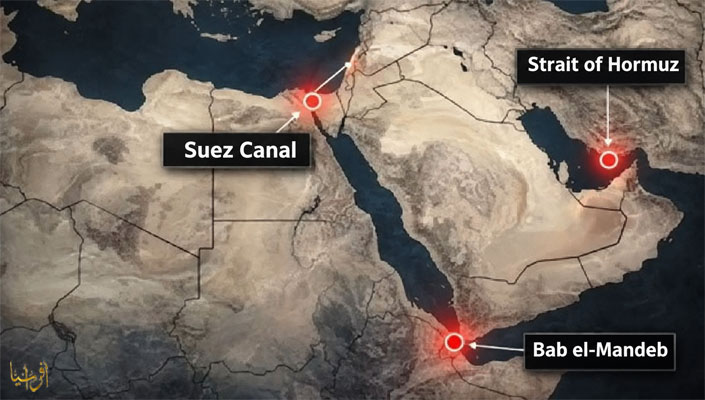
Afrasianet - Ahmed Hafez - The Straits of Hormuz and Bab al-Mandeb are no longer a chapter in geography lessons or just a title for political crises in the geopolitical conflict between countries, but have turned into a daily equation that calculates fuel bills, tanker insurance premiums, and bread prices in markets thousands of kilometers away from these two corridors.
Between the waters of Hormuz, which is only 39 kilometers wide, separating Iran from Oman, and the waters of Mandab that are divided between Yemen and countries in the Horn of Africa, nearly one-fifth of the world's oil and its equivalent pass through its liquefied gas on the one hand, and more than a tenth of its comprehensive maritime trade on the other, in an equation that cannot bear a long interruption without being felt by every home in Asia, Africa, and Europe.
The past five months have revealed that these two arteries are no longer just a threat in the hands of the powers that be in the region or beyond, but have become a real arena for escalation and the export of crises to the whole world: when oil flows through Hormuz fell by 30% during the first quarter of 2026 following the confrontation with Iran, Brent crude jumped more than 45% to exceed the $100 barrier per barrel.
When the Ansar Allah group (Houthis) announced its naval blockade of Saudi Arabia last July and targeted two tankers loaded with oil, fears of a theoretical possibility turned into an operational reality, as a result of which eight tankers changed their routes in just two days.
Between a wave of escalation and a fragile truce, and the results of U.S.-Iranian talks that are still pending until this morning on the fate of freedom of navigation in Hormuz, and its repercussions in Bab al-Mandeb, the urgent question remains:
Which corridor really holds the key to global energy security and trade? Which one is more capable of causing the deeper shock when the sailing stops?
This report answers this in 5 points.
Economic Importance: Energy Tank and Commercial Artery
The structural nature of the straits imposes a pivotal role in shaping the global economy, as the Strait of Hormuz becomes the "world's most important energy reservoir" whose importance cannot be divided into currently or even near-term alternatives. Bab al-Mandeb stands out as a transcontinental logistical bridge that connects the factories of the East with the markets of the West.
This functional disparity makes the former a safety valve for global industry, and the latter a pulse for the movement of consumer goods and restless supply chains.
Karim El-Gendy, director of the Carbon Institute for Energy and Climate Research, bases his analysis of the specificity of the Strait of Hormuz on the fact that it is the only corridor that pumps about 20% of global LNG exports, making any disruption a harbinger of 30 million tons of gas lost this year alone if the turmoil continues.
While all eyes are on Hormuz as an energy artery, Major General Mohamed Abdel Wahid, an expert on strategic affairs and maritime security, believes that Bab al-Mandeb represents a "transit strait" par excellence, as between 8.7 and 9.3 million barrels of oil pass through it daily, but the bulk of its cargoes is concentrated in the trade of containers, food commodities and industrial supply chains.
This importance is even more dangerous in the analysis of the researcher in military and strategic affairs Ali Al-Dhahab when he emphasizes that the danger of Hormuz stems from the fact that it passes one-fifth of the world's energy supply in a narrow corridor around which the alternative pipes do not have the ability to absorb the shock of its stop, as the maneuvering capacity through Saudi, Emirati or Iraqi airlines does not exceed very limited quantities compared to the volume of the original flows, which gives Hormuz an economic weight more than any other corridor.
The repercussions of the crisis. Price shock and lane throttling
When crises erupt, sea lanes turn from channels of exchange to tools of economic pressure and deals on the negotiating table, with the fallout going beyond just delaying shipments to restructuring global shipping and insurance costs.
While tension in Hormuz is triggering an earthquake in energy prices, the turmoil in Bab al-Mandeb is causing supply chains to throttle and the cost of living skyrocketing, even thousands of kilometres from the Middle East.
In his statements to Al Jazeera Net, Al-Gendy paints a bleak picture of the consequences of the confrontation in Hormuz, pointing out that premiums against war risks have jumped from 0.25% to about 10% of the value of the ship, which means that one tanker is now paying about $10 million per trip compared to $250,000 previously.
Advisor for International Economy and Transport Ziad Al-Hashemi explained in statements to Al Jazeera that transport and insurance companies have been monitoring the developments of the two straits together since the beginning of the US-Iran confrontation, stressing that the transfer of tension to Bab al-Mandab has increased the pressure on global energy markets and raised the levels of risks for shipping and insurance companies.
Al-Hashimi pointed out that the risks are still within manageable limits, noting that about 27 ships, including oil tankers and commercial vessels, continued to cross Bab al-Mandab in a single day despite the threats, which reflects the continued relative confidence in the possibility of continuing navigation.
Comparative reports reveal that the total direct cost of diverting ships away from Bab al-Mandab is estimated at between $15 billion and $20 billion annually, while premiums against war risks jumped from $10,000 to between $150,000 and $500,000 per trip, and the Shanghai Container Freight Price Index rose by more than 149% to exceed $3,600 per container.
Redirecting oil shipments from the Saudi port of Yanbu through the Cape of Good Hope adds about 3,000 to 4,000 nautical miles per journey (or about 10,000 miles, according to Reuters data), an additional 10 to 14 days of sailing, and raises the cost of fuel alone between $200,000 and $400,000 per trip ($3 to $5 million per year per vessel), as well as about $1 million in transit fees Suez Canal per ship.
Major General Mohamed Abdel Wahid believes that these figures reflect the amount of pressure on the global economy, which is facing a rise in fuel costs and fees, especially with the addition of about $400,000 in additional fuel costs for each trip that is forced to circumvent the Cape of Good Hope.
Geographic Status and Threats
Aside from the economic aspects, the two straits clash with different security and military strategies, and behind them stands the nature of the actors and forces controlling the ground.
The Strait of Hormuz, as the strategic affairs and maritime security expert explains in his statements to Al Jazeera Net, is governed by a "conventional deterrence" equation between regular states and armies, as the threat party is known and the geography is limited to a length of only 167 kilometers and a width of between 33 and 90 kilometers, making it "easier tactically in terms of security or direct military control" in light of the presence of an international coalition and clear red lines.
Bab al-Mandab is governed by the equation of "asymmetric warfare", as the challenges extend to large areas of the southern Red Sea , the Gulf of Aden , the Arabian Sea , and the Indian Ocean, in addition to the large number of Yemeni and Eritrean islands on its banks, which adds further complexity.
More importantly, according to Brigadier General Ali al-Dhahab in his statements to Al Jazeera Net, the actual control of the strait is distributed between irregular actors such as the Houthis and pirates on the one hand, and the bases of regular armies (the most dense in the world with about 8 permanent bases in addition to a "floating" military presence) on the other.
Al-Dhahab deepens his analysis that "Iran's threat exceeds the threat of the Houthis because of its geographical location in control of the strait and the forces of influence that derive from the diversity of its capabilities." He believes that the anti-piracy mission near Bab al-Mandab is "part of the priorities of foreign bases, not all of them," and that maritime crime "cannot be completely eliminated" because the real sources of threat lie on land, in the strongholds of armed groups inside Yemen , Somalia and Sudan.
This geographical and political difference makes Hormuz an arena for a "conflict of wills" and a testing ground for "attrition tactics."
The dilemma of military and security insurance
The current security challenges place the military insurance complex in front of several dilemma, and they are divided between moral, economic, political, and military, as heavy weapons lose their effectiveness in the face of cheap drones, and military bases are transformed from power centers into low-impact logistical control points. This imbalance in the cost balance makes the protection of navigation a process of "financial drain" that outweighs the cost of crises themselves.
Major General Abdel Wahid points to a stark paradox in Bab al-Mandeb, where international powers are forced to use defensive missiles at a cost of $4 million to shoot down drones worth no more than $20,000, which he describes as a "fundamental flaw" in the deterrence equation.
The maritime security expert emphasizes that most military bases in Djibouti, while dense, lack full coordination and are dominated by logistics, making traditional security methods such as convoy escorts useless and vulnerable to direct targeting.
The most obvious point in highlighting the difference between the two corridors lies in the priorities of the military deployment of the major countries, as this is determined based on the seriousness of the actors and the controlling forces on the ground, in addition to the influence on the source of the threat, which explains the international response historically focused more on Hormuz than on its presence around Bab al-Mandeb, according to the researcher in strategic and military affairs.
Brigadier General Al-Dhahab concludes with a strategic conclusion that both lanes cannot be fully secured, considering them as "political cards" used for blackmail and international pressure.
He believes that the focus of the international response on Hormuz historically reflects the seriousness of dealing with Iranian threats compared to the anti-piracy missions in Mandab, stressing that Hormuz will remain a "dagger" in the side of Gulf security unless major political files are resolved wisely beyond the language of military battleships.
Emergency exit and availability of alternatives
The events of recent weeks reveal that the availability of alternatives remains the most prominent element in the comparison between the two corridors, and here the analysis of the three experts intersects on one conclusion: Bab al-Mandeb has a complete alternative, albeit an expensive one, while Hormuz has no real alternative at all.
For Harmoz, director of the Carbon Institute for Energy and Climate Research, he explains that he has partial alternatives to oil through pipelines, but they do not cover more than a third of what used to pass through the strait, and as for the liquefied natural gas market, there is no quick alternative to it at all, as it cannot be transported through pipelines, and there is no alternative route that can compensate for stranded shipments in the short term.
The figures confirm this analysis, as the total available alternative capacity for the Strait of Hormuz collectively does not exceed 3.5 to 4.4 million barrels per day, meaning that a complete closure of Hormuz leaves more than 16 million barrels per day without any actual access to the markets.
The same is confirmed by Major General Abdel Wahid, noting that these alternatives "only transport very small quantities", and therefore "there is no maneuver to dispense with Hormuz, and therefore any threat in it is effective, exhausting and painful".
The most dangerous alternative, according to Al-Jundi, is that the traditional alternative to Hormuz has always been the Bab al-Mandab Strait itself by redirecting shipments from the Saudi port of Yanbu, but the escalation last month has also closed this "back door," and Asian refineries are considering an exceptional route through the Suez Canal, the Mediterranean Sea, and then the Cape of Good Hope.
The bottom line is that closing the straits together eliminates the margin of safety that has helped hold global energy markets afloat since the beginning of March.
On the other hand, the alternative remains available for Bab al-Mandeb, which is the Ras al-Raja road, as any ship can sail on this route, as Major General Abdel Wahid emphasizes, despite its high cost of fuel, sailors' wages, and the consumption of boats, which gives the global market "the ability to absorb the shock of any crisis" in it.
The conclusion of the experts' analysis is one conclusion:
There is no real competition between the two corridors as much as there is integration in the quality of the risk they pose; Hormuz represents an immediate energy crisis that the global economy cannot bear to endure for more than a week without inflationary repercussions, and it has no real alternative to make up for what the market is losing.
As for Bab al-Mandeb, the occurrence of unrest in it represents a shock of cost and time that the world can absorb for years through a ready-made, albeit expensive, alternative, and the price of which will be borne by both consumers and exporting countries.
________________
Source: Al Jazeera
________________
