
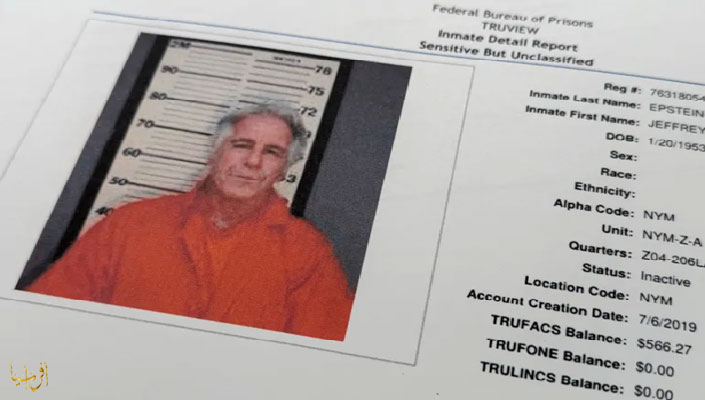
Epstein is dead, but the model is alive and frightening.. Jeffrey Epstein's death didn't bury the truth.
Afrasianet - The death of American businessman convicted of sex offender Jeffrey Epstein has not buried the truth, but has opened the door for more details to be revealed, according to American writer John F. Harris in Politico , arguing that seven years later, the case is more influential than ever.
Harris points to two paradoxes that emerged in the seven years following Epstein's death: the first was that much of the truth had already come out to the public, and that the answers did not remain pending on his death as expected.
The second irony, according to the author, is that Epstein's death seemed at the time to be the end of "a cowardly life overshadowed by fraud and sexual exploitation," and could have been folded quickly, but it did not happen, as his case was still present seven years later.
Uncovering the Truth
Harris says Epstein's "very manipulative" nature and the ease with which he was able to catch some of the world's richest and most successful people have become widely known, in a way that probably wouldn't have happened if he had been alive.
He adds that all of Epstein's associates who were relieved by his death in 2019 were "completely wrong," as the scandal's damage to the reputations of a number of figures was only at its beginning.
Knowing the details of the exchange of interests and vulgar jokes, which "disgustingly" reveal the essence of the way Epstein forged his ties with the elite, is a "gift to future generations," made possible by what he describes as the "documentary treasure" of his vast collection of emails.
He explains that these messages were released under a law passed by Congress, after prominent voices in the MAGA movement, which was later joined by Democrats, insisted on publishing them despite US President Donald Trump's reluctance to do so.
However, important details remain shrouded in mystery, including the exact circumstances of Epstein's death, as well as the full disclosure of the nature of his relationship with Trump, the article notes, adding that many survivors of Epstein's crimes are still resentful and demanding more answers.
Elite Mirror
Epstein's network of connections, Harris argues, reveals profoundly how an era that produced an enormous amount of power and wealth deviated, at least in some elite circles, from "restraint, discretion, and the simplest rules of decency."
"If a person at the beginning of the 22nd century wants to know the nature of the upper echelons of American society in the early 21st century, it will be difficult for him to ignore a personality whose career has intersected, in a way that has left a negative impact, with two presidents, Trump and Bill Clinton, and with royalty figures such as former Prince Andrew, as well as Bill Gates, the most prominent technology pioneers of the 20th century and the most prominent philanthropists of the 21st century."
One striking feature of Epstein's emails is the "eagerness to communicate" displayed by many of the people whose names have been linked to the scandal.
Harris considers that what the case also revealed was "the superficiality of Epstein and his wealthy sex-obsessed friends," a fact he describes as a shocking revelation.
What has changed in 2026 compared to 2019 is that Jeffrey Epstein's name will remain in the national memory as long as there is interest in the Trump era, and his emails are likely to be read for decades to come.
On the same subject, an American website published:
More than six months after the U.S. Department of Justice released millions of documents related toJeffrey Epstein last winter, at the request of Congress, the case is back in the spotlight once again, according to Axios.
The American website identified 7 things that it said were the reason for the return of this issue again.
First, require Senator Tillis to vote on Todd Blanche's appointment
Republican Senator Tom Tillis has announced that he will not vote to confirm Todd Blanche to his position at the Justice Department unless the latter holds a meeting with survivors of Epstein's abuses, who have been vocal and persistent critics of the Justice Department's handling of the investigations.
Blanche met with the survivors last week, but they considered the meeting to be just a "duty" and a routine procedure to fill in the boxes, rather than a substantive dialogue.
Second, the Survivors' Public Attack on Todd Blanche
Not only did the survivors express their displeasure with the routine of the meeting, but also came out with public statements that were highly critical of Blanche.
Annie Farmer, one of Epstein's co-defendants and his partner Ghislaine Maxwell, described Blanche as "rude, condescending, and deliberately not giving any real commitments to survivors."
Another survivor, Danny Pinsky, told Congress that the meeting lacked substance and was not "productive" at all.
Third, a new injunction on the Epstein files
At the end of June, a federal judge issued an order requiring the Justice Department to release additional uncensored records, none of which were withheld, related to the Epstein investigation, or to provide a legal justification to prevent it from doing so.
This came in response to a lawsuit accusing the ministry of failing to fully comply with the Epstein Act issued last year. However, the Justice Department responded days later by refusing to release any additional records, arguing that they had already complied with the law.
Fourth, a democratic investigation into possible foreign relations
Democratic Rep. Jamie Raskin has launched an investigation into whether Epstein acted as an "unregistered foreign agent" taking advantage of his connections, including his relationship with President Donald Trump.
Raskin noted that Epstein had actively worked for multiple foreign governments without legally registering himself as their agent, and Ruskin had given the government until Aug. 3 to provide records linking Epstein to 19 different countries.
Fifth, J.D. Vance's admission of mishandling of the files
During an appearance on the talk show with YouTuber Joe Rogan, Vice President J.D. Vance admitted that the Trump administration mishandled the way it handled the release of the Epstein files.
Vance bluntly said that if people accuse the administration of mishandling the Epstein release process, they are right: "We have already mishandled it," which is a striking statement.
Sixth, Warren Buffett's Criticism of Bill Gates' Relationship with Epstein
In a remarkable development in business circles, billionaire investor Warren Buffett has described Microsoft founder Bill Gates' relationship with Jeffrey Epstein as disgusting or offensive to taste.
The comments came after Buffett's company stopped its donations to the Gates Foundation for the first time in two decades, noting that Gates' relationship with Epstein had been the subject of scrutiny for years, and Gates had stated in 2019 that he regretted meeting him.
Seventh, the Gates Foundation concludes its internal review
The Bill & Melinda Gates Foundation released a three-page summary of an external review of the foundation's relationship with Epstein, which concluded that there was no evidence that the foundation paid Epstein money, or that the foundation's officials were aware of his sex trafficking activities. However, the foundation expressed deep regret for some of its staff interactions with him in the past.
These seven points prove that the ghost of Jeffrey Epstein continues to haunt public institutions and prominent figures. His case has become a real test of how transparent these institutions are, how they respond to questions that remain unanswered, to the criticism of survivors, and to the constant demands for the full truth.
Epstein's case is one of the most controversial in recent history, as the man was an American financier and billionaire who was convicted of sex crimes and establishing a vast network of trafficking and sexual exploitation of minors in collaboration with his partner, Ghislaine Maxwell.
What has always made his case the headlines is his extensive network of contacts that included politicians, heads of state, businessmen, and prominent public figures.
In 2019, he was charged with running a network of sex trafficking and exploitation of minors, before he was found dead in his cell at a federal prison in New York, in an incident that was officially considered a suicide, but which remained the subject of controversy and multiple theories.
His ex-partner, Ghislaine Maxwell, was also convicted in 2021 on charges related to recruiting underage girls for Epstein and was sentenced to many years in prison.
In this context, the US Department of Justice has released thousands of new documents related to the late financier and convicted sex offender Jeffrey Epstein, in a move that has reopened one of the most sensitive files in American and global politics, as it includes photos and names of influential figures, amid an official confirmation that appearing in the documents does not imply criminal involvement.
However, the British news website iPaper identified four questions that it said that the documents published last Friday without explanation or context were not answered, pointing out that many of these new documents have been extensively revised under the pretext of protecting victims, which has sparked a legal and political debate over the extent of compliance with the transparency law passed by the US Congress.
First: Will Donald Trump appear in the new files?
U.S. President Donald Trump is not directly featured in the post, except for a photo of Epstein handing a woman a commemorative check signed by D. Trump.
Trump called Epstein a "wonderful man" in 2002, before later confirming that their relationship ended prematurely, calling him "suspicious."
None of the survivors of Epstein's capture have accused Trump of wrongdoing, and Trump himself denies knowledge of Epstein's crimes, despite his name previously appearing in airline ticket records and communication books published in previous years.
However, the revision of the recent files makes it impossible to say for sure whether Trump is present in them or not.
In contrast, former President Bill Clinton's name appears repeatedly in the new files, further exacerbating the partisan divide after publication.
Second: Why didn't you publish all the files? Has he violated the law?
The Justice Department announced that "hundreds of thousands" of other documents would be released later, but prominent Democrats accused the Trump administration of violating the Epstein Files Transparency Act, which requires that all documents be released within 30 days, without withholding for "political embarrassment or harm."
Democratic Senator Adam Schiff commented on the new files, saying, "The law is clear... The administration cannot change the rules, it is established by law."
The White House spokeswoman defended the move, calling it "the most transparent administration in history" and attacking Democrats for allegedly communicating with Epstein even after his conviction.
Third: Where was Prince Andrew's photo taken?
A photo showing Prince Andrew stretching out in the middle of a group of women, with Ghislaine Maxwell behind him, has raised new questions, especially after media reports suggested the photo was taken in Sandringham, one of Britain's royal palaces.
Other photos also showed Epstein and Maxwell at Balmoral, the royal residence in Scotland, opening the door to serious questions about whether royal property was used in the context of Epstein's crimes. But the British royal palace has not commented on the allegations.
Fourth: How many victims?
The identities of the women and girls have been completely hidden in the documents, making it difficult to determine the true number of victims, and the Justice Ministry said it had identified more than 1,000 victims, but legal considerations may prevent the final number or the ages of the victims from being revealed.
The Epstein Files are the result of extensive federal investigations into Jeffrey Epstein's years of sex trafficking network that targeted minors, with the help of accomplices including Ghislaine Maxwell, who is currently serving a prison sentence.
The case has become a symbol of impunity due to Epstein's extensive ties to politicians, princes and businessmen around the world, and officially ended with his death in his cell in 2019 in circumstances described as "suicide," but it remains widely questioned.
Years later, each new batch of documents reveals that the file has not yet been closed, and that the big questions remain unanswered.
Politico: 7 years after Epstein's death.. His Letters Reveal the Dark Face of the American Elite
The article in Politico examines the continuing repercussions of Jeffrey Epstein's case seven years after his death, what his documents reveal about his extensive network of relationships with prominent figures, and how his case has become a window into the nature and dark side of the American elite.
John Harris says:
Seven years after the death of convicted American billionaire Jeffrey Epstein in his New York cell, his case is still firmly present on the American scene, with documents and correspondence continuing to uncover his extensive network of relationships with prominent political, financial and academic figures.
In an article published by Politico, John Harris argued that Epstein's death did not close the case as some close to him had hoped, but rather contributed to keeping his life and relationships under scrutiny, leading to the publication of a large number of documents and emails associated with him, and it became clear that Epstein was a more influential figure and a more embodiment of a dark age.
Harris noted that the picture has become clearer about Epstein's personality and his ways of building relationships with wealthy and influential figures, taking advantage of his wealth and aura that he has built around himself, as well as his ability to reach high-profile political, financial and academic circles.
Harris noted that important details remain a mystery, including how Epstein committed suicide, in a supposedly secure facility, according to the official coroner's report, as well as a full disclosure of his relationship with U.S. President Donald Trump, and the cause of its apparent collapse in the early 2000s.
Epstein's network includes prominent names, including Trump, former President Bill Clinton, Prince Andrew, Bill Gates, Leslie Wexner, Leon Black, Jess Staley, and Larry Summers, among other academic and intellectual figures. Their names in the files or their association with Epstein do not imply that they were involved in his crimes, as several of them denied knowing about his criminal behavior, according to the article.
One of the most striking ironies revealed in the case is the nature of Epstein's relationships with some members of the elite, which show in his emails a remarkable level of personal admiration and desire to communicate, despite his previous conviction in a 2008 sex case.
The documents also highlighted the superficial and vulgar nature of some of Epstein's relationships, particularly through the letters and honors he received on the occasion of his 50th birthday, which included a slew of sexual suggestions and obscene jokes.
Jeffrey Epstein's files reveal a striking aspect of the nature of his relationships with prominent figures in the world of finance and business, as his correspondence shows a level of personal closeness and trust with names that were supposed to be far from a man convicted of sex crimes.
One of the most notable of these relationships, according to Harris, was the one with Jess Staley, with whom he exchanged emails that included sexual suggestions using Disney characters.
In a 2009 letter, Staley told Epstein, "I owe you a lot. I appreciate our friendship. I rarely find a friendship of this depth."
Other messages also reveal that Bill Gates described Epstein's lifestyle as "completely different and rather interesting," even though he said it didn't suit him.
Harris concludes that Epstein's case has shifted from a story about a wealthy sex offender to a window that reveals aspects of the nature of the American elite at the turn of the 21st century, including the influence of wealth, social relations, and the projection of power in building status.
Epstein's name will not disappear from American memory anytime soon, but his life and network are likely to continue to be studied for decades, especially as documents related to his case continue to be published.
Dirty Works: On the Bureaucracy of Evil in the Epstein Model
Let's look at how the media covers, how the courts accelerate or slow down, and how accountability works. We know that Epstein's model is alive and bigger than we expect, and that there are also workers and employees who are doing their jobs to the fullest, but with acceptance and silence.
As for the writer Noureddine Iskandar , he says:
The world opened its eyes wide as the horrific facts of the Epstein Island affair unfolded, and with each truth that came to light, questions grew as to the horror of the crimes committed.
But the media and the public focus was mainly on the identity of the figures involved in these dirty acts, and the appetite of the traditional and new media to use these facts in the context of the political conflict associated with each of these personalities was opened.
of politicians, businessmen, artists, and celebrities in various fields fell in the light of the major scandal, and their news became widely followed and with unprecedented fervor.
Behind this big picture, as each of the characters involved sought to treat the case as an urgent and dangerous case, a dark corner remained at the heart of this scene, and it concerned those who enabled Jeffrey Epstein to carry out his crimes, and who represented the bureaucratic infrastructure necessary to complete each crime in itself.
The "club" of those involved turned into something like a closed cult whose door Epstein opens the door to selected names, or names to be implicated, since the leads that were revealed pointed to Epstein's intelligence connections to a device Israeli intelligence, the Mossad, and that his work over many years was not only driven by moral deviance and a desire to enjoy through crime.
The whole issue is a large, coordinated work, whose people are carefully selected to serve as a result of their implication in the interest of a network of interests, one of the most important of which will be Tel Aviv. Who are these? And why do they lose focus? To what extent does this absence facilitate the idea of helping deviant criminals commit their crimes, without accountability?
Complete evil structure
The moment the entire network was exposed was a rare moment in which a full intent of evil was revealed to the public that had become a permanent working machine, where humanity groaned under screams and in closed rooms, and only a small part of what Epstein himself documented, or of which the victims later spoke about, emerged.
There was calm, organization, and division of roles, which made the whole process seem like a normal routine, or a high-level job, in relation to the level of the characters involved, their lifestyle, and the services they were provided to them.
Beneath the veneer on display, the crux of the case emerged as a human, administrative, and economic network that made abuse a repeatable process, in which bodies were used as a source of pleasure, and in which collaborators were transformed into an organized crime bureaucracy.
Their identities range from the receptionists with their broad smiles, the lures who contact the victims and drag them into the stinking swamp, flight attendants and crews, lawyers who work hard to protect the criminal system from any exposure or prosecution, assistants who organize appointments and facilitate roles, drivers who see children and young women being transported like herds to the altar of crime and bring others back, cooks who prepare the tables of the island's wealthy, and middlemen who trade in the holiest thing on earth.
Alongside these are the visiting personalities who see the crime, commit it, and remain silent about it, waiting for the next journey. All of these are the heart of the issue and not a margin in the story, and they are its necessary infrastructure.
In political sociology, the concept of "bureaucratic evil" is used to describe that type of crime that is not committed out of hatred or individual sadism, but through disciplined professional performance within institutions or networks.
These are precisely the concepts that the evil looks like a monster as we imagine it in movies and stories, but rather in the utmost elegance and elegance.
Cold employees who perform their roles "professionally and professionally," even to make you think that they are practicing a sacred or high-level mission.
Cruelty is not required. What is really needed is to complete the procedure as if it were a meticulous protocol in an honest business, in which criminal acts are broken down into small tasks, so that no one feels responsible for the whole picture.
If one of them is asked about his contribution to the crime, he will say that he is applying the law and the rules of the profession.
This is what a lawyer will do, for example, while an assistant will say that he is following the instructions of his superiors, and the pilot will say that he is doing his usual job and that it has nothing to do with what the passengers are doing, or what the victims are transporting to be exposed to it later, or what they were already exposed to before receiving them on the return flight.
This is about those who have returned, and they are not everyone in any case, after the data revealed murders and ritual practices in which children are sacrificed on the massacres of the secret doctrines of the "elite" of civilization.
The employee here can claim to be doing his job, but the scale of the crime reveals that the perpetrator is the sum of them, from Epstein to his chief assistant Gillian Maxwell, to every doorkeeper who stood up and locked a door, or opened a hallway through which the crime could pass.
In fact, in the execution of this level of crime, there is a clear evil bureaucratic mastery, since breaking down the crime into small parts does not make each part sufficient for conviction, and it does not enable any person involved to possess the full secrets of the great crime. However, it was enough for Nasser to emerge from among them, revealing the tip of a thread, which would have spared a large number of victims the horrors of what they experienced on the cursed island.
Ordinary people can practice satanic evil by simply remaining silent about a single scene that passes in front of them, so how can one remain silent in the suspicion of raping a child, without mere suspicion stirring the human conscience and exposing the whole story?
Thus, every silence about one of the features of the crime is a complete participation in all the crimes, because the commission of one of these types of violations is enough to confirm that the whole chain is moving in the same direction, and that the ambiguity of the place, the guests and the victims dragged there indicate a crime scene full of dirty practices, especially since the matter has been going on for many years, and it was not an interrupted event or a passing sight in which the memory of the details may be absent.
Crime does not need savages, but ordinary people who do their jobs well. But why do these networks work so smoothly? And why are so many participants silent?
Here we enter a more ambiguous private path, which can be called the "moral economy of the elites." The commodity here is the human body, from the most tender to the most eloquent. In the market itself, values are traded, silence is bought by influence, money, threats, repression, but also by temptation.
A network of powerful relationships that leads to the prevention of accountability. The victim is the only party who does not have negotiating capital. His position in this process is a loser in any case, and he is cut off from the world, he does not have sovereignty over his body, in front of those who have control over presidential offices, governments, parliaments, intelligence services, armies, and transcontinental companies. And what can a weak person do in the face of such a system? But our central point here points to a striking paradox.
With the enormity and tyranny of the figures involved and their perverse project, a junior employee standing at one of the doors closed on crime can demolish the entire structure with a word, a picture, or just a leak. This possibility is precisely the door of condemnation for every pawn in the game of major crime.
But these pillars of the crime infrastructure have been distributed across their tasks in the opposite direction. Lawyers are able to turn assault into civil disputes, silence agreements that turn pain into a financial item, and use political connections to obscure any investigation. The media plays its role in deciding when to shut up, when to speak, who to disclose and who to cover.
In Epstein's model, sex was a tool and a document of pressure and blackmail, its secrets stored as a valuable asset for the future. Through this balance, the destinies of countries and peoples are changed, decisions are adopted, and the guarantee of compliance is the crime held by the decision-maker, or those next to him.
The result is to build loyalty networks within the elite world, through shared secrets, rather than shared ideas. The person involved is easy to obey, whether it is to know the information or to participate in the crime.
In this way, the crimes are an alternative, informal, transient technique for state institutions to govern globally, and to pick the interest (of the operator with the interest) without going through any bureaucracy within a specific country.
Only from Jeffrey to the implicated, who will come out to support the genocide or to advocate "for the right to self-defense" of another child killer in a remote part of the world. This clearly explains Epstein's association with Israel, for example.
Outside of the power of constitutions, Epstein's power is governed by the wishes of decision-makers, and therefore by their decisions. But back to the filth workers themselves, how did they keep quiet? How did they manage to swallow so much filth?
Crime Normalization Workers
The most dangerous thing about this system is not its top, but its human base, who move, arrange, sign and open doors. It is not normal for all of them to be sadistic. Many of them are ordinary people, they have families, bills, fears...
But they learned one basic skill, which turned them into evil souls, which is the separation between function (interest) and conscience, and this is the essence of evil in the administrative field, that is, to perform your role accurately and leave the results to others.
The pilot who did not touch the victim, the lawyer who did not smell the abused bodies, and the muffled assistant who would not speak the truth, are all fundamental pillars of the system, and they have participated in it because they are trusted by the Great Satan who runs the machine. This particular trust is enough to condemn Epstein's group, his people, and his incubating environment.
Over time, abnormal practices become routine, trips are repeated and faces change, but the pattern is constant, and the pattern is enough to uncover any crime.
Ordinary detectives in a series of minor thefts of motorcycles or even clothes from the laundry shop look at the pattern. As long as the Epstein people have witnessed the pattern and haven't acted, they're no doubt accomplices in crime.
The first shock that should move the conscience disappears with repetition, and kills the conscience of the weak souls. Then everything becomes normal, and this is what sociologists call "normalization of violation."
Choosing not to speak gives the system its legitimacy and normalcy, and silence in turn becomes an investment for violators to expand their crimes, as long as it is safe. But why children in particular?
Why children?
Children are the weakest link in the whole shameful scene. They have no voices, no lawyers, no platforms, no assistants. Their voices are too weak to break through the gates of the place, so how can you get out of an island?
Far from psychoanalyzing the sick phenomenon, which may open the door to new discoveries in the field of diseases, deviations and evils, the children's choice of this role, as a fragile victim, is due to the pleasure of the predatory instinct enhanced by an unlimited level of evil.
You may shake yourself if a boy is slapped in a school or on a street, or even by his mother in the lobby of a shopping mall. But you will not find the reaction worthy of kidnapping, rape, murder, torture. These are too horrible to find a suitable punishment.
This leads to an important conclusion, which is that childhood is without real protection in our whole world. You wouldn't be surprised if you say that among the criminals in this case are those who teach/work in the field of humanitarian work! Children don't have networks of relationships and forms of interests.
They are innocent of that, and this innocence is their killing in an environment of meanness. Fragility here is an opportunity that must be exploited, and the right to enjoy and enjoy crime is guaranteed to those who have acquired power, money, influence or fame.
In this case, the crime becomes an institutional act, the head is Epstein or those behind him, but the institution is large and there are many, maybe more filthy workers in it, than we expect.
If we want to point them out, let's look at how the media covers, how the courts accelerate or slow down, and how accountability goes. If the facts are obliterated, it means that the filthy people are a majority that are spread around the world.
Epstein is dead, but the model is alive and frightening.
________________
