
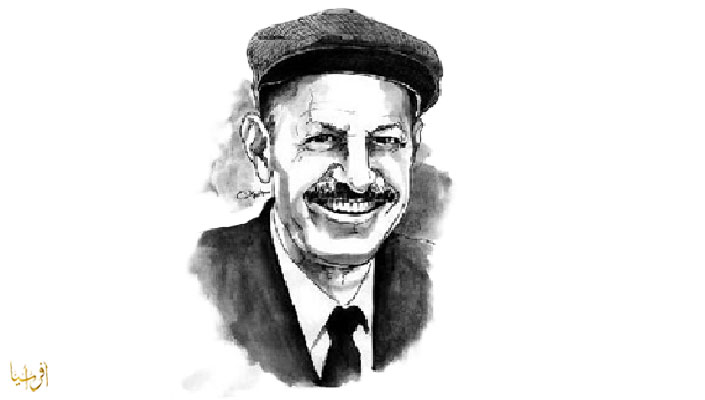
Afrasianet - by Dr. Diaa Khudair - Twenty years have passed since the death of the friend and storyteller Khalil Al-Sawahari, and his presence is still in the literary memory, not only as a name of the prominent Palestinian and Arab story, but also as the author of a narrative experience that has its own characteristics, and its features related to the loss of the homeland and the space of the first composition that makes literature more attached to the human being, the place and the memory.
As the twenty years since the death of Abu Arwa seem to be an occasion to restore him from the absence of the body to the presence of the text, and from personal memory to the broader literary memory, we remember how some writers disappear when their voices are silenced, and others begin their real lives after their departure, when their works are separated from their author and enter this harsh test of time.
When I visited Al-Swahari's wife and his companion um Urwa in their home in the Fifth Circle in Amman, I was convinced of how the absence turned into a presence for this woman whose time had stopped and the hands of her clock did not move away from his husband and her companion, so she remained with him in his death and absence, as she lived with him in his life and his overwhelming presence.
Al-Sawahiri, in my estimation, is one of those whose text has been able to recover its author, whenever we return to his stories in "Al-Bashoura Café (1975), which recorded a remarkable turn in the history of the Palestinian story, and then (The Transformations and Struggles of the Wandering Solomon"), which was published following the author's visit to Jerusalem about twenty years after the publication of the first collection of stories, in which we found something of Jerusalem, something of Palestine, and something of the Arab man in his daily distress.
I wrote in a way that resembles a biography that In it, the writer's life and the life of his protagonist are matched and the evidence is exchanged, when the latter's life and narrative pronunciations become a source of interpretation in which the author is inseparable from the narrator who represents him, regardless of the critical criteria that emphasize the neutrality of this narrator, his impersonal traits, and his relationship with the writer as a separate person from him.
In this collection is the nom de guerre of Khalil al-Swahri himself, even if in some texts this name has taken on various other signs and insignias.
It does not change the nature of the narrative discourse, nor its main themes. The external realism of the story, which is written about a man who suffered the experience and tasted its bitterness, and who observed with a sense of humor and advanced artistic awareness the development of the issue inside and outside the homeland, and used its material to produce creative texts that are not far in spirit and smell from what happened on the ground, I say that this realism is the obsession in which the committed writer tries to create art, while he reproduces his life and a collective life or certain models of it in his own way.
Perhaps one of the things that is evident in Khalil al-Swahiri's experience and art is that he was not a prolific writer. He does not write the story without specific reasons and a real need in which his material is extracted from the well of the lived experience, with a feeling of pressure to express his private affairs, which have been mixed and mixed with public affairs with all the subjective and subjective baggage that this entails, and permeates it in economic, political and cultural spaces.
It is well known that Khalil al-Swahri's world is not the world of the national bourgeoisie, but rather the world of workers and simple people, who nevertheless possess the deepest wisdom in Palestinian memory that his characters bear to varying degrees, and can intervene at certain moments to stop the narrative and return the narrative imagination to a reality that has the rigidity of tradition, the power of language, and the ability of history to resist.
The presence of bourgeois, influential people, or large functional and social positions in the world of the Swahri story would arouse suspicion and suspicion in the narrator in all the narrative models of the author.
Perhaps this is one of the reasons that prompted me to prepare my book about him, which was titled Khalil Al-Sawahri (The Sad Moon of Jerusalem), and made its introduction a broad entrance to his narrative achievement, in an attempt to collect the critical writings that fell under my hands that dealt with the art of Al-Sawahiri's storytelling, and to read through them his location, his experience, and what he added to the art of the Palestinian and Arab story at that time.
For me, this work was not just an attempt to document what was written about al-Sawahiri, but rather, in essence, it was an attempt to return to his narrative experience from multiple angles, and to discover the artistic and human layers it stores.
The real writer cannot be reduced to a specific biography or a set of titles, but his literary world should be seen as an integrated structure in which vision and style intertwine, place and memory, and personal experience with general experience intertwine.
Hence the image of the sad Jerusalem moon, which I chose as the title of the book, was more of a passing metaphor. In Al-Sawahiri's experience, Jerusalem remained more than a place where events took place; it was a memory, pain, and spiritual presence in its moon, which is now suffering from a greater eclipse, and at the same time it was a human space where the fates, dreams, and breakdowns of the characters intersected. In this sense, Jerusalem seems to him to be a city that inhabits the text, just as the text inhabits the memory of the writer.
Al-Swahri had a special sense of capturing small details that might seem ordinary or marginal at first glance, and then giving them their human significance through the narrative.
This ability to turn the everyday into a literary material is one of the signs that stops the reader of his stories. For him, the story is not just a story to be told, but a search for the meaning behind the story, and for the human being who may be hiding behind the fleeting details.
Therefore, the reading of al-Sawahri should not stop at the topics he addressed, no matter how important they may be, but should also turn to the way in which he dealt with those topics.
The Palestinian cause, for example, does not become literature just because it is present in the text; what gives it its literary value is the extent to which the writer can transform it into a living human experience, into characters with their own features, dreams, and fears, and the extent to which he adds his own spirit to it to keep it in action, rather than just symbols or slogans.
This is where the importance of al-Swahiri lies: he was the son of a cause and a memory, but he did not allow the cause, in the most beautiful moments of his art, to swallow man. Man remained the center of the story, and his daily suffering and yearning for life, freedom, and dignity remained the area in which the story moved.
If Palestine was strongly present in his experience, its presence was not separate from the concerns of the Arab man in general. For al-Sawahiri, the Palestinian place opens up to broader questions: the question of exile, uprooting, nostalgia, alienation, the loss of places, and the transformation of memory into an alternative homeland.
His stories can therefore be read outside the boundaries of the immediate political occasion, because in the end, they speak of a person when he loses what he loves, and when he tries to regain it through words and memory.
In my book, I have tried to approach this experience through his texts and the studies and critical readings he has written about it, and to gather scattered threads that can help paint a clearer picture of his narrative achievement. It was remarkable that the multiplicity of readings did not lead to the abolition of Al-Sawahari's privacy, but rather revealed multiple aspects of his experience, and confirmed that a good text remains open to new readings as the reader changes and the times change.
Today, twenty years after his departure, the need to return to Swahri seems even more urgent. Time does not only remove the living from our memory, but it also rearranges the entire literary scene. Names that shine in their time and then fade, and other names come forward slowly, because what I wrote was deeper than the moment I wrote it.
Perhaps al-Sawahri is one of those who deserve to be reintroduced to the new generations, not only out of loyalty, but because in his experience he is able to say something to us today in our present lives.
The literature that lives is the literature that can transcend the time of its writing, and at every stage it finds a reader in whom it sees something of its own questions.
Thus, after twenty years of al-Sawahiri's absence, the question no longer resurges: What is left of Khalil al-Sawahiri? Rather, the question becomes: What is left of us from Khalil?
Therefore, the remembrance of the brother of the friend Abu Urwa on the twentieth anniversary of his departure is not a restoration of a literary past that has passed away, but rather an invitation to re-read his texts and to put his experience in its true context within the Palestinian and Arab story.
The last cover of the poem by the poet Ezz al-Din al-Manasra reads as follows:
Khalil al-Sawahri (Son of Jerusalem) remained, in my memory, one of the pioneers of the modernization movement in Palestine and Jordan since the early 1960s, that literary modernist movement that was manifested in the magazine "The New Horizon" published in Jerusalem (1961-1966), which was called the "New Horizon Group".
Al-Sawahri was the most active in the field of short story writing and criticism, along with his colleagues: Mahmoud Shukair, Yahya Yakhlaf, Majed Abu Sharar, Fakhri Kawar, and others. Al-Sawahri was also the cultural editor of a number of Palestinian newspapers for many years, which made many young storytellers at that time learn the art of short story writing from him.
If every writer has his own image that is stored in memory, the image of Al-Swahri that has remained with me is the image of that sad moon over Jerusalem: far and near, at the same time, carrying some light and a bit of sadness that we hope will not reach the point of total eclipse as a result of what is happening to Palestine these years and these days.
________________
