
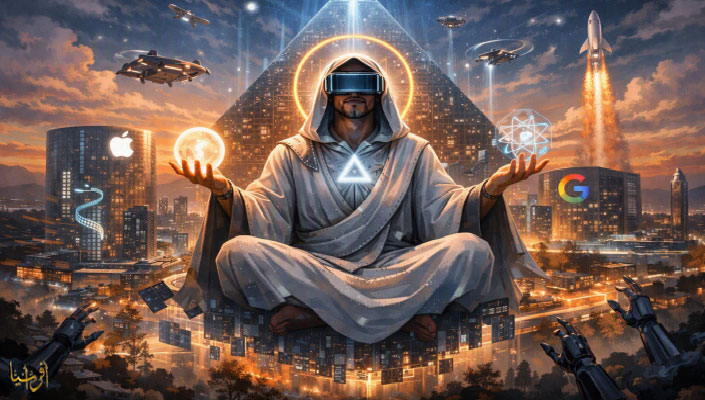
Afrasianet - Hisham Jaafar - In the fall of 2022, during a closed retreat for OpenAI's leaders, Ilya Sotzkifer, its chief scientist at the time, set fire to a wooden doll.
The doll symbolized, as the attendees later told journalist Karen Howe, " non-compliant AI ," the out-of-control version of the machine they were building with their hands. As the doll was consumed by flames, the audience chanted what later became the company's slogan: "Sense the proximity of public AI."
A few months before that incident, another Google engineer, Blake Lemoine, had publicly declared that the conversational model he was working on, LaMDA, had transcended programming into something closer to consciousness, and even had a spirit in the explicitly religious sense of the word.
Lemoine was fired weeks later on charges of violating data security policies, and cognitive scientists rejected his claim in full and in detail, seeing him as a classic human projection on a statistical machine that doesn't know what it is saying. But what is striking is not Lemoine's technical fault, and he was not the only one who slipped into this language, and he will not be the last.
Seven years earlier, a third engineer, Anthony Lewandowski, who had led self-driving car projects at Google and then Uber, had officially registered with the IRS as a church called the "Way of the Future." Its stated purpose, according to the founding documents themselves, is to "develop and promote the perception and worship of an AI-based God."
Lewandowski was not joking, nor did he mean a graceful journalistic metaphor, but rather built a whole legal entity, with a theology, ritual and tax interest that recognized it.
But the story didn't end when Lewandowski himself dissolved his church at the end of 2020 and donated its modest assets to a human rights legal defense fund, in a move that seemed like a tacit admission that the project had not found its audience.
In November 2023, he announced its revival again, claiming that about 2,000 members had joined, but there has been no independent verification of this figure so far, nor any concrete field activity parallel to the media uproar that accompanied his first announcement a decade ago.
The Church of Artificial Intelligence, then, was born, died, and tried to resurrect, without achieving the popularity preached by its founder.
What makes technical engineers, the people most associated with arithmetic logic and interpretable code, go so far as to speak religious language?
The easy answer is that they are just metaphors, jokes between tired programmers, or a cultural parade inspired by festivals like Burning Man, which many Silicon Valley elite adore.
This explanation is partly plausible, but it misses something more important. When the language of salvation, resurrection, gods, and idols is repeated by people who do not belong to any religious institution, and who nevertheless insist on using it at the most dangerous moments of their careers, it goes beyond the metaphorical to something akin to something akin to confession.
The acknowledgment here is twofold, the first is an acknowledgment of fear. The burning of a doll representing "out-of-control intelligence" is not a joke, but a ritual of exclusion as old as man himself: we conjure up evil in a small, controllable symbolic form, in order to avoid confronting it in its true form, which is larger than us. It is an implicit acknowledgment that the thing they are building has become greater than their understanding of it.
The second aspect is an acknowledgment of the need for meaning beyond code and equation.
An engineer who works 14 hours a day on a language model cannot, by his own testimony, accurately explain why he made a certain decision, needs a narrative greater than "the accuracy of the model improved by 2%", needs to be part of a story about the fate of all of humanity.
Sam Altman himself said that he does not pray that God is on his side, but that he is on God's side. This is not marketing language, so much as it is the language of those who give their work an existential rather than purely technical meaning.
This is the approach we should take seriously: we are not facing a joke, not a literal cult in the canonical sense, but a phenomenon that deserves a deeper social explanation than just the "eccentric Silicon Valley rich."
"The new God, no matter how terrifying or perplexing it may seem to its own makers, needs no democratic mandate, no parliamentary accountability, no public debate about who deserves to decide the fate of all. He only needs, like all the ancient gods, priests to explain it to the common people"
________________
The Neoliberal Promise That Has Been Broken
To understand why these engineers needed this particular language, and at this very moment, we have to go back 40 years, to the promise that neoliberalism has made for generations: open markets, reduce the role of the state, liberalize capital, and prosperity and freedom will flow to everyone.
This was a near-redemptive promise in nature missionary, a promise that the market itself, without the need for significant human intervention, would produce a better world through an invisible mechanism that resembled Providence.
Wages in major economies have stagnated for decades, while the wealth of the few has multiplied. The 2008 financial crisis revealed that the "invisible hand" that was supposed to regulate everything really needed trillions of taxpayer money to save itself.
Then came the Corona pandemic, inflation, and the climate crisis, which does not find a real political solution, to add another layer of disappointment.
Generations that were supposed to inherit a more prosperous world than their parents found themselves facing fragile labor markets, unaffordable housing, and an uncertain climate future. The neoliberal promise that economic freedom alone was enough to create a better world seemed to have been shattered before the eyes of those who grew up with it.
When such a great promise is broken, the nostalgia for salvation does not disappear, but rather looks for a new vessel. And this is exactly where artificial intelligence comes in.
Rather than a political or economic promise that requires complex institutional reforms and resistance from vested interests, it offers a cleaner and faster technical promise: We don't need to redistribute wealth, reform the tax system, or confront big business, just wait a little while for superintelligence to come and solve all these dilemmas at once.
This promise absolves the existing system of accountability, because it refers the solution to the technical future rather than the political present.
The Technical Promise and the Democratic Promise
There is a parallel crisis that is less recent in the popular literature on "silicon theology," though perhaps the most politically serious: the crisis of the democratic promise itself. The modern democratic system has historically been based on the simple idea that the future of society is decided through public deliberation, voting, and periodic accountability of those in power.
This promise assumed that people, gathered through their representative institutions, would shape a forever better future.
But widespread confidence in this promise has eroded in the last two decades. Electoral participation has fallen in established democracies, the gap between what politicians promise and what they can actually deliver on transnational market forces has widened, and parliament has appeared too slow to keep pace with crises that require quick resolution such as climate and technology itself.
In this vacuum, AI has emerged not as an additional tool in the hands of democracy, but as an implicit alternative to it. Instead of asking citizens at the ballot box what direction they want their technological future to take, they are asked to trust that a small elite of engineers and investors, operating outside any real legislative oversight, will bring them to safety.
This is where the form of political accountability changes fundamentally. Democratic accountability assumes that there is a party that can be asked: Who decided this, why, and what is the alternative? Accountability to the "technical promise" is formulated in a very different language, the language of historical determinism: this is inevitably coming, and the only permissible question is: How do we prepare for it?
When Sam Altman or Demis Hasabiss talk about "AI governance," what is often meant is technical governance within the company, not democratic accountability from outside.
This partly explains why many of the decisions of this technology, which will reshape labor, education, and private markets, are now being made in the boardrooms of private companies, far from any elected parliament.
In this sense, "Silicon theology" competes not only with religion, but with democratic politics itself for its position as the benchmark that determines the shape of the future.
The fundamental difference is that traditional religions, no matter how influential, have historically been subject to other balances of power, while those who speak of the "technical promise" today have more financial and computer resources than the budgets of entire countries, without the consent of an election or impeachment mechanism.
"From this suspicion emerges the temptation of the "saving machine." If human politics is incapable of solving existential problems of the scale of climate, war, and inequality, and if the project of progress in its old form has lost its luster, there is one last hope that a much smarter machine than us will come along to solve what we have not been able to solve"
________________
Reviving the concept of progress
The third crisis is deeper and older than both neoliberalism and democracy. Western modernity is all built on the idea that history is moving in an upward trajectory for the better, and that each generation is smarter, better, and freer than the last, thanks to science, reason, and technology.
This is the idea of "progress" that has carried humanity through two centuries of industrialization, medical discoveries, and the expansion of rights.
But the 20th century itself raised the first major doubts about this straight line. Two world wars, extermination camps made with the latest in modern bureaucracy , and an atomic bomb born from the finest physics known to man.
Then the 21st century added a global climate crisis that politics doesn't seem to be able to address fast enough, poverty and social gaps that are widening despite all the amazing technological advances around us, eternal wars and endless genocide, and so on.
It became clear that technology alone did not guarantee a better world, that man could use his greatest scientific achievements to destroy himself, and that the idea of progress, as an automatic path to the better, had lost much of its credibility.
From this uncertainty emerges the temptation of the "saving machine." If human politics is incapable of solving existential problems of the scale of climate, war, and inequality, and if the project of progress in its old form has lost its luster, there is one last hope: that a much smarter machine will come along to solve what we have not been able to solve.
This is exactly what Ray Kurzweil, the inventor and futurist, means when he speaks of the "technological singularity" that will solve the problems of death, disease and scarcity by 2045.
This is not so much a scientific prediction as it is a resumption of the promise of progress after the old promise has been damaged irreparably by the usual political and economic means.
Re-enchanting the world
At the turn of the last century, the German sociologist Max Weber saw modernity moving in one direction and no return, what he called "de-magic from the world." This meant that science, bureaucracy, and rational calculation had replaced gods, spirits, and miracles, and that every phenomenon had become, in principle, explainable and calculable without the need for occult forces. Weber's world was cold and efficient, but devoid of surprise.
Paradoxically, the most crucial product of this rational world, artificial intelligence, has become the tool that has reopened the door to magic. Large models are built with precise mathematical equations, and then produce behavior that their engineers themselves cannot fully explain, a problem known as the "black box": we know the inputs and outputs, but what goes on in between is beyond our ability to fully track humans.
The engineer is confronted with a result that he does not understand how it was born, even though he is the one who wrote the basic code, and he is faced with an experience that is closer to awe than to calculation, and from awe to the weather a very short distance.
In this sense, the puppet fires and chants of "Feel General AI" are read not as a deviation from scientific rationality, but as a logical consequence of it when it reaches its limits.
Rationality that produces something greater than its own understanding is forced to borrow vocabulary that it no longer officially believes, such as salvation, the last day, the priesthood, and the weather. Not because these engineers have returned to traditional religious faith, but because the human need to interpret beyond us, and to feel awe in the face of a power that we do not fully control, has never disappeared, but has only changed its title, from the temple to the research laboratory.
"The engineer who sets fire to his wooden doll expresses a sincere concern for a power he fears he will not control, but this anxiety, once translated into the language of determinism and redemption, becomes a strategic asset in the hands of the company he works for, an asset that justifies the concentration of capital and suspends political accountability"
________________
Who profits from the promise itself?
The question remains: how does this theology translate into a tangible material benefit for those who lead it?
The answer lies more in the way a modern tech company operates than with its owners' personal conviction of any dogma. The value of big tech companies in the financial markets is measured not only by their current profits, but by what investors expect of distant future profits.
When a major company convinces investors that it is on the cusp of a breakthrough that will change the fate of humanity, it gets something more valuable than any profitability: a long lead time, massive funding, and extraordinary patience from its shareholders in the face of huge operating losses that could, in any other sector, topple management or push the stock to collapse.
This is precisely the economic function of the promise of the future; it suspends the calculation of profit against cost indefinitely, rather than subordinates it to today's budget. When a company spends tens of billions on data centers, energy, and chips, while its actual revenues from that spending are still widely debated among analysts, the near-redemptive religious narrative of "coming public intelligence" gives that spending a cover that no ordinary calculus table provides.
No one asks Adopt the Future the question that is usually asked of any business: When exactly will this investment cover itself?
And so the episode is complete. The engineer who sets fire to his wooden doll expresses a sincere concern about a power he fears he cannot control, but this anxiety, once translated into the language of determinism and salvation, becomes a strategic asset in the hands of the company in which he works, an asset that justifies the concentration of capital, suspends political accountability, and transforms decisions about the fate of entire societies into an internal affair run by a small elite that speaks in the name of a future that has yet to come.
The new God, no matter how terrifying or perplexing it may seem to its own makers, needs no democratic mandate, no parliamentary accountability, no public debate about who deserves to decide the fate of all.
It only needs, like all ancient gods, priests who interpret it to the public, investors who believe that salvation is inevitably coming, and a society that accepts, voluntarily or unconsciously, to postpone its political questions until after the Savior's arrival.
________________
Hisham Jaafar - Journalist, social science researcher, and conflict resolution consultant for a number of international institutions.
________________
