
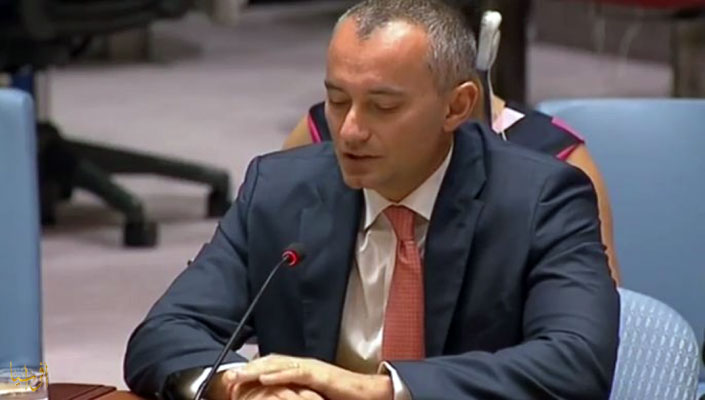
Afrasianet - Statements made to Al Jazeera by the High Representative of the Peace Council, Nickolay Mladenov, carry a clear threat to the Palestinians of a return to the genocide in the Gaza Strip unless they abide by what Israel wants, because he equated those who committed to everything agreed upon and put forward with those who did not, analysts say.
Mladenov told the interview program that the failure to implement the road map, put forward by the council, means that war could return again, noting that Qatar, Egypt and Turkey played an important role in advancing the agreement with the Islamic Resistance Movement (Hamas), and that he hoped that the National Committee would take over its tasks in the Gaza Strip soon.
Mladenov also confirmed that he has received pledges of $7 billion for the reconstruction of the Gaza Strip, and that the mechanism of operation of the International Stabilization Force and its deployment sites in the Gaza Strip have been determined.
Mladenov's remarks followed a joint statement by Israeli Prime Minister Benjamin Netanyahu and his Defense Minister Yisrael Katz, in which they said they had not issued any directive to open the Erez (Beit Hanoun) crossing to goods.
The statement stressed that there will be no reconstruction in Gaza until Hamas is disarmed and all weapons in the Strip are dismantled. Katz said that Israel will not allow Hamas or any party to return to threatening towns in the south, as happened on October 7, 2023, and that those who do so will pay a heavy price.
Threat to Palestinians
Dr. Muhannad Mustafa, an expert on Israeli affairs, described these statements as very dangerous, because they mean that the war will return unless the Palestinians accept what Israel wants, and because it equates the two sides in responsibility, even though Hamas accepted the plan while Israel publicly rejected it, and in the words of its Prime Minister Benjamin Netanyahu.
In an interview with Al Jazeera, Mustafa said that Mladenov ignored that Israel rejects the map even though it partially includes its goal of disarming Hamas, holds it accountable and ignores its non-compliance with any of the terms of the ceasefire and its expansion in the Gaza Strip under the umbrella of the agreement.
Mustafa argued that Mladenov's speech gives Netanyahu an implicit green light to return to war, because it does not warn Israel, but rather warns Palestinians who do not want this war to return.
Even Mladenov's talk of providing $7 billion for reconstruction ignores Netanyahu's statement two days ago that there will be no reconstruction of Gaza unless Hamas is completely disarmed.
The director of the Palestinian Media Foundation, Ibrahim Al-Madhoun, did not differ from the previous statement, but described Mladenov's statements as frightening and shocking to the Palestinian side, and said that he treats this talk as a threat to them, despite their commitment to everything stipulated in the agreement and despite their acceptance of Mladenov's plan.
A Prelude to the Return of Genocide
The war continues and has not stopped, and therefore Mladenov threatens the return of the genocide, the displacement of the people and the full control of the Gaza Strip, and justifies Israel's behavior and paves the way for what it wants, according to Al-Madhoun, who said that the issue of weapons is being treated as a pretext to resume the genocide, despite Hamas' signature on the peace council paper that stipulates its removal.
Al-Madhoun described the current situation as very difficult because Israel treats Gaza as an internal affair and does not abide by anything that the United States says or accepts, while the intervening parties have no way of dealing with this behavior.
Mladenov was required to clarify who was responsible for the disruption of the plan, who committed to the agreement and who did not, rather than paving the way for Netanyahu to take a step that would help him overcome his political crisis, says Al-Madhoun.
Political analyst Ahmed Tanani said Mladenov's warnings were very dangerous because they contradicted his job, which is supposed to prevent a return to war, not to threaten its return.
However, these statements confirm that Mladenov is not a neutral mediator and deals with her rejection of the plan he has drawn up, which is considered binding on all parties, as if it is a position that requires trying to convince her rather than obliging her, but rather ignores the resolution issued by the UN Security Council on the need for all parties to abide by the outcomes of this council, as Al-Madhoun says.
Political analyst Mohammed Halasa agreed with Tanani's statement, saying that Israel is reassured that Mladenov will not break the ceilings of its terms, and knows that this is not his role and that he does not dare to do so, and that he is trying to present something to the Arab side that shows him as neutral.
Israel has accepted what the United States wants tactically in order to get out of the circle of international criticism and isolation, while continuing to kill without being said to have violated the ceasefire, which pleases Americans, according to Halasa.
A Talk from the Tongue of Israel
Mladenov fully embraces the Israeli narrative and goes with it where it goes, and he is not expected to deviate from this path, which contingent the most basic rights of the Palestinians on the issue of disarmament, according to Halsa, who said that the international official's speech "is not innocent because Israel is exploiting it to say that disarmament is an American and UN demand, not an Israeli demand."
Paul Davis, a professor at the Institute for Global Policy, said the real problem was that Israel's agenda in Gaza was different from that of the states, and that the two positions had to be reconciled so that the parties could move forward.
In an interview with Al Jazeera, Davis added that Israel can use the veto it it wants after agreeing on a specific mechanism and after the international force enters the Strip, and then it must be told everything that will be agreed upon and accepted.
At the same time, Davis blamed Hamas, which he said refused to hand over its weapons and that if it had been serious about this situation it would have already carried it out, noting that the group "will get a guarantee that its leaders will not be killed in exchange for surrendering weapons."
The agreement stipulated a gradual Israeli withdrawal from Gaza in exchange for steps taken by the Palestinians, including disarmament, but it did not abide by what was agreed upon and prevented the entry of aid, goods, medicines and equipment, and even ate away an additional 8% of the Gaza Strip.
Israel also refused to include a committee of technocrats, which is supposed to manage the Gaza Strip and provide basic services such as food and clean water, as well as security, health care, education, and reconstruction, according to an interactive screen provided by Salam Khader on Al Jazeera.
________________
Source: Al Jazeera
________________
