
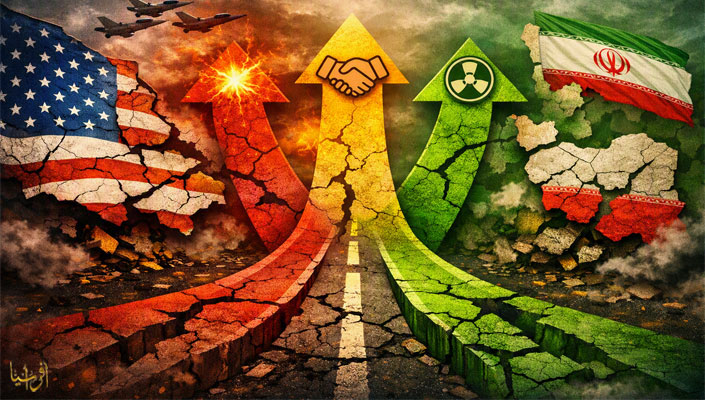
Afrasianet - Oraib Al Rantawi - Six months after the outbreak of the US-Israel war on Iran, the language of escalation, threats and threats is still an issue on the rhetoric of the warring parties, without the beating of the war drums succeeding in extinguishing the efforts of the mediators or injuring diplomacy in a fatal way.
It is as if we are still, and perhaps will remain for a while, in the face of the "long-distance race" between the two tracks of escalation and de-escalation, and without any signs of radical breakthrough looming on the horizon, it opens the door to hope for a comprehensive settlement that will put an end to a crisis that has dragged on for a long time. Its military and economic fragments, the region, and indeed the entire world.
From the maximum military pressures to the maximum economic pressures, the Trump administration is moving from one tool to another in its war on Iran, and I think that its sleeve is not yet devoid of papers and tools, but the latter is the least expensive for the United States and the most expensive for Tehran, and in the background of the scene, the American military buildup is still on the doorstep, and the Pentagon is still working hard to fill its warehouses of equipment and ammunition, which were almost depleted by the wars of Iran and Ukraine.
On the other hand, Tehran is still on the verge of defiance of Washington and its measures: escalation for escalation, we will strike all those who engage in Washington's economic war, the blockade is a declaration of war, which will be met with unnatural responses, referring to the option of resorting to military force to close the strait, and to strike at energy sources and methods of exporting them throughout the region. The region, and the economies of the world, are still standing on one foot, holding their breath.
In this context, it does not seem reprehensible that the arrival of the mediators in Tehran, Pakistani General Asim Munir, and the Omani minister, coincided with the arrival of the mediators in Tehran, hours before the US Treasury announced the maximum sanctions in history to be imposed on a particular country, and on the countries and entities that deal with it, if they do not break Washington's orders. It is a new peak and an additional milestone in the race between war and diplomacy.
"The Trump administration, after nearly two years of its deep or superficial involvement in the crises of the region, has concluded that there is no point in negotiating with politicians and diplomats, even if they cloak in the cloak of legitimacy and hold the highest government titles"
________________
The "Comprehensive Deal" Scenario
On a path parallel to the prevailing escalation trajectory, behind closed doors, elements of a possible scenario that goes beyond the existing state of non-war and non-peace, which may last for a long time or shorter, just as the scenario of partial settlements and temporary truces goes beyond what has been concluded or is extended by the fait accompli. A scenario that may go further than can be imagined at the present moment, towards the shores of a "comprehensive settlement."
According to the information, the Trump administration, after nearly two years of deep or superficial involvement in the crises of the region, from the eastern Mediterranean to the shores of the Caspian Sea, has reached a fundamental conclusion: that there is no point in negotiating with politicians and diplomats, even if they are cloaked in the cloak of legitimacy and hold the highest government titles.
The history of American diplomacy indicates its willingness to negotiate with the "powerful," even if it requires crossing red lines, and turning a blind eye to its lists and classifications of those who are terrorists or sponsors of terrorism.
Among the signs of this shift in the American approach is that Washington has opened direct channels of communication, for example, with the Hamas leadership, and had dinner with its most prominent leaders from the Doves and Falcons schools, as in the colloquial classifications, its rejection of Israeli objections to the Kushner-live meetings, and even the exchange of courtesy (not to mention flirting) with the movement, even though it still tops its blacklists of terrorist organizations.
The irony is that the Hamas-Washington channel is opening in an increasingly wide manner, at a time when Washington itself is striking more circles of isolation on the authority and the presidency in Ramallah, amid the probabilities that it will not grant President Abbas an entry visa to the United States (for the second time) to participate in the meetings of the United Nations General Assembly, not because Abbas is involved in or inciting the resistance, but because his authority, in the slightest state of weakness and erosion, while Hamas still enjoys an active physical presence on the ground, in the Gaza as in the West Bank, despite the war of extermination, cleansing and encirclement, in the West Bank as well as in the Gaza Strip.
Another sign of this shift in the American approach was President Trump's question to his Lebanese guest, Joseph Aoun at the White House, whether he would like his administration to engage in a direct dialogue with Hezbollah, a reference that was not understood to mean that the former was asking the latter for "permission" to do so, but was interpreted by the statements of his envoy to Syria and his ambassador to Turkey, Tom Barak, when he downplayed the importance of the negotiating table in and around Lebanon, without the powerful sitting at it:
Iran and Hezbollah, as if we are in the process of returning to the "first clause" of the memorandum of understandings that Washington reversed and turned to the content of what was stated in it about the "interdependence of the two tracks" between Lebanon and Iran, or as if we were in the process of tacitly acknowledging the blocking of the Washington-Rome track for direct negotiations between Lebanon and Israel, under the sole auspices of the United States, and acknowledging the need to involve Iran and Hezbollah in the process after their exclusion.
Hezbollah responded to the American salute in the same way, when its chief executive council, Mahmoud Qamati, announced that the party is not closing the door to direct negotiations with Washington, and that the matter will be officially under consideration, when the party receives an invitation to this dialogue, while Lebanon's sources and leaks speak of messages and offers that reached the party through many mediators and well-wishers.
Long before that, Washington had concluded an agreement with Ansar Allah, under the auspices of the Sultanate of Oman, before Trump twice threatened it with bombing, according to which it obtained Houthi guarantees that American ships, both civilian and military, would not be targeted, as they were passing through the "Al-Ahmar" and "Bab al-Mandeb" gates. It did it in isolation from Israel, and without paying attention to its cries, as the Houthis continued to target Israeli interests at sea, and imposed a kind of siege on the port of Eilat afterwards.
Until the leaks about a Kurdish channel came for direct dialogue and negotiation between Washington and the Revolutionary Guards, led by the region's leaders, who are close to Washington and who do not lack channels and ties with Tehran.
Washington confirmed the existence of the channel through its president, while Iran was quick to deny it, and I find myself inclined to believe the American narrative this "rare" time, for the simple reason that Tehran, if it admits this, it will have issued a sentence of "marginalization" on its presidency, foreign affairs, parliament, and all those who have contributed to the negotiation process so far.
It has officially acknowledged the narrative of "the Supreme Leader's dominance of the Guards, and the latter's takeover of Iran."
"This multi-track approach leads to the conclusion that the dark clouds of escalation that hang over the region, and the deafening drumbeat of military and economic war, never bring down the scenario of "going to a big deal", so that the mother of political surprises, at the end of three years, will be countless surprises in politics as well as in the field"
________________
Once again, it seems that Washington is tired of the game of negotiating with politicians and diplomats, who need to return to the fighters and warriors, who are the owners of the "solution and the contract", so it decided to go directly to the decision-makers, who do not need to review anyone, and who, if they agree to something, will not find it stubborn to pass it on to the rest of the spectrum and local parties, when the hardliners see that it is in Iran's interest, they will not find opposition from the reformists, and if it were the other way around, any agreement would need a "second reading" to be approved by the hardliners.
These statements coincide with other leaks issued by Trump in his private meetings, in which he expresses his desire to end the war as soon as possible, and his keenness to avoid slipping into the "Great Battle" scenario, or the "Day of Judgment," and even more, according to Israeli media sources, his desire to visit Tehran when possible, so that he may have a chance to compete for the Nobel Prize again, and this may be one of the worst "disturbances of his dreams."
This multi-track approach leads to the conclusion that the dark clouds of escalation that hang over the region, and the deafening drumming of military and economic war, never bring down the scenario of "going to a big deal", and that the mother of political surprises, at the end of three years, will be one of countless surprises in politics as well as on the ground.
Screenplay: Gamhan
However, the chances of this optimistic scenario colliding with sudden or unexpected "wild card scenarios" seem always a possibility, and it is not permissible to drop any of them, and two of them are mentioned in this article:
First: Israel turns the tables from the gate of Lebanon
The paths of the transformation in the American positions are being closely followed in Tel Aviv, accompanied by concern and anticipation of what the leader of the White House may hide, and perhaps a willingness to take the risk of cutting off the path of this path and its transformations.
Tel Aviv will not take the risk of challenging Washington directly, such as attacking Iran directly, declaring its rejection of the path of negotiation and diplomacy. It may do so in ambiguous ways, such as making Lebanon a gateway to drag Hezbollah and, by extension, Iran, into a renewed war.
The scenarios that are being circulated to occupy the heights of Ali al-Taher, all the way to the region of Al-Tuffah and the western Bekaa, may be the gateway to the "Big Bang." Carrying out assassinations or intelligence operations deep inside Iran under the pretext of thwarting a direct threat may be another gate.
Surprises of this kind may descend on the entire region, the lightning strike that interrupts the flow of events and their expected and controlled development.
"The history of American diplomacy indicates its willingness to negotiate with the "powerful" even if it is necessary to cross red lines, and to turn a blind eye to its regulations and classifications of those who are terrorists or sponsors of terrorism"
________________
Second: Explosion of a wave of popular anger in Iran
This scenario is supported by the suffocating economic crisis that is squeezing Iran, and the collapse of its national currency to unprecedented historical levels, as a result of the tightening of the grip of sanctions and blockade, and with Washington's tendency to chase supply chains and trade dealings with abroad, and its intention to impose sanctions on third parties, developments that add to the financial and economic crises that Iran has accumulated as a result of a long and protracted blockade, and the losses in civilian, military and industrial objects that resulted in the previous three rounds of US-Israeli attacks on Iran.
This scenario is fueled by an American-Israeli strategy that plays on the cards of components and minorities, and is desperate to invest in what it calls the "grievances" of the Iranians.
The chances of this scenario in the division within the corridors of government are also enhanced, and it is not in detail that President Bazeshkian does not leave an occasion to pass, without taking it as an occasion to warn of the dangers of crises that are interacting within the Iranian street, and the state's inability to provide enough services and improve the lives of citizens.
But there are factors and reasons that push this scenario backwards at the same time.. The regime cohesed after the shock of terror and the decapitation of leaders. Power moved smoothly from one generation to the most radical generation.
The funeral of the late leader was a referendum on the regime's popularity, and showed the existence of a solid bloc of 25%-30% of the Iranian people supporting the regime..
The Basij, which had previously been weakened by the reduction of its budgets and the dismissal of many of its employees, returned and regained its position in the recent appointments.. the pre-emptive strikes launched by the IRGC against the vanguards of the Kurdish opposition, inside Iran and in the Kurdistan Region, it dropped the element of surprise and pushed back the minority card.
The experience of the second decade of the third millennium, which was called the "Arab Spring", began with the suicide of a "basta" vendor in Tunisia, which overthrew leaders and rulers who no one thought would descend from their thrones without the intervention of Divine Providence, while the echo of that ordinary incident still reverberates in many countries and countries to this day, and God knows best.
________________
