
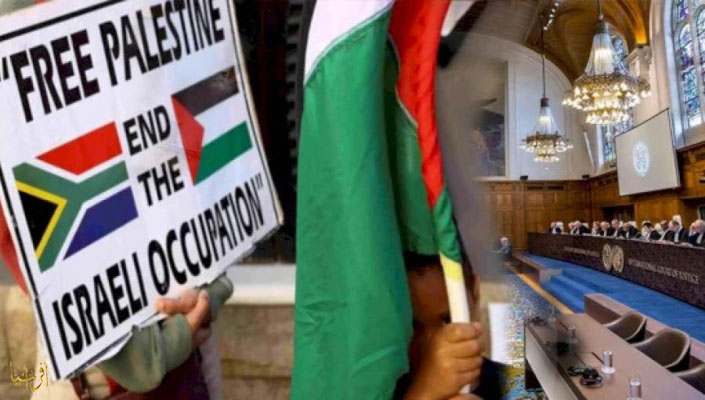
Afrasianet - South Africa has launched a new move against Israel at the International Court of Justice, with an expanded dossier proving Tel Aviv's failure to abide by the decisions it should have complied with immediately, a move that analysts say will put more pressure on the Israelis but will not bring immediate gains to the Palestinian side.
Pretoria announced on Friday that it had submitted an extensive dossier on August 25, which it said contained information and evidence documenting Israel's non-compliance with the court's binding interim measures to protect Palestinians in the Gaza Strip.
In 2024, the Court of Justice issued 3 separate decisions, including, in particular, the prohibition of acts under article II of the Genocide Convention and the facilitation of access to humanitarian services and assistance.
A third decision, issued in May of the same year, included an order to halt the military offensive in the southern Gaza city of Rafah and to keep the crossing open for aid.
The new move came as South Africa's original 2023 case against Israel entered a judicial path that could stretch for years, after Tel Aviv filed a counter-memorandum and challenged the court's jurisdiction.
Replenishment of pressure
Because of the Israeli dialectic, the court has set dates for a new round of proceedings that extends until 2029, giving the issue of immediate measures and monitoring their implementation in the near term great importance, as it turns it from a judicial battle into a political test for the international community, which is supposed to ensure that what the Court of Justice has described as irreparable damage in Gaza is avoided.
The move reflects South Africa's sense of the need to increase pressure on Tel Aviv, which has not complied with its interim measures after it found that the verdict in the case would not be handed down before 2030 or 2031, according to international law professor and former chairman of the UN Human Rights Committee William Chubas.
The verdict was expected to be issued this year or next year, Czabas said during his participation in the program "Beyond the News," noting that this did not happen because the court "works patiently and not slowly, and therefore it was necessary to highlight Israel's non-compliance and submit the documents, so that the court can begin the oral argument and then issue the verdict."
What South Africa has done is brave and bold to confirm and characterize what Israel has done in the Strip, but the problem is that the court does not have the tools to implement its decisions on the ground, according to Chabas, who said that "it requires international action, and that the latest move may push more of Israel's supporters to stay away or be more cautious in dealing with it, but all of this remains a small part of the larger Palestinian story."
Chavez spoke about the court's right to act on its own to punish Israel for not adhering to the interim measures, but ruled out that it would do so because it does not have the tools to implement any new decision without solidarity and pressure from several countries, not only from South Africa, as well as the possibility of Washington's intervention to prevent any anti-Tel Aviv move.
Less Israeli Fear
But the Israeli reaction to the new move taken by South Africa against it has received little attention, as it is no longer concerned with international law or justice under the current US administration, says Dr. Muhannad Mustafa, an expert on Israeli affairs.
When Pretoria filed its first lawsuit, the Israeli position was different because Joe Biden was still in the White House, and therefore there was a belief that international law could be respected, which prompted Tel Aviv to deal with the court and even accept the interim measures and pledge to implement them, according to Mustafa in "Beyond the News."
At the moment, there is no room to talk about the fear of the law inside Israel, where some of its ministers are demanding the killing of civilians in the Gaza Strip because "there are no innocents among them," without the government's military advisor moving to prosecute him for these demands, which Mustafa said are completely contrary to Tel Aviv's commitment before the Court of Justice.
It is true that about two weeks ago, the army announced the investigation of about 170 cases related to possible violations in Gaza, before later announcing the closure of all investigations except for four that could be considered, and then, according to Mustafa, it ended up investigating two cases, one of which was related to the murder of the child Hind Rajab, because it caused an international resonance.
The whole issue is propaganda, according to Mustafa, who said that Israel is concerned with its global image, especially within the United States, so as not to lose its place in the international community and international institutions, adding, "However, today Tel Aviv will face more pressure because it has become easier to prove its crime, and because its judiciary has complied in this genocide."
Less Palestinian dependency
Even the Palestinians no longer rely much on the Court of Justice to take urgent steps to protect them and improve their living conditions, which have not improved due to the court's decisions or Security Council Resolution 2803, which stipulated the need to urgently improve living conditions, according to Palestinian political analyst Dr. Iyad al-Kara.
The Palestinians have realized that Israel no longer cares about society or the Court of Justice, and that it relies entirely on the American umbrella, according to Al-Kara, who told "Beyond the News" that the court itself has become a target of Tel Aviv and Washington.
Al-Kara did not underestimate the importance of the recent South African move, stressing that it needs regional and international support and may be an incentive for more countries to join the cause because it supports the Palestinian narrative and confirms that what happened in the Gaza Strip was a genocide that does not fall under the statute of limitations.
Therefore, it is not possible to talk about a strategic shift in the situation in the Gaza Strip because of this recent move by South Africa, which reaffirmed Israel's indifference to the law or the international community, as well as its disavowal of all the agreements it has accepted.
________________
