
Afrasianet - Suleiman Haj Ibrahim - The question of the fate of the Middle East, its future fate, and the ceiling on ending the crisis has become the primary concern of senior analysts in intelligence circles and decision-making centers, and in houses of expertise and foresight around the world.
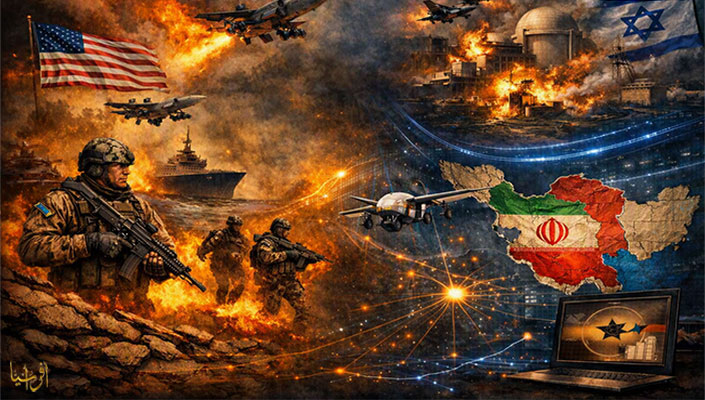
At a time when these questions are escalating, and with them the public's desire to understand what is happening, urgent warnings are spreading about the expansion of the US-Israel war against Iran, and the unleashing of its sparks to include the entire region, leading to its direct repercussions on neighboring countries to spread to remote areas.
Sober forward-looking readings move away from superficial news narratives and delve deeper into complex structural shifts: from the war of attrition that is exhausting the economies of multiple capitals, to the rise of new regional alliances that rewrite the rules of engagement and balances of deterrence, to existential risks that threaten many countries.
The Gateway of History to Understand the Present and Foresee the Future
A striking paradox has recently emerged, as a number of thinkers and strategic theorists have not only read the present with its direct tools, but have returned to history as a laboratory for understanding what is going on and anticipating its consequences, invoking classic models that explain the dynamics of the current conflict.
Graham Allison, author of Thucydides' Trap thesis, stands out in this context. The proponents of this approach analyze and invoke the Peloponnesian war model and Israel's behavior, emphasizing the fear of the existing power from the growth of the rising power and breaking its qualitative superiority towards adopting the option of pre-emptive war to avoid tipping the scales.
These theories show how international chaos drives states to accumulate power and secure their limbs, and warns of the dangers of Washington's involvement in wars of attrition that serve its international adversaries in Beijing and Moscow.
In this context, theorists explain how the major powers slid into a full-scale catastrophe that no one planned for its full size as a result of inflexible security commitments and pressures from regional subordinate parties, as well as evoking the legacy of the Crimean War and the fragile balance of power when alliances rush to contain any expansion that seeks to fill regional gaps and unilaterally redraw geopolitical maps.
The popular image that reduces the confrontation to a fleeting round of escalation followed by a declaration of calm ignores the fact that the region has witnessed two separate wars, not one, and continuous and non-stop skirmishes.
The first episode of this clash began on June 13, 2025, when Israel launched unilateral strikes on Iranian nuclear facilities and missile systems, followed by direct US military intervention by bombing the Fordow, Isfahan, and Natanz complexes.
Tehran responded by targeting the U.S. base of Udeid in Qatar, before U.S. President Donald Trump announced a ceasefire on June 23, ending what was known as the War of 12, which was in fact nothing but a prelude to a broader and more violent round. Anyone who was anticipating the situation realized at the moment that the worst was coming.
After the aborted round of nuclear negotiations in Amman and Geneva in February 2026, when the United States and Israel launched a major bombing campaign targeting about 500 Iranian military targets with more than 1,200 precision bombs in 24 hours, accompanied by a cyberattack that disrupted the Iranian internet for more than 60 hours.
The assassination of Iran's Supreme Leader Ali Khamenei in those strikes was a turning point that exposed the papers of the US-Israeli alliance and indicated its intention to eliminate the mullahs' regime in Tehran and push Iranian opposition figures accepted in Western capitals.
This second war, which is broader and more dangerous than the previous one, changed the nature of the conflict and moved it to the stage of comprehensive confrontation, which complicated attempts to anticipate the outcome of things without understanding the full scene.
The Geneva Mirage and the Hidden Truth
Intellectuals and analysts are talking about the Geneva mirage, referring to the analysis of the details of what has been called the Tehran agreement with the United States, and here lies one of the most common points of confusion in media coverage.
At the G7 summit in France in mid-June 2026, Trump stated in a celebratory tone: "I'm very happy to say it's signed, completely signed. The whole agreement is signed, and the strait is already partially open." Iran has agreed to refrain from possessing a nuclear weapon and accept international monitoring, he said, referring to an official signing ceremony in Geneva.
But Tehran had previously officially denied signing a deal. What actually happened was the signing of the "Islamabad Memorandum of Understanding", which consists of 14 items that include the reopening of the Strait of Hormuz, the lifting of the blockade on ports and licenses for the export of Iranian oil, and a $300 billion reconstruction plan, with a final negotiation deadline of 60 days.
The collapse of situational consensus
So far, experts have failed to identify who is mainly responsible for the collapse of the situational consensus that absorbs and defuses the crisis, and sometimes Washington, sometimes Tel Aviv, and sometimes Tehran, to the extent that some have described the three capitals as an exchange of the role of the villain. Days later, Iran attacked a U.S. base in Jordan, resulting in U.S. military deaths.
With the 60-day deadline expiring on Aug. 17 without an agreement, Trump declared that he was "in no hurry" to conclude a deal, while the speaker of Iran's parliament declared what he called a "political and military victory," and the Revolutionary Guards denied the existence of secret negotiating channels, declaring the end of the truce process.
Washington and Tehran Hawks: Convergence of Interests and Sustaining Tension
In the face of the tension and the increasing level of fear of the situation unfolding, many analysts tried to draw the picture and find out which parties are working against the option of a consensus on the truce, and the results were in the form of the existence of two opposing networks of actors with an interest in keeping the confrontation burning, trying to marginalize the peaceful circles seeking solutions to end the crisis.
In Washington, Secretary of State Marco Rubio and Senator Tom Cotton, along with the late Senator Lindsey Graham, spearheaded the call for regime change rather than simply curbing its nuclear capabilities. On August 2, 2026, Rubio stated that the regime must change.
Although this hardline alliance has seen a shift with the death of Graham, who had previously called for the arming of Iranian civilians and described Khamenei Sr. as the "Hitler of the modern era," the movement is still working behind the scenes to achieve the goal of toppling the regime.
This division reveals a conflict within the administration itself between the decisive team and the containment team represented by Vice President Vance and Director of Central Intelligence John Ratcliffe, who have expressed reservations about plans to push for an immediate internal uprising as unrealistic.
In Tehran, the Revolutionary Guards, who have imposed Mojtaba Khamenei as supreme leader, according to the analysis of observers of Iran, and the hardline movement led by Saeed Jalili, are the front against any concession, viewing the negotiations as a capitulation that leads to a repeat of scenarios of the collapse of other regimes.
On the other hand, President Massoud Bezishkian and Foreign Minister Abbas Araghchi, with the support of former President Mohammad Khatami, are pushing for the resumption of dialogue to save the battered economy. Robert Malley of the International Crisis Group describes this division as a conflict between a current that wants to invest what has been achieved militarily in diplomacy, and a current that believes that the ceasefire came before Iran inflicted enough pain on its opponents.
The strategy of "economic anger"
There is a plan that Washington has been implementing since mid-August 2026, moving toward the option of programmed economic exhaustion rather than engaging in a ground war, through an official strategy called "economic rage." This approach coincides with an analysis published by the Washington Institute for Near East Policy on "strategic patience" as an alternative to futile strikes, and what the Foundation for Defense of Democracies has revealed to widen Tehran's internal cracks through a comprehensive blockade.
According to many sources contacted by Al-Quds Al-Arabi, the advocates of strangling the lungs of the Iranian regime and drying up its sources are a strategy that the White House hawks seek to pursue, even exhausting the regime, and renewing the plan to overthrow the government from within through comprehensive chaos that would have had the reasons for success, despite their disappointment at the failure of the first attempt after the assassination of the former leader.
According to the idea echoing in the corridors of the White House, Tehran will surrender, as a result of the erosion of cash reserves, inflation exceeding 40 percent, and the currency at historic lows in a path that the Foundation for Defense of Democracies has described as an "economic catastrophe."
The Israeli economy also raised the defense budget for 2026 to about 144 billion shekels, with military spending remaining close to 8 percent of GDP, a rise in the debt-to-GDP ratio from 60 to 69 percent, and an increase in the value-added tax to 18 percent, according to research by Gali Engber published in the Jerusalem Post.
Why are analysts talking about Fall 2026?
Analysts link the timing of major military operations to the dates of political entitlements on both sides of the Atlantic: Washington November 2026, and Israeli writer Ron Ben-Yeshaya's Ynet has argued that Trump is seeking to avoid a global energy crisis and a jump in fuel prices before the midterm elections, while using the current lull to accelerate munitions production, making a post-election confrontation a likely option.
In contrast, Modern Diplomat scholar Julian Spencer Churchill predicted a preemptive strike before that to employ it electorally. In Tel Aviv, October 27, 2026: Netanyahu faces the corruption trial in which he finished his testimony after 98 sessions, in a path that could extend until 2028.
According to the Israel Institute for National Security Studies and the Arab Center, Netanyahu finds the continuation of the war the only way to maintain his alliance with the extreme right, Smotrich and Ben-Gvir, and to avoid judicial and popular accountability, despite the opposition of 61 percent of Israelis to the truce, and the warning of 550 former security officials in the Leaders for Israel's Security movement against the depletion of the army without a strategic horizon.
The Gulf States and the Geography Dilemma
The U.S.-Israeli war on Iran, Tehran's targeting of its neighbors with missiles and drones, and the partial closure of the Strait of Hormuz following the faltering Islamabad memorandum have changed the reality of the six Gulf Cooperation Council (GCC) countries, albeit differently between capitals.
The Carnegie Endowment, in an analysis by Frederick Weary and Charles Johnson, described the event as a "stress test" that exposed the fragility of external dependence. A paper at the Middle East Council on Global Affairs summed up the scene that "security cannot be subcontracted," warning that the Islamabad memorandum completely ignored the security of the Gulf.
According to Yoel Guzinsky at the Institute for National Security Studies in Israel and researcher Anna Jacobs, this shift has prompted the GCC countries to adopt a "hybrid approach" that combines maintaining channels of dialogue with Tehran, building self-deterrence networks, and deepening economic partnerships with China, in order to consolidate their position as a "strategically independent middle power" that protects development transformation plans away from unilateral polarization.
The Mecca Pact and the Turkish-Israeli Rivalry
The conflict has produced new security arrangements that have reshaped regional balances, and came in the context of the announcement of the Mecca Trilateral Alliance, which preceded the signing of the joint defense agreement between Saudi Arabia and Pakistan on September 19, 2025, until it was officially expanded with Turkey's accession on August 7, 2026 in Mecca.
Stephen Cook at the Council on Foreign Relations and Bloomberg Analysis believes that the alliance establishes a post-US regional order, but it is not a comprehensive Islamic NATO, as talk of a Pakistani nuclear umbrella for the alliance is governed by a doctrine of deterrence designed exclusively towards India, and does not represent an automatic nuclear shield for the region, according to the assessment of the Center for Strategic and International Studies.
Analyses of Ankara's strategy have linked the alliance's entry strategy, and its turbulent relationship with Tel Aviv, in light of the Turkish-Israeli rivalry in Syria.The most prominent indicator of the direction of Ankara-Tel Aviv's relationship was what happened in August 2026, and Israel's targeting of the Abu al-Dahur base in Idlib to prevent a supposed Turkish positioning, which necessitated U.S. mediation to establish a disengagement mechanism.
The Washington Institute and the International Crisis Group describe this tension as a manageable "tactical competition for influence in Syria," not an existential conflict as described by some enthusiastic headlines.
When deconstructing the overall scene, forward-looking readings try to gather all the passages to form the complete picture, in order to understand the dimensions of the fission war that began in Washington, Tel Aviv, and whose fire almost consumes the region on a large scale.
Beneficiaries behind the scenes
The analysis goes beyond the current fire boundaries to reach the periphery behind the curtains, as the U.S. attrition in the region raises the question of who will benefit from the international chessboard. Many readings believe that Russia is one of the biggest beneficiaries of this spiral.
The analysis of Elena Rybakova and Alicia García-Herrero at the Peterson Institute for International Economics estimated that Moscow will earn between $45 billion and $151 billion in additional revenues in 2026 due to jumps in oil prices from $70 to more than $120 per barrel.
Coverage by the American network "PBS" documents a tangible dimension of this parallel attrition, and the depletion of most of its defense capabilities in the region without the ability to replenish stockpiles, which contributes to strengthening Moscow's capabilities in its war on Ukraine, which has dried up NATO's coffers.
Retired U.S. Admiral Robert Morett summed it up by saying that the White House has become "completely distracted by Iran." Not far from Moscow is China, which closely monitors U.S. naval operations and missile interceptions in the Gulf to benefit from them for intelligence in the Taiwan file, while Tehran has exploited the Hormuz crisis to push yuan oil settlements as a way to circumvent sanctions.
However, Robert Green, in an analysis by the Carnegie Endowment, cautions against overreading this shift: Iran-linked intermediaries have "regularly converted yuan revenues into dollars and euros," while yuan derivatives markets remain "very limited," making any real challenge to the dollar's dominance in energy trade constrained by an unmature Chinese financial architecture.
Omar Aziz, a researcher at the Middle East Council on Global Affairs, argued that U.S. strikes on Iran were aimed at dismantling the geographic link between China's Belt and Road and Russia's North-South corridor, but he noted that Beijing and Moscow have refrained from making any concrete security commitments to Tehran, and China's own energy security has been damaged by the closure of Hormuz, exposing the limits of anti-Western alliances.
The Labor of the New International Order
The indicators gathered here, from hundreds of billions of dollars in bills, the erosion of the legitimacy of governance in Tehran and Tel Aviv, and electoral pressure in Washington, show that the region is gradually approaching a decisive juncture.
Based on the intersections of the field and the calculations of strategic think tanks, the regional landscape faces three main paths that will shape the outcome of the next phase:
The postponed Big Bang scenario (all-out war after November 2026): Washington and Tel Aviv are supposed to resort to a large-scale military settlement after the end of the US midterm elections and the passage of the Israeli elections in the fall of 2026, taking advantage of the easing of electoral pressures, the accumulation of ammunition stockpiles, and the benefits of the military and economic blockade and sanctions imposed on Tehran.
This option aims to paralyze Iran's deterrence capabilities and try to topple the regime, and its danger lies in igniting a full-scale regional war that drags the Gulf's energy corridors and vital facilities into the fire. The maturation of a realistic settlement:
It stems from the realization of the impossibility of a military solution by all parties and the high cost of financial and political attrition beyond the capacity of endurance, which pushes regional and international mediators to impose a new realistic negotiation path that establishes a balance of mutual terror and mutual concessions, similar to the scenario of ending the Iraq-Iran war in 1988.
However, historical experiences, such as the India-Pakistan arms race, which eventually settled on a balance of mutual terror rather than all-out war, confirm that the painful stalemate could drag on for years, interspersed with dangerous rounds of escalation before any major settlement matures.
As these scenarios take shape, it becomes clear that the Middle East is no longer just a proxy arena, but a real laboratory in which deterrence theories are retested and the balances of a new regional and international order are inaugurated whose rules will not be the same as before.
________________
Source: Al-Quds Al-Arabi
________________
