
Afrasianet - Ashraf Al Hawar - In a more serious way than the situation in the past period, Israel has increased the intensity of its threats to deal with the Gaza Strip, and explicitly reintroduced the return to the option of war, after it failed to pass its conditions for proceeding with the implementation of the rest of the stages of the ceasefire agreement, by insisting on the clause of "demilitarizing the resistance", despite the fact that it did not implement the terms of the agreement in its first phase, which has negative effects on the residents of the Gaza Strip, who are suffering from the scourge of war and its serious consequences. The moment.
In parallel with military plans on the ground, which include continuing to tighten the siege of Gaza, depriving the population of medicine and food, as well as continuing limited military attacks that inflict casualties in areas of displacement, Israel has been continuing to expand its control over the Strip by annexing new areas to the "Yellow Line", which has increased in size from the truce agreement that came into effect on October 10 last year, and has explicitly threatened a return to war.
On the ground, Gazans have not felt it, despite The holding of rounds of negotiations for the truce last week was an extension of the previous week, with any improvement, as these negotiations were conducted in order to improve and develop the truce while Israel was continuing its policy of tightening the siege imposed on the population and significantly limiting the entry of medical and food aid, thus increasing the harsh reality that exceeded the capabilities and capabilities of the population, and expanding the circle of disease and hunger.
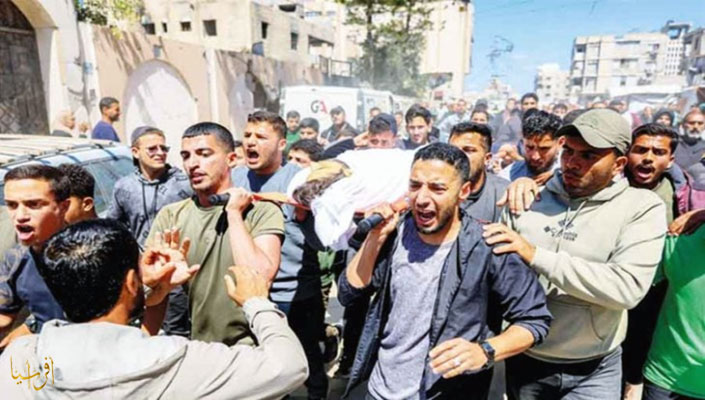
The displacement far from the areas under Israeli control, and its neck was on Wednesday, where 13 martyrs, including the son of the head of the Hamas movement in Gaza, Khalil al-Hayya, were martyred, to once again confuse the existing scene in Gaza in a more dangerous way than it is, and at the same time continue to expand the scope of their control over the Strip, reaching from 53 to 60 percent, according to a Hebrew report, which pointed to the expansion of the "Yellow Line" to the west, which has become called the "Orange Line."
It seemed clear from these hostile policies that are contrary to the ceasefire agreement, which come within Israel's plan to tighten the noose on the Gaza Strip and its inhabitants further, in order to push for the implementation of the conditions set by Israel in partnership with the United States of America, and included in the project to transition to the second phase of the truce that was presented to the resistance factions, most notably the "disarmament" condition, especially since these dangerous policies, which increase the burdens of Gaza, were followed by direct threats to return to war.
Less than a few hours after the Hebrew media revealed a meeting of the Cabinet for Security and Political Affairs, a meeting (postponed) with the aim of discussing the return of war, the Israeli Channel 14 revealed that during a meeting held by Israeli Prime Minister Benjamin Netanyahu with senior IDF commanders, he stressed that Israel has no intention of retreating from its main goal of dismantling Hamas' military and government capabilities.
He pointed out that the Israeli army currently controls security zones that cover more than 50 percent During the meeting, he said that he conveyed a message to President Donald Trump and his team that if the United States does not bring in an outside party to take over the task of disarming and demilitarizing the Gaza Strip, that this task will fall to Israel, and that its army is currently in a very good position to accomplish the task, and that the government will choose the most appropriate timing to carry out the final operation.
The "mini-ministerial session", which was replaced by a mini-consultation chaired by Netanyahu, while revealing discussions within the IDF's General Staff pushing for the resumption of the war on Gaza, were canceled, and Israel Radio quoted military officials in closed talks as saying that "the most appropriate time to resolve the battle against Hamas is now", considering that the mission in Gaza "has not been completed", claiming that the war that stopped last October ended without achieving the goal of "resolving or dismantling Hamas".
The report indicated that the army leadership believes that it is necessary to return to targeting Hamas, in light of what it describes as the movement's continuous refusal to disarm it, despite the rounds of talks held in Cairo during the past months with mediators, which did not lead to progress in the implementation of the second phase of the ceasefire agreement.
Talking about a round of war, he said, "We will have to do it ourselves in light of the lack of progress in the talks," pointing out that the paratrooper brigades have been returned to the Southern Command sector (which oversees Gaza), in addition to the important headquarters, after he also revealed that the Southern Command has completed the preparation of operational plans to return to fighting, in the event of a political decision to do so.
Negotiations Under Fire
Amid these tensions, the High Representative of the Peace Council in Gaza, Nickolay Mladenov, arrived in Israel last Monday for an urgent diplomatic visit, following reports of the stalemate in negotiations related to the Gaza Strip, to hold high-level meetings with the leaders of the Israeli security system to discuss ways to defuse tensions on the ground. Donald Trump said of the efforts made, "We continue to move forward for a better future for Israelis and Palestinians."
Mladenov even targeted the son of Hamas leader in Gaza, Khalil al-Hayya, who is also the head of the movement's negotiating delegation in the truce agreement.
On the other hand, Hamas, which understood the matter well, responded in the words of al-Hayya himself by saying after the martyrdom of his son, who is the fourth to die as a result of Israeli attacks, by saying, "The Zionist enemy is accustomed to negotiating with Palestinians and non-Palestinians with fire," and added, "This targeting, which was an extension of the Zionist enemy's targeting of the negotiating delegation in Qatar last year, comes in the same way context, he wants to impose what he wants on the negotiating table, but with fire."
"We are negotiating in the name of our people and in the name of our resistance in what achieves the goals of our people," he added, adding, "If the Zionist enemy thinks that by targeting the leaders or their children and families, it can take from us what we do not want, and achieve what it wants through murder and terrorism.
I say that this is an illusion and it is impossible to achieve it in these circumstances, and the occupation will not achieve its goal," he said, noting that Hamas' compass is "the interest of our people, the achievement of its legitimate political goals, the achievement of stability and tranquility for them, and the achievement of what can make our people firm on their land and remain firm in their homeland Two sources in the Palestinian resistance factions said that the last round of dialogue held in the Egyptian capital, Cairo, on discussing the development of the ceasefire agreement, did not achieve any significant progress, and that the situation remains the same, especially since Israel did not commit to implementing the pledges made by the mediators in the previous round, regarding the creation of conditions and the implementation of the terms of the first phase, at a time when Israeli threats were unveiled to resume the war against Gaza.
The last "was not easy," and that the movement's delegation that met with the mediators and Mladenov presented the position of the movement and the partner resistance factions, on the last offer made by Mladenov, the most prominent of which was that the resistance factions agree to "disarmament" and that a timetable be reached for this, in exchange for the start of the implementation of the second phase, which includes Israeli withdrawals from the Gaza Strip, where Israel occupies more than 53 percent of the Gaza Strip under the "yellow line."
The "disarmament" clause as a condition for the further development of the truce agreement in a way that serves the Gaza Strip, in light of the Israeli aggression and its effects that continue to plague the Gaza Strip and threaten its residents with more death, disease and hunger, and that it first requested that the full provisions of the first phase be implemented, and then talk about the second stage, and that the movement, as on previous occasions, did not find any guarantees that oblige Israel to implement the terms of the new phase of the agreement, in light of its continued refusal to implement the obligations found in the terms of the agreement.
The ceasefire agreement, which came into effect on October 10 last year, continued with Israel's continued evasion of the entitlements of the truce agreement in its first phase, prompting Hamas and the resistance factions to continue to reject the current method of proposal by the Peace Council to develop the ceasefire agreement, as it favors Israel to the extreme, and meets its demands, which are mainly based on "disarming the resistance."
He explained that Hamas took the initiative and made all commitments in the past stage, but the occupation did not abide by most of the clauses, adding that "they see only weapons, which are a guaranteed right to the Palestinian people in pursuit of the state and their legitimate rights."
On the other hand, the humanitarian crisis in the Gaza Strip is deepening due to the continuation of the blockade, and the Ministry of Health in Gaza announced that the crisis of the shortage of laboratory testing materials in laboratories and blood banks is worsening, as 86 percent of the needs of laboratories and blood banks have become zero, and explained that there is a severe shortage of medical materials and supplies, especially medicines, and that blood gas testing materials have been completely sold out in the laboratory of Al-Aqsa Martyrs Hospital, and that the quantities The remaining in other hospitals is enough for a few days, and warned that the continued shortage of testing materials "threatens the medical follow-up procedures for medical cases, operations, emergencies and intensive care," and called on all concerned authorities to intervene urgently to speed up the provision and introduction of laboratory supplies and blood banks.
The Gaza Center for Human Rights (GCHR) expressed its deep concern over the unprecedented environmental and health deterioration in the Gaza Strip, after saying that the situation has reached "catastrophic levels" that threaten the lives of hundreds of thousands of displaced people and citizens.
As a result of the repercussions of the military aggression and the ongoing Israeli blockade, the Center confirmed in a report that it has monitored a wide outbreak of rodents (rats and mice) and harmful insects, in conjunction with the continuation of the suffocating siege policy and the prevention of the entry of basic supplies to combat these pests, and stressed that the waste crisis in Gaza has become one of the most severe environmental crises in the region's modern history, as 900 thousand tons of waste accumulate from October 2023 to December 2025.
The Gaza Center for Human Rights (GCHR) confirms that this is "a systematic use of the environmental epidemic and a tool of pressure on civilians," and called on the international community to immediately press for the opening of the crossings and the introduction of heavy equipment to collect and transport waste.
In addition to this health problem, which threatens to spread diseases amid the lack of medicine and treatment, there is another problem, after municipalities in the Gaza Strip were recently forced to stop work at some sewage pumping stations.
As a result of the complete depletion of essential oils and spare parts needed for the periodic maintenance of these plants, the United Nations media website reported that four out of every five sewage pumping stations have stopped working. As a result, about 40,000 cubic metres of untreated sewage flows daily into the sea and into the areas where families live.
