
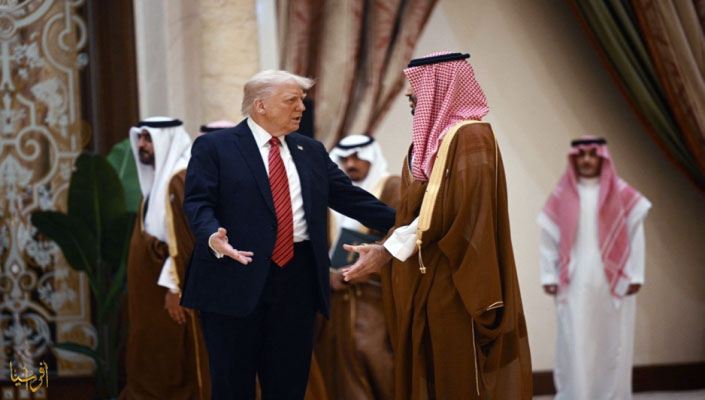
U.S. President Donald Trump speaks with Saudi Crown Prince Mohammed bin Salman before taking a family photo during the Gulf Cooperation Council (GCC) meeting in Riyadh on May 14, 2025
What is the "123" agreement?
Afrasianet - The question that has preoccupied decision-makers in Washington in recent years has not been whether Saudi Arabia will build a civilian nuclear program, but with whom, and on what terms.
As strategic competition between the United States, China, Russia, and France intensifies, nuclear power is no longer just an electricity project, but a tool of geopolitical influence, a means of building decades-long partnerships that connect countries to technology, fuel supply chains, expertise, and training.
The U.S. administration realized that its continued adherence to the traditional conditions it imposed on other partners could push Riyadh to knock on the doors of Beijing or Moscow, which have made no secret of their willingness to enter the Saudi market with less restrictive and more flexible offers.
The loss of the United States in this race would have meant more than a geopolitical loss and a multibillion-dollar trade contract, as it would have meant the move of one of its most important allies in the Middle East to a competitive technological and strategic space, at a moment when Washington seeks to contain and reduce Chinese influence Russian presence.
But the road to the deal was not without its challenges. Washington knew that giving Saudi Arabia more space in the nuclear cycle would reopen the debate over the nuclear nonproliferation policy it had advocated for decades.
Iran would be quick to accuse the United States of double standards. Other regional states, such as Egypt, Turkey, and perhaps the United Arab Emirates in the future, may also find in the Saudi-U.S. agreement a precedent to demand similar rights in developing their civilian nuclear programs.
The Saudi-U.S. nuclear deal was not just a technical understanding to build reactors or transfer technology, but a strategic decision made by Washington itself.
The administration wants to preserve its partnership with Riyadh, prevent its rivals from making a strategic breakthrough in the Gulf, and entrench a decades-long alliance in one of the world's most sensitive industries.
"Saudi Arabia and the United States began negotiating the '123 agreement' more than a decade ago, but the negotiations ran into one obstacle that remained present in all rounds: the 'right to enrich uranium'."
________________
The agreement also represents a renewal in Saudi-U.S. relations. Since King Abdulaziz and President Franklin D. Roosevelt met in 1945, the relationship has been based on an "oil-for-security equation." Today, it has expanded to become "advanced energy, technology, and investment versus strategic partnership."
The nuclear program is not just a project to produce electricity, but is part of a broader Saudi vision to diversify the economy, reduce dependence on oil for electricity production, and launch a domestic nuclear industry that includes mining, fuel production, engineering, scientific research, and the localization of advanced technologies.
Therefore, the reading of this agreement goes beyond its legal and technical provisions:
Why did it become the gate of nuclear partnership with Saudi Arabia?
The Saudi-American agreement cannot be understood without understanding what is known in Washington as the "123 Agreement."
This figure refers not to a political name or a nuclear project, but rather to Section 123 of the U.S. Atomic Energy Act of 1954, which regulates all forms of civilian nuclear cooperation between the United States and any foreign country.
Under the law, no U.S. company can sell a nuclear reactor, transport nuclear fuel, or export nuclear-related equipment and technology unless there is a "123 agreement" in force between the United States and the country concerned.
Therefore, the agreement signed with Saudi Arabia is not a contract for the construction of a specific reactor, but rather the legal framework that makes all future contracts possible.
For this reason, too, the administrations describe the "123 agreements" as not just trade agreements, but long-term strategic agreements, because they bind the partner country to the United States for decades through technology, fuel, training, surveillance, and supply chains.
How does the agreement work?
Article 123 stipulates a set of prerequisites before any nuclear cooperation is allowed, most notably: the use of technology for peaceful purposes only, the subject of all nuclear facilities and materials to IAEA safeguards, the prohibition of the transfer of technology to a third party without Washington's consent, the imposition of restrictions on the reprocessing of spent nuclear fuel, and the granting of the right to review certain sensitive activities related to nuclear materials.
In other words, the agreement does not grant the state absolute freedom, but rather ties its nuclear program to a network of legal and technical obligations that extend throughout the life of the project.
Why did the negotiations take years?
Saudi Arabia and the United States began negotiating the "123" agreement more than a decade ago, but the negotiations ran into one obstacle that remained present in all rounds: the right to enrich uranium.
"The Trump administration saw the loss of the Saudi nuclear program to Beijing or Moscow as a strategic defeat, not only economically, but also in the battle for influence within the Gulf"
________________
Successive U.S. administrations have been demanding that Saudi Arabia repeat the Emirati model, namely voluntarily abandoning uranium enrichment and reprocessing nuclear fuel.
Riyadh, on the other hand, believed that this condition diminishes its sovereignty and deprives it of benefiting from its natural resources, especially after the discovery of promising uranium reserves inside the kingdom and the launch of a national program to explore and develop them. Hence, enrichment has become the central issue in the negotiations, not the construction of the reactors themselves.
Gold Standard
In 2009, the UAE signed the region's first "123" agreement. Washington considered it the "gold standard" at the time, because Abu Dhabi voluntarily pledged not to enrich uranium or reprocess nuclear fuel within its territory, even though the NPT grants states this right for peaceful purposes.
The administration then tried to impose this model on all of its partners. But Saudi Arabia refused from the outset to accept this limitation, insisting that its rights should be equal to those of any other NPT member state. That is why the agreement has been suspended for many years.
What has changed?
The transformation has not been so much technical as political and strategic. In recent years, the international environment has changed dramatically.
First, China and Russia have become the world's largest exporters of nuclear reactors, and have begun offering countries in the Middle East, Africa, and Asia with funding and technology that are less tied to U.S. political conditions.
Second, Saudi Arabia has aggressively entered international bid competition, and it has become clear that it has real alternatives if Washington does not respond.
Third, the U.S. nuclear industry has declined significantly compared to its competitors, and U.S. companies need massive projects to bring them back to the global market.
The fourth factor was geopolitical par excellence. The Trump administration saw that losing the Saudi nuclear program to Beijing or Moscow would be a strategic defeat, not only economically, but also in the battle for influence within the Gulf.
"From Riyadh's point of view, it makes no economic sense to extract uranium and then export it as raw and import it again after enriching it abroad, if it has the ability to develop this industry locally"
________________
Why is the agreement a turning point?
The significance of the agreement lies not in the construction of one or two reactors, but in the fact that it represents the first real review of U.S. policy that has prevailed since the signing of the UAE agreement.
If the Saudi model becomes the new reference, other countries may demand the same treatment in the future, meaning that the concept of a "gold standard" may be reversed in favor of a more flexible model based on risk management rather than preventing sensitive capabilities entirely.
This is why the agreement has generated widespread interest within U.S. national security circles, because it not only changes Washington's relationship with Riyadh, but it could also change the rules of U.S. nuclear cooperation with the entire world.
Has Washington Agreed to Uranium Enrichment?
The question that has occupied the negotiations for more than a decade was simple in formulation, but extremely complex in its dimensions: Would the United States accept Saudi Arabia to have a nuclear fuel cycle on its soil?
The official language issued by the Saudi and US governments was cautious, talking about "peaceful nuclear cooperation" and "the highest standards of nuclear safety, security, and non-proliferation," without going into the technical details of enrichment and reprocessing.
However, US reports, led by the Wall Street Journal and Reuters, confirmed that the negotiations ended in a formula that would allow the kingdom to develop uranium enrichment activities within its territory within agreed controls and control mechanisms, which represents the essence of the shift in the situation American.
Why does Saudi Arabia insist on enrichment?
Since the launch of its nuclear program, Riyadh has maintained that its goal is not limited to the purchase of ready-made reactors, but to build an integrated nuclear industry. The kingdom is based on three main considerations:
First: National sovereignty: Saudi Arabia believes that the NPT grants all member states the right to develop the nuclear fuel cycle for peaceful purposes, including uranium enrichment, as long as the activity remains under the supervision of the International Atomic Energy Agency (IAEA). In this sense, it considered its demand for prior renunciation of this right to be an exception inconsistent with international law.
Second: Mineral Resources: In recent years, the Kingdom has announced the discovery of promising reserves of uranium ore, and has talked about programs to explore and develop them within Vision 2030. From Riyadh's point of view, it makes no economic sense to extract uranium and then export it as raw and import it again after enriching it abroad, if it has the ability to develop this industry locally.
Third: Building an industrial base: The Saudi goal goes beyond electricity production. The nuclear program is part of a massive industrial project that includes mining, engineering, scientific research, training, locally manufacturing components, and the creation of thousands of jobs in advanced technical sectors.
"Washington believes that the difference is not in the presence of enrichment, but in the political context, the level of transparency, and international commitments. But this explanation does not convince all experts"
________________
Why was Washington refuseing?
The United States is not opposed to civilian nuclear power, but views enrichment as the most sensitive link in the nuclear program. The difference between fuel used in civilian reactors and fuel used to manufacture nuclear weapons is not the type of material, but the degree of enrichment.
Low-enriched uranium, which is used to produce electricity, could, if the right centrifuges are available, gradually raise its enrichment to higher levels.
Proliferation reduction experts describe enrichment as a "dual-use technology": It is civilian in origin, but it also gives the state the knowledge and infrastructure that can be used militarily if a political decision is made.
Hence the insistence of successive US administrations to prevent the proliferation of enrichment capabilities whenever possible.
What has changed?
The change stemmed not from Washington's conviction that enrichment was no longer a risk, but rather from a reassessment of the risks. The administration concluded that Saudi Arabia would not abandon its nuclear project if the United States refused, but would look for other partners.
China and Russia have been strongly present in this calculation. Beijing is expanding its presence in Saudi Arabia's energy sector and has growing experience in building reactors, while Russia, through Rosatom, is the world's largest exporter of state-owned nuclear reactors.
Thus, the American choice is between two possibilities: the program will remain within the Western system, with American oversight and American technologies, or it will move to strategic competitors, with Washington losing any ability to influence its future development.
The administration has therefore preferred to accept a more flexible formula, but it maintains its central role in the program.
Did Saudi Arabia get an absolute "green light"?
The answer is: no. Even according to U.S. reports, any enrichment would be subject to technical, legal, and regulatory restrictions. Facilities would remain subject to IAEA safeguards, and details of the fuel cycle, control mechanisms, and conditions for technology transfer would be set out in subsequent executive agreements.
In other words, Riyadh did not get unfettered freedom, but it did get American recognition that civilian enrichment could be part of its nuclear program if it adhered to agreed controls. And this is the real shift.
What does this mean for Iran?
This is where the most delicate comparison begins. Tehran will be quick to say that Washington uses two different criteria: it punishes Iran for enrichment, while it accepts it in Saudi Arabia.
The United States, on the other hand, responds that the problem with Iran has never been just the presence of centrifuges, but the nature of the entire program, enrichment levels that have reached limits close to military use, reduced cooperation with the International Atomic Energy Agency, and the accumulation of a large stockpile of highly enriched uranium.
In other words, Washington argues that the difference is not in the presence of enrichment, but in the political context, level of transparency, and international commitments. But this explanation does not convince all experts.
A number of former U.S. officials and members of Congress have warned that granting Saudi Arabia this right will make it harder in the future to reject similar demands from other countries, and weaken the U.S. argument against Iran when it comes to the principle of enrichment itself.
"China has a growing capacity to design and build reactors quickly and at a lower cost than Western competitors, with greater willingness to provide financing"
________________
Herein lies one of the most important problems raised by the agreement: it not only changes Washington's relationship with Riyadh, but it also reopens the global debate about the limits of the right to enrichment, and whether the nuclear nonproliferation regime enters a new, more flexible phase. And more complicated.
Why did Trump agree?
Had this agreement been negotiated ten years ago, it likely would not have seen the light of day. The shift was not in the Saudi position, but in the international environment that prompted Washington to reconsider its priorities.
On the surface, the deal appears to be a civil nuclear energy project. But at its core, it is part of a broader strategic competition between the United States, China, and Russia to lead the next generation of global infrastructure, in which nuclear reactors, artificial intelligence, semiconductors, and supply chains have become as important tools of influence as aircraft carriers.
From "Oil for Security" to "Technology for Partnership"
Since King Abdulaziz and President Franklin D. Roosevelt met aboard the U.S. cruiser Quincy in 1945, the Saudi-American relationship has been based on a clear equation: oil for security.
But the world has changed. The United States is no longer as dependent on Gulf oil as it was in the 1970s and 1980s, while Saudi Arabia is less dependent on the United States alone for technology, investment, and weapons, and has opened up to China, India, South Korea, and other countries.
Hence, a new equation for the bilateral relationship had to be formulated. The Trump administration views the nuclear program as one of the pillars of this new equation, along with artificial intelligence, advanced technologies, joint investments, and defense cooperation.
China's Obsession
It was perhaps the Chinese factor that was most influential in changing the American calculus. In recent years, Beijing has strengthened its presence in the Gulf in an unprecedented way. It became Saudi Arabia's number one trading partner.
It invested in energy and infrastructure projects. In 2023, it sponsored the Saudi-Iranian agreement. Its companies also became strongly competitive in the fields of telecommunications, energy, and technology.
In the nuclear field in particular, China has a growing ability to design and build reactors quickly and at a lower cost than Western competitors, with a greater willingness to provide financing.
The message to Washington was clear: If the United States does not make a convincing offer, Riyadh has real alternatives. The American question is no longer "Do we give Saudi Arabia a nuclear program?"".
Russia. The Other Competitor
China was not alone in the U.S. calculations. Russia, through Rosatom, is today the world's largest government exporter of nuclear reactors.
It builds or participates in nuclear projects in Asia, Africa and the Middle East. It offers an integrated model that includes financing, construction, fuel, operation, and training.
"The "123 Convention" does not become effective once it is signed. Congress has the right to review them within a specified period of time, and can veto them if it deems that they do not meet national security requirements or nuclear non-proliferation principles"
________________
For Washington, the relocation of the Saudi nuclear program to Moscow or Beijing means not only the loss of economic contracts, but the loss of decades of political and technical influence.
The nuclear program is not a project that ends when the reactor is operational, but rather an ongoing relationship that may last 60 or 80 years, including fuel, maintenance, modernization, training, waste management, and the development of new generations of reactors.
Westinghouse... The Biggest Beneficiary
Westinghouse, a symbol of the U.S. nuclear industry, views Saudi Arabia as one of the world's biggest business opportunities in the coming decades.
The kingdom plans to build a number of nuclear reactors to meet the growing demand for electricity and water desalination, and to reduce oil and gas consumption in energy production.
That means contracts worth tens of billions of dollars, not just in construction, but in fuel, services, maintenance, and modernization.
U.S. reports suggest that the administration is also viewing the deal as a way to revive the U.S. nuclear industry, which in recent decades has lost much of its global standing to Russian and Chinese rivals.
Rebuilding the U.S. Supply Chain
The Saudi nuclear program will require thousands of industrial components, from pumps, pipes, valves, and control systems, to software and measurement devices.
Washington hopes that a wide network of U.S. companies will benefit from these contracts, revitalizing parts of the nuclear supply chain that have been slumped by a lack of new projects in the United States.
Trump's Vision
President Donald Trump's approach to the issue reflects his economic and political philosophy. He views alliances from the perspective of tangible interests.
If the United States can achieve three goals in a single deal (strengthening the alliance with Saudi Arabia, preventing the expansion of China and Russia, and creating jobs and contracts for U.S. companies), the deal becomes, in his view, more of a strategic investment than a political concession.
For this reason, the administration has been willing to accept a more flexible formula on enrichment, as long as the program remains within a regulatory and legal framework Washington is allowed to retain a central role in it.
The deal is not only nuclear
And that's where the most important thing lies. The mistake is to think of the deal as a project to build power reactors. In fact, it's part of the redefinition of the Saudi-U.S. partnership in the post-oil era.
It's an agreement on technology, industry, investment, competition with China, and the repositioning of the United States in the Gulf, as much as it is an agreement on nuclear energy.
So its true value is not measured by the number of reactors that will be built, but by the role it will play in shaping the balance of economic and strategic power in the Middle East during the The next three decades.
Why is the deal causing so much controversy within Washington?
If Riyadh and Washington presented the deal as a strategic achievement that establishes a decades-long partnership, reactions within the United States have revealed a deep division over its implications.
The objections are not centered on the idea of nuclear cooperation with Saudi Arabia itself, but on the precedent that the deal might set and the message it sends to the rest of the region, and to Iran in particular.
The debate did not begin after the agreement was signed, but years earlier, from the moment Riyadh made the request to retain it The right to enrich uranium.
Congressional obstacle
Under the U.S. Atomic Energy Act, Treaty 123 does not become effective once it is signed. Congress has the right to review it within a specified period of time, and it can veto it if it deems it does not meet national security requirements or nuclear nonproliferation principles.
If yes, then the Saudi-American agreement will not just be a bilateral agreement, but the beginning of a reshaping of the global nuclear game
Although it is not procedurally easy to drop the deal, the debate in Congress will be an important indicator of the extent of the division within the American establishment.
Republican and Democratic voices have already begun to demand full details, especially on the provisions on enrichment, oversight mechanisms, the role of the International Atomic Energy Agency (IAEA), and whether the administration has made concessions beyond what previous administrations have rejected.
The Great Paradox
Among the critics of the deal is Democratic Rep. Brad Sherman, who argued that Washington has for years justified its pressure on Iran by refusing to have a nuclear program, while today it appears more willing to support the peaceful nuclear capabilities of a strategic ally.
Sherman argues that this shift could weaken the U.S. position in the face of other nuclear programs and open the door to similar demands from countries seeking to develop their civilian nuclear capabilities.
Sherman also noted that U.S. business and industrial interests, especially nuclear power companies, have become part of the considerations that have prompted the administration to adopt a more flexible approach to the deal.
The issue is not Saudi Arabia
Nuclear non-proliferation experts look at the issue from a different angle. They are not necessarily questioning Saudi Arabia's current intentions, but rather the legal and political precedent that the deal might create.
If Washington is willing to accept uranium enrichment in Saudi Arabia, what will stop other countries from demanding the same treatment? What will be the U.S. response if Egypt, Turkey, or the UAE demand similar rights in the future? Can the United States reject this after agreeing to it with Riyadh?
These questions, for them, are more serious than the agreement itself.
What about Israel?
The Israeli position will be complex. Israel may be the country that has followed the negotiations with the most attention. For years, Tel Aviv has been opposed to any deal that gives Saudi Arabia the ability to enrich uranium, fearing that in the future it will become an industrial base that can be developed if political conditions change.
On the one hand, Israel sees strengthening the U.S. partnership with Saudi Arabia as countering Iran, limiting Chinese and Russian influence in the Gulf. On the other hand, it does not want to see the first Arab nuclear program to have enrichment infrastructure.
Therefore, Israeli contacts with Washington during the negotiations focused on ensuring that restrictions and controls are severe enough to prevent any future deviation toward military use. Israel will continue to push for maximum transparency and international oversight.
Normalization... From a condition to a separate file?
Under President Joe Biden's administration, the nuclear negotiations were part of a "grand bargain" that included: a U.S. defense agreement with Saudi Arabia, a civilian nuclear program, and the normalization of relations between Saudi Arabia and Israel.
However, with the normalization path faltering due to the war in Gaza, the Trump administration seemed to be moving toward separating the tracks.
Information that has emerged over the past months indicates that the nuclear agreement has continued to progress even in the absence of a normalization agreement, although President Trump later reiterated that normalization remains a strategic goal for the administration, and that he hopes that the new climate created by the agreement will lead to facilitating this path in the future. In other words, normalization is no longer a technical condition for the completion of the nuclear agreement.
But it is still part of the broader U.S. vision to reshape regional balances.
Ultimately, the real debate within Washington is not just about Saudi Arabia. Rather, it is about a much larger question: Are we facing a new phase in nuclear non-proliferation policy?
If yes, then the Saudi-U.S. agreement will not just be a bilateral agreement, but the beginning of a reformulation of the global nuclear game, so that geopolitical competition with China and Russia becomes no less influential than traditional nonproliferation considerations.
This makes the agreement, in the eyes of many experts, one of the most significant shifts in U.S. nuclear policy since the end of the Cold War.
What does the deal mean for Saudi Arabia?
The Saudi-U.S. nuclear deal could be mistaken for a project to produce electricity only. For Riyadh, the nuclear program is part of a broader vision to restructure the national economy, transforming the kingdom from an oil-exporting country to one that produces advanced technology and exports industrial knowledge and services.
The real value of the agreement is therefore measured not by the number of reactors that will be built, but by the industrial and scientific system that will be born around it in the coming decades.
Energy First... But it's not the only goal
Saudi Arabia's electricity production consumes large amounts of oil and natural gas.
Despite the expansion of solar and wind projects, population growth, industrial expansion, and growing demand for electricity and water desalination force the kingdom to look for stable sources that can operate around the clock.
"One of the scenarios discussed by some experts is the possibility of the Kingdom becoming a regional hub for nuclear industries and services in the future"
________________
This is where nuclear power comes in. A nuclear reactor does not rely on the sun or wind, operates continuously for decades, and provides huge amounts of electricity without high carbon emissions.
In this sense, Riyadh views nuclear energy as one of the pillars of the future energy mix, along with gas and renewable energy.
Oil for export Edit
Every barrel of oil used to produce electricity within the kingdom is not exported to global markets.
Therefore, one of the most important economic gains of the nuclear program is the release of more crude oil for export or for value-added manufacturing.
For an economy that has historically relied on oil, this equation means increased revenues, improved resource efficiency, and enhanced resilience to energy price fluctuations.
But Saudi ambition goes beyond electricity production.
The nuclear program means the creation of an entire industrial sector that includes: uranium extraction, crude processing, nuclear fuel development, reactor parts manufacturing, nuclear engineering, software and control systems, research centers, universities and training, maintenance and service companies.
Experiences of nuclear states indicate that each reactor generates a vast network of industries and services that last for decades, creating thousands of high-skilled jobs.
The project therefore directly intersects with the objectives of Saudi Vision 2030 in the localization of technology, the development of local content, and the building of a knowledge-based economy.
Uranium... New Wealth
In recent years, the Kingdom has announced promising discoveries of uranium ores and initiated programs to explore reserves and assess their economic viability.
If studies prove that these reserves are commercially exploitable, Saudi Arabia could in the future become a player in the nuclear fuel market, not just an importer of technology.
Hence the Saudi insistence not to give up the right to enrich in advance. From Riyadh's point of view, the construction of a national nuclear industry is not complete if the most important link in the fuel cycle remains outside the country.
Localization of knowledge
In all the countries that have built successful nuclear programs, reactors have not been the biggest achievement.
The real achievement has been human development. The Saudi program includes extensive plans to prepare engineers, physicists, and nuclear safety specialists, establish partnerships with U.S. universities and research centers, and transfer operational and technical expertise to Saudi personnel.
Over time, the nuclear program could turn into one of the largest technology transfer projects in the history of Saudi-U.S. relations.
A new political status
The impact of the agreement is not limited to the economy. Having an advanced civilian nuclear program gives Saudi Arabia additional political weight. Nuclear energy is not just an economic sector, but an indicator of the industrial and scientific progress of countries.
Today, only a limited group of countries have integrated nuclear programs, making Saudi Arabia's joining this club a step that strengthens its regional and international standing.
It also gives it a greater ability to participate in shaping the future of global energy, especially with the growing trend towards reducing carbon emissions and the resurgence of interest in nuclear energy in many major economies.
Is Saudi Arabia becoming a regional hub?
One of the scenarios discussed by some experts is the possibility of the Kingdom becoming a regional hub for nuclear industries and services in the future.
If the project is successful, and national cadres and a local industrial network are developed, Saudi Arabia may be able to provide engineering, training, and industrial services to other countries in the Middle East, Asia, and Africa, as South Korea has done over the past decades.
This is in line with the Saudi vision that seeks to transform the kingdom from an importer of technology into a producer and exporter.
"One of the most obvious outcomes of the deal is that it limits Beijing and Moscow's chances of entering the largest anticipated civilian nuclear project in the Middle East. China and Russia were betting that U.S. hesitation would open the door to their offers"
________________
Despite the ambitions, building a nuclear program is not a quick project. Reactors need many years to design, license, construct, and operate. Building human capacity, regulatory institutions, and nuclear culture requires decades of continuous investment.
Therefore, the agreement signed with the United States does not represent the end of the road, but the beginning.
Success will not be measured by the signing of the agreement, but by Saudi Arabia's ability to transform it into an integrated national project that combines technology, industry, economy, security, and education, and establishes a new phase in the transformation path it has begun The Kingdom is within Vision 2030.
Will the deal change the Middle East?
If the Saudi-U.S. agreement represents a turning point in the bilateral relationship between Riyadh and Washington, its real impact will go beyond the two countries to reshape the strategic balances in the Middle East for decades to come.
The agreement not only changes the future of energy in Saudi Arabia, but also reopens questions that have seemed to be settled since the end of the Cold War: Who has the right to enrich?
How can the right to peaceful nuclear energy be reconciled with non-proliferation? Can the United States maintain the non-proliferation regime, while at the same time competing with China and Russia?
Is an Arab nuclear race starting?
Since the announcement of the agreement, the most frequently asked question has emerged in Western think tanks: Will the deal lead to a nuclear race in the Middle East?
The answer is not simple. Legally, most countries in the region have the right to develop peaceful nuclear programs under the NPT. But in practice, the United States has been trying for decades to limit the proliferation of enrichment and reprocessing technologies, because they represent the most sensitive link in any nuclear program.
If the Saudi model becomes acceptable, other countries may demand the same rights. But having a nuclear program is not just a political decision.
It is a project that requires tens of billions of investments, scientific and industrial infrastructure, regulatory bodies, universities, thousands of specialists, and many years of work.
Talk of an immediate nuclear race is therefore exaggerated, although the agreement will certainly change the nature of the debate about the future of nuclear energy in the region.
Iran... Winner or Loser?
Iran will be the first to try to use the deal politically. It is expected to use it to assert its narrative that Washington is applying double standards, allowing its allies what it rejects to its adversaries.
But the United States sees the deal as strengthening its position vis-à-vis Iran, not the other way around. Rather than letting Saudi Arabia turn to China or Russia, Washington has ensured that Saudi Arabia's nuclear program remains within a Western legal framework, subject to a network of international obligations and oversight.
From this perspective, the administration sees the deal as increasing its influence regionally, and reduce the margin of maneuver for Tehran.
China and Russia... Strategic Loss
One of the most obvious outcomes of the deal is that it limits Beijing and Moscow's chances of entering the Middle East's largest civilian nuclear project. China and Russia have been betting that U.S. hesitation will open the door to their bids.
But the signing of the agreement means that the United States has regained initiative in one of the region's most important strategic sectors.
This does not prevent continued competition in other areas, but it does ensure that the Saudi nuclear program remains tied to Western technology for decades.
Here it must be noted that this project, and because of the full American support and in all fields for Israel, setting the Israeli-Saudi normalization condition as a priority for the implementation of the project and Saudi Arabia's position rejecting normalization except by resolving the Palestinian issue, puts the American position in the corner of question as to whether Saudi Arabia may resort to China or Russia for such a nuclear partnership!!
________________
Source: Almajala - Agencies
________________
