
Afrasianet - Over the past few days, Libya has seen several acts of violence, which analysts attribute to the warring parties' clinging to their own gains, especially the money they get from oil smuggling, and each side's quest to prove its ability to administer the part of the country under its control.
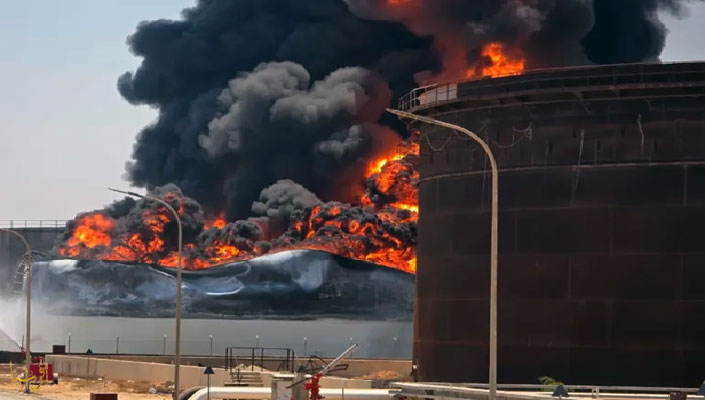
The strategically important Zawiya oil refinery in western Libya has been hit by drone attacks over the past few days, while the eastern city of Benghazi has seen the assassination of the head of military intelligence, Maj. Gen. Fawzi al-Mansouri, with a bomb that targeted his car.
The deterioration in security was not limited to a specific area, as while al-Mansouri was assassinated in Benghazi, western Libya witnessed another escalation in the form of drone attacks targeting the strategic Zawiya oil refinery.
The latest attacks on Tuesday came a day after a tank containing about 4.5 million liters of gasoline was targeted, causing a fire in it, prompting the Libyan Oil Corporation (LNA) to threaten a state of force majeure and stop work at the Zawiya oil complex.
These successive security developments come at a sensitive time when there is increasing talk locally and internationally about serious initiatives to bring the East and West camps closer together and work to unify the military and sovereign institutions.
It also comes in light of increasing economic pressures on the Libyan currency and the scarcity of foreign exchange, which prompted the governor of the Central Bank of Libya , Naji Issa, to submit his resignation, which was rejected by the Libyan Council of State.
Conflict of interest
These developments reflect the two conflicting parties in the east and west holding on to the gains made by each other from illegal oil sales and seeking to prove their ability to administer the areas under their control, according to researcher and academic Faraj Dardour.
During his participation in the program "Beyond the News", Dardour said that these parties sell up to half of Libya's oil outside the framework of the law, and that they are not willing to give up the hundreds of millions of dollars that are made from these operations, referring to the speech of retired General Khalifa Haftar, who told his officers two days ago that he will not allow politicians to impose on him what they want after all his achievements.
Libya was unable to hold parliamentary and presidential elections scheduled for 2021, but have since been postponed after the High Electoral Commission declared them "impossible to hold."
Oil smuggling does not stop at the eastern region, but also extends to the western region, which is under the control of the internationally recognized Government of National Unity led by Abdelhamid Dbeibeh, and in which militias are active that Dardour said are practically not under state authority, although in theory they are subordinate to the government.
Those who are now trying to share power and wealth do not want to establish a united, sovereign state that would be able to hold accountable those who break the law, according to the spokesman, who saw the assassination of al-Mansouri in Benghazi as an attempt by Khalifa Haftar to get rid of all witnesses to what he described as past crimes.
Mansouri was among the commanders involved in the 2019 attack on southern Tripoli, killing many people in operations he himself led, and "he was a witness to the Tarhouna massacre," according to the spokesman.
Dardur does not blame one side over the other, but rather accuses all those vying for power, influence and wealth of preventing the success of any local, regional or international initiative to end this situation and unify the country.
Introduction to an External Solution
What is happening in one region of Libya cannot be separated from what is happening in another, according to political analyst Ahmed Touati, who believes that Libya is witnessing a state of paving the way for an external solution that the Libyans did not participate in formulating or are capable of interfering in.
Both governments are no longer able to carry out their tasks in the area they control, so these security and financial developments are nothing but an attempt to intimidate the citizen and pressure him to live until he accepts any solution that is proposed later, Touati told Beyond the News.
The political division and the attempt of each side to prove its strength is the main motivation for these scenes, which the speaker expected to repeat, saying that Libya "has entered a phase of re-engineering power and unification of institutions, as a result of the conflict in its current form reaching an impasse."
These events, which affect the security and livelihood of the Libyan citizen, "will make him less opposed to any of the initiatives that he previously rejected, including the initiative put forward by the United States less than two months ago," according to Touati.
In June, Washington revealed that it was seeking to broker a power-sharing deal between the two rival administrations in eastern and western Libya.
Libya is politically divided between the Government of National Unity headed by Dbeibah in Tripoli and the government appointed by the House of Representatives in early 2022 headed by Osama Hammad in Benghazi and administers the east and most of the south.
The Eastern Libyan Forces Command has previously announced its readiness to engage in negotiations on a U.S. initiative to unify the executive branch, while the head of the High Council of State, Mohamed Takala, and the head of the Presidential Council, Mohamed al-Menfi, have announced their rejection of the initiative.
In a joint statement, Speaker of the House of Representatives Aguila Saleh, along with Takala and al-Menfi, announced the agreement on a new roadmap, which includes the formation of a high committee to supervise simultaneous presidential and parliamentary elections before February 2027, amid ongoing efforts by the UN mission to end the division.
The assassination of Al-Mansouri and the targeting of oil facilities raise questions among Libyans
On the other hand, a series of simultaneous security, political and economic developments in Libya have raised a wide wave of questions on social media platforms, following the assassination of the commander of the Military Intelligence Service, Major General Fawzi al-Mansouri, in Benghazi, the targeting of oil facilities in the city of Zawiya, the closure of the headquarters of the municipality of Qasr al-Akhyar, and the resignation of the governor of the Central Bank of Libya, Naji Issa.
The occurrence of these events in different parts of the country coincided with the escalation of fears of a return to the forefront of security tensions, in light of the continuing political division and the multiplicity of armed forces, which led Libyans to wonder whether these events are separate or reflect a broader shift in the Libyan scene.
Assassination of Al-Mansouri
In Benghazi, Maj. Gen. Fawzi al-Mansouri, director of the Military Intelligence Department of the General Command of Eastern Libyan Forces, was killed after his car was detonated with an explosive device in the al-Hawari area on Monday evening.
Platforms and accounts in eastern Libya published footage documenting a car burning in the area, saying it belonged to al-Mansouri, while two security sources, who asked not to be identified, confirmed to Reuters that he was killed in the explosion.
No party has claimed responsibility for the assassination, and it is not yet clear who is behind it or the details of the explosive device used.
The deputy commander-in-chief of the eastern Libyan forces, Saddam Haftar, mourned al-Mansouri and described his death as the result of a "treacherous terrorist operation", while the deputy head of the Libyan Presidential Council, Moussa al-Kony, called for the circumstances of the assassination to be revealed and those responsible to be brought to justice.
In a post on the X platform, Al-Kony said that his country "strongly" condemns the targeting of oil assets in Zawiya, as well as the assassination of Al-Mansouri, stressing that "the wealth of Libyans is a red line, and the blood of every Libyan is sacred."
Targeting Zawiya facilities
Coinciding with the assassination of al-Mansouri in the east, the western city of Zawiya witnessed security developments targeting vital oil facilities.
On Monday evening, the National Oil Corporation declared a state of emergency in the city, following the collapse of a fuel tank and the outbreak of a fire in it, and said that the oil complex was targeted as part of what it described as "repeated attacks."
Local sources told Al Jazeera that the explosion occurred at the Zawiya refinery as a result of a drone attack, while circulating posts spoke of the collapse of a tank that contained millions of litres of gasoline.
The Zawiya oil complex is one of the vital facilities in Libya, which gives its targeting a dimension beyond the security aspect, in light of the oil sector's sensitivity to the Libyan economy and fuel supply.
Threatened municipality
The municipality of Qasr al-Akhyar announced the closure of its headquarters, saying on its Facebook page that a group of the city's youth had closed the headquarters against the backdrop of threats from the mayor, Abdul Rahman Khalifa, and the employees of the municipality's office.
This development, coupled with the assassination and targeting of energy facilities, has prompted activists to speak of a broader state of tension involving institutions and personalities in different parts of Libya.
Libya on a hot fire
Activists and bloggers reacted to the coincidence of these events, arguing that what happened in a few hours was more than just isolated incidents.
Journalist and politician Omar al-Ansari said that Libya witnessed a "hot night", pointing to the assassination of al-Mansouri and the targeting of Zawiya facilities, in addition to developments related to the Central Bank.
Activists went on to consider what happened as a "parallel targeting" of power centers in the east and west of the country, pointing to the assassination of al-Mansouri in Benghazi, the targeting of oil tanks in Zawiya, and the resignation of the governor of the Central Bank.
Bloggers asked: "The assassination of a senior intelligence leader in the east, coinciding with the attack on a strategic oil facility in the west, are we facing the beginning of a new security escalation in Libya?".
Other publications have made more scathing hypotheses about who was behind al-Mansouri's assassination, and linked the manner in which his car was blown up to possible internal conflicts, but these proposals remained speculative and did not provide evidence of the involvement of any particular party.
Open Questions
Between the assassination of a senior intelligence official in Benghazi, the targeting of oil facilities in Zawiya, the closure of a municipal headquarters, and the resignation of the governor of the Central Bank, Libya appeared to be facing an extraordinary night in which security, political and economic developments overlapped.
These simultaneous incidents have brought to the fore questions about who is behind them, and whether they are isolated incidents or are indicators of a broader security and political escalation.
But the most prominent question that Libyans are debating is not only about who is behind each incident, but whether its simultaneity is a sign that the country is entering a new phase of tension, and who has the ability and interest to push the Libyan scene towards this confrontation again.
These developments come days after clashes between armed groups in the cities of Zawiya and Surman in western Libya, resulting in deaths, injuries and the escape of prisoners, without an official announcement of the death toll or the identity of the parties involved.
These developments once again reveal the fragility of the security and political landscape in Libya, which has been living for years in the shadow of the division between competing institutions and forces in the east and the west, in addition to the multiplicity of armed formations that enjoy varying influence in different regions of the country.
________________
Source: Al Jazeera + Social Media
________________
