
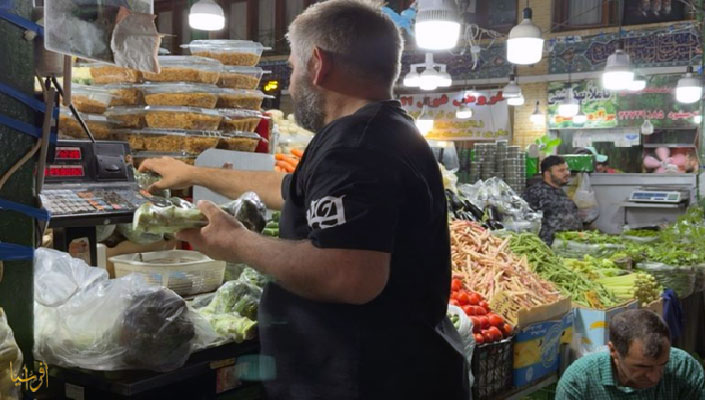
Washington's sanctions on Thursday mark the practical opening of Trump's unveiled economic pressure front against Tehran and its partners.
Afrasianet - U.S. President Donald Trump on Thursday declared an "unprecedented economic war" on Iran, threatening countries and institutions that provide it with a "lifeline" with dire economic consequences, as Washington moves to intensify economic pressure on Tehran, amid signs that the latter is ready for a protracted confrontation.
Trump wrote on his platform "Truth Social" that any country that allows its financial institutions, companies, airports or government agencies to provide any form of support to Iran will face "serious economic consequences." Tehran "did not know how to seize the great opportunity" to strike a deal with Washington. "I declare the most crushing economic operation ever taken against any country," he said, vowing "an unprecedented economic war."
Iranian Foreign Minister Abbas Araqchi responded that what Trump called "Economic Victory Day" was an attempt to distract attention from "unprecedented debt and rising interest costs" in the United States, adding that "sticking to failed policies will only bring more defeat and hostility from the Iranians," and that "U.S. economic terrorism threatens the global economy and sovereignty around the world."
Trump did not specify what measures Washington would take, while Fares said his threats represented "psychological warfare and a propaganda campaign." China buys more than 80 percent of Iran's oil shipments, according to Kepler data, while the UAE has announced the suspension of all trade activities, exchanges and financial transactions with Iran until further notice.
At the White House, according to Politico, "there is no talk of a military escalation against Iran at this time" and that Trump is focused on "strangling Iran economically." Treasury Secretary Scott Besant said the economic isolation would be "the largest in history," pledging "the harshest sanctions" and adding that they would "lead to the collapse of the regime."
On the other hand, IRGC spokesman Hossein Mohebi said that in the event of a new war, Iran will use weapons that are "completely different from the past" and more destructive, pointing to the development of warheads, the accuracy of the strike and the range of the missiles.
The remarks coincide with the appointment of Mojtaba Khamenei to senior security positions, including Mohsen Rezaei as secretary of the Supreme National Security Council, Hossein Taeb as Basij commander, Ahmad Vahidi as commander of the Revolutionary Guards, and Ali Abdollahi as chief of staff. Taeb's appointment, who is seen as close to Mojtaba, reflects the establishment's fears of renewed unrest as the economic situation deteriorates, and that the Basij could play a key role in suppressing any future protests.
These appointments do not necessarily mean that Iran is adopting a preemptive war doctrine, but they do suggest a different perception of the nature of the phase, that the confrontation will most likely continue, prompting Tehran to build a leadership capable of fighting it for longer, while trying to maintain negotiating channels.
Is Trump Expanding His Economic War and How Is Iran Defending?
U.S. President Donald Trump's remarks, coupled with the Treasury sanctions announced Thursday, sounded like an announcement of the start of a broader round of economic war on Iran. While the sanctions targeted a funding network linked to Lebanon's Hezbollah and the Quds Force, Trump's Eid went further than Tehran, hinting of economic consequences for countries and those who provide them with economic support.
The sanctions targeted a network that the U.S. Treasury Department said aids Hezbollah and serves the Iranian regime under the command of the Islamic Revolutionary Guard Corps' Quds Force.
They came hours after Trump and Treasury Secretary Scott Bisant promised an unprecedented tightening of economic pressure on Tehran and its dealers, giving the U.S. threat an operational dimension even if its current scope remains limited.
The US Treasury said the new sanctions target individuals linked to Iran's Islamic Revolutionary Guard Corps (IRGC) and Hezbollah, and include 10 people in a network responsible for transferring funds to the Lebanese party, according to the ministry. It also announced the latter's re-inclusion on the sanctions list, saying it was serving the Iranian regime under the command of the Quds Force.
According to the same department, the network benefits from funding routes that include oil smuggling, illicit shipping, and money smuggling. OFAC updates show the designation of individuals linked to Hezbollah and the Quds Force, with addresses in Turkey and the United Arab Emirates, and place them at risk of secondary U.S. sanctions.
The timing and nature of the sanctions give the impression that they are the first announced measure in the course of the U.S. threat. But it does not mean that Washington has announced after the major economic package promised by Besent, as the published measure focuses on a funding network linked to Hezbollah and the Quds Force, and does not yet announce broad sanctions on buyers of Iranian oil, banks, or shipping and insurance companies as independent sectors.
Economic Front
Trump said in a post that any country that allows its financial institutions, companies, airports or government agencies to provide "any kind of lifeline to Iran" would face "enormous economic consequences." He did not name specific countries, nor did he specify what actions Washington might take.
Besant then told CNBC that the United States would impose "the toughest sanctions in history" on Iran and that it was combining the existing blockade with economic pressure in what he called a "double whammy." He also called on China to cooperate with Washington and announced that a press conference next Monday would detail future measures.
In doing so, the U.S. promise not only to add names to sanctions lists, but also outlines pressure that could target the economic environment surrounding Iran. Today's sanctions appear to be a concrete start to this front, albeit at this point targeting Iran's allies. The biggest test remains whether the administration will expand targeting to foreign buyers of Iranian oil, banks, and intermediaries from third countries.
Tehran's response
At the time of writing, there has been no public Iranian response to the new sanctions on the Hezbollah network. Today's Iranian response to Trump's broader threat came through Foreign Minister Abbas Araqchi , who considered the US president's announcement to launch a broad economic pressure campaign against his country as an attempt to divert the attention of the American public from domestic problems, including mounting debt and the rising cost of borrowing.
Araqchi added that doubling down on what he described as failed policies would only lead to a "new defeat" and hostility to the Iranians, arguing that "U.S. economic terrorism" threatens the global economy and the national sovereignty of states. This response does not include announcing countermeasures or a specific comment on the new Treasury sanctions.
For his part, Deputy Foreign Minister Kazem Gharibabadi said that Washington has moved into "economic war" after its military war failed to achieve its goals. He added in a post on the X platform that the United States claims that Iran is on the verge of defeat, but at the same time asks its allies to help it, considering that calling the new round an economic war does not hide its past failures, he said.
These statements do not include an announcement of Iranian countermeasures or a specific comment on the U.S. Treasury decision on the Hezbollah network, but rather are part of a political response to Washington's broader pressure trajectory.
The limits of containment
Economist Isaac Saidian, in an intervention to Al Jazeera Net, believes that the effectiveness of pressure is not measured by the number of names added to the sanctions lists, but by its ability to disrupt access to and transfer of foreign exchange and the continuation of necessary imports. He says that the subsequent expansion of sanctions to oil buyers, banks, shipping and insurance could make trade with Iran more expensive and risky, and gradually transfer the impact to the exchange rate , imports, markets and the purchasing power of households.
The government in Iran has tools to mitigate the shock, including managing the exchange market, foreign currency reserves, prioritizing imports, and subsidizing basic commodities, Saeedian said. But he stressed that these policies may slow the transmission of impact, but they cannot remove the impact of sanctions or compensate indefinitely for the lack of foreign resources, the difficulty of transferring funds and the high cost of imports.
The economist warned that price controls may transfer part of the burden from the consumer to the public budget.
According to Saidian, the most important criterion is the state's ability to maintain three vital links: access to foreign exchange, the ability to divert resources, and the continued import of essential goods. If these three cycles are pressed at the same time, supportive policies alone will not be enough to absorb the impact.
In this sense, today's sanctions on Iran do not appear to be just an addition to long U.S. lists, but rather the executive beginning of a front of economic pressure that Trump has unleashed against Tehran and its partners.
But Monday's announcement will determine whether this front will remain directed at the financing networks of Iran's allies, or evolve into a broader campaign that raises the cost of trade, finance and economic dealings with Tehran.
Washington Chooses Allies: Either with Us or Against Us
The United States has stepped up its rhetoric toward Iran, reaffirming its intention to implement a wide-ranging policy of economic isolation against Tehran, while Iran has denounced the new U.S. measures as "economic terrorism."
Earlier on Thursday, U.S. Treasury Secretary Scott Besant said Washington had told its allies that they had to choose between supporting U.S. efforts to isolate Iran economically or standing in the opposite camp.
In an interview with CNBC, Besant added, "Either you are with us or against us." He also called on China to "go along with the plan," arguing that some discussions with Beijing would be preferable to be held away from the public.
'Crime against humanity'
Iran's Foreign Ministry condemned the new US sanctions, saying they target the entire Iranian people and amount to "economic terrorism" and "crimes against humanity."
The Iranian Foreign Ministry stressed that these measures will not affect "Iran's determination to defend its independence, sovereignty and national interests."
The Iranian Foreign Ministry said that the US sanctions reflect, in its view, Washington's inability to achieve its goals, and described the sanctions policy as an approach that has proven to be a failure in the past, and its repetition will only lead to similar results.
She also stressed that Tehran will continue to defend its national security and national interests in the face of what it described as US political, economic and military pressures.
What is left of Trump's sleeve from economic sanctions on Iran?
After 47 years of accumulated U.S. sanctions on Iran, Washington appears to have largely exhausted the list of direct economic targets whose sanctions could add new qualitative pressure on Tehran.
Therefore, the "unprecedented economic war" that US President Donald Trump is promising is moving further outside Iran, towards countries, companies, and banks that still provide it with outlets for trade and finance, foremost among them China.
This threat presents the administration with a different dilemma than previous rounds of sanctions, with regard to what actually remains of Iranian targets whose punishment could lead to additional significant economic damage.
According to the Atlantic Council Forum, the U.S. has already imposed sanctions on "almost every sector of Iran's economy," designating thousands of individuals and entities, including energy, petrochemicals, shipping, metals, and automobiles, as well as the Central Bank, the Revolutionary Guards, and the late Supreme Leader Ali Khamenei, while Iran's banks have been cut off from the SWIFT network for years.
This expansion means that the space for direct sanctions inside Iran is close to saturation, and that the inclusion of more Iranian entities could have a marginal economic impact. The center of gravity is shifting to the parties that give Tehran access to trade and financing, rather than simply adding new Iranian targets.
The war is moving abroad
Since April 16 , the U.S. Treasury Department has been carrying out what it calls "Operation Economic Rage," which the Atlantic Council's Energy Sanctions Observatory describes as an escalation based on secondary sanctions to target shadow fleets, foreign refineries, and financial intermediaries in China, the United Arab Emirates, Hong Kong , Iraq, and Oman.
Secondary sanctions derive their strength from the influence that the dollar and the U.S. financial system give to Washington, as they place foreign institutions at a trade-off between continuing to do business with Iran or retaining access to U.S. dollars, markets, and financial institutions.
From this angle, Trump's threat to punish any country that provides Tehran with an economic outlet represents a significant expansion of the logic of secondary sanctions.
But the expansion of this policy leads Washington directly to China, which buys more than 80 percent of Iran's oil exports, according to Kepler's 2025 data. Much of this supply goes to small independent Chinese ranks, with payments going through small Chinese banks and trading companies in Hong Kong and increasingly yuan settlements that go beyond the dollar-based system.
This is where China's major banks emerge as one of the most powerful sanctions cards that Washington has not used as a whole. In April, U.S. Treasury Secretary Scott Besant confirmed that the U.S. had sent letters to two major Chinese banks warning them of the dangers of Iran-related secondary sanctions, but had not imposed actual sanctions on them.
China Draws Pressure Limits
The limits of escalation here are not only Iran's ability to withstand sanctions, but also the cost to the United States and global markets as a result of their expansion.
Targeting a large Chinese bank could increase pressure on Iran's trade and financing, but it could confuse a wider range of financial transactions and warrant a response from Beijing, which dominates the supply of a number of vital minerals.
China has already passed laws requiring its companies to comply with U.S. sanctions on Chinese refiners and not enforce them on Chinese soil, as Washington also seeks a summit between Trump and Chinese President Xi Jinping later this year.
The equation is becoming increasingly sensitive in the energy market, as tightening restrictions on Iran's oil trade or targeting major buyers could drive up prices globally, the same risks that analysts associate with proposals for land blockades and secondary tariffs authorized by Senator Lindsey Graham's legislation.
Some of the most powerful remaining sanctions tools thus become options that could reverse, whether through energy prices, trade relations with China, or supply chains for metals and industrial goods.
The Paradox of Sanctions
A longer-term problem also arises with the financial system that gives Washington the power of sanctions. According to an analysis by Chatham House, the sheer volume of sanctions has deepened cooperation among countries subject to them, led by China , Russia, and Iran, and pushed them to develop payment and clearing channels that are less exposed to the dollar and the Western financial system.
The U.S.-China Economic and Security Review Committee of the U.S. Congress reached a similar conclusion, noting that China has created a financial structure that is largely isolated from the global financial system to maintain its ability to deal with U.S.-sanctioned partners.
This dynamic reveals a paradox in the economics of sanctions: secondary sanctions can raise the direct cost to Iran and its partners, but at the same time give target countries a greater incentive to develop payment and settlement systems that reduce their dependence on the dollar, which may gradually weaken some of the leverage from which Washington derives the effectiveness of sanctions.
Pressure margins narrow
Analysts say the list of new tools that combine strength and applicability is limited. The National quoted a senior Middle East and North Africa analyst at Rain Network as saying that the remaining and viable economic tools are "not many."
Maya Nikolaze, deputy director of the Economic Governance Initiative at the Atlantic Council's Center for Geoeconomics, argues that the most effective course of action is to tighten enforcement of existing sanctions and continue to target hidden banking and financing networks, including those in Hong Kong, that are used to pass on Iranian oil revenues.
By this logic, the next phase of the lobbying campaign may not be to discover new Iranian sectors to punish them, but to fill the loopholes that allow Tehran to circumvent sanctions, and go after intermediaries, financing networks, shadow fleets, and buyers who keep its exports and revenues flowing.
The Treasury Department still believes that this approach can have an economic impact, describing its August 10 action as the eighth action in 2026 against Iran's "shadow banking network," while Besant said it is "teetering."
But reaching a radically new level of pressure requires larger, more expensive options. Imposing sanctions on major Chinese banks or expanding targeting to governments that do business with Tehran could further squeeze Iran's economy, but it would also widen the repercussions for trade, finance, energy markets, and global supply chains.
Hence, the equation of sanctions is changing after decades of pressure on Iran. It is no longer a question of how much sanctions Washington can add, but rather how much additional economic damage it can inflict on Tehran before the cost of escalation on China, global markets, and the U.S. economy itself becomes part of the punishment.
________________
Source : Al Jazeera- Agencies.
________________
